On the morning of September 27, 2024, a new chapter of crisis opened for Lebanese civilians when the Israeli military began distributing digital warnings ordering residents to abandon their homes across wide swathes of the country. Within seconds of these alerts circulating via WhatsApp groups — marked with red highlights pinning targeted buildings, streets, and entire districts — panic spread. People crowded over their phone screens to identify local landmarks, narrow roadways quickly became choked with idling cars, and families poured into the streets, clutching small children and supporting elderly relatives to escape. In some residential areas, warnings landed mid-school day: administrators rushed students out onto sidewalks, where tearful children waited alone, stranded as their parents fought through gridlocked traffic to reach them.
This pattern of sudden, short-notice expulsion orders paired with immediate airstrikes has become a devastating routine for Lebanese communities in the months following an initial 2024 ceasefire that paused two months of open conflict between Israel and Lebanon. By March 2025, four months after that truce took hold, these warnings still upend lives without warning.
Twenty-nine-year-old Sarah, a resident of Lebanon’s south Beirut suburb of Dahieh, was preparing iftar at her parents’ Jamous Street home when an Israeli expulsion order popped up in her family’s WhatsApp group. Her young son was playing with a toy car in her childhood bedroom when the alert came, distributed by the Israeli military’s Arabic spokesperson on X without any clear timeframe for evacuation. “We didn’t know how much time we had,” Sarah recalled from Majdal Selem in south Lebanon. “The second I saw the map, I knew it was our building.” She grabbed her son, leaving his shoes behind, and ran out the door without grabbing even her purse or any personal belongings. By the time she reached the street, the entire neighborhood was in chaos: blocked roads, panicked residents fleeing in every direction, and nearby schools already emptied of students. “There were people who weren’t able to escape in time, and they were stuck in the area,” Sarah said. “The area wasn’t emptied in that time; it is not realistic. It is very crowded and densely populated. How could you empty it in two hours?”
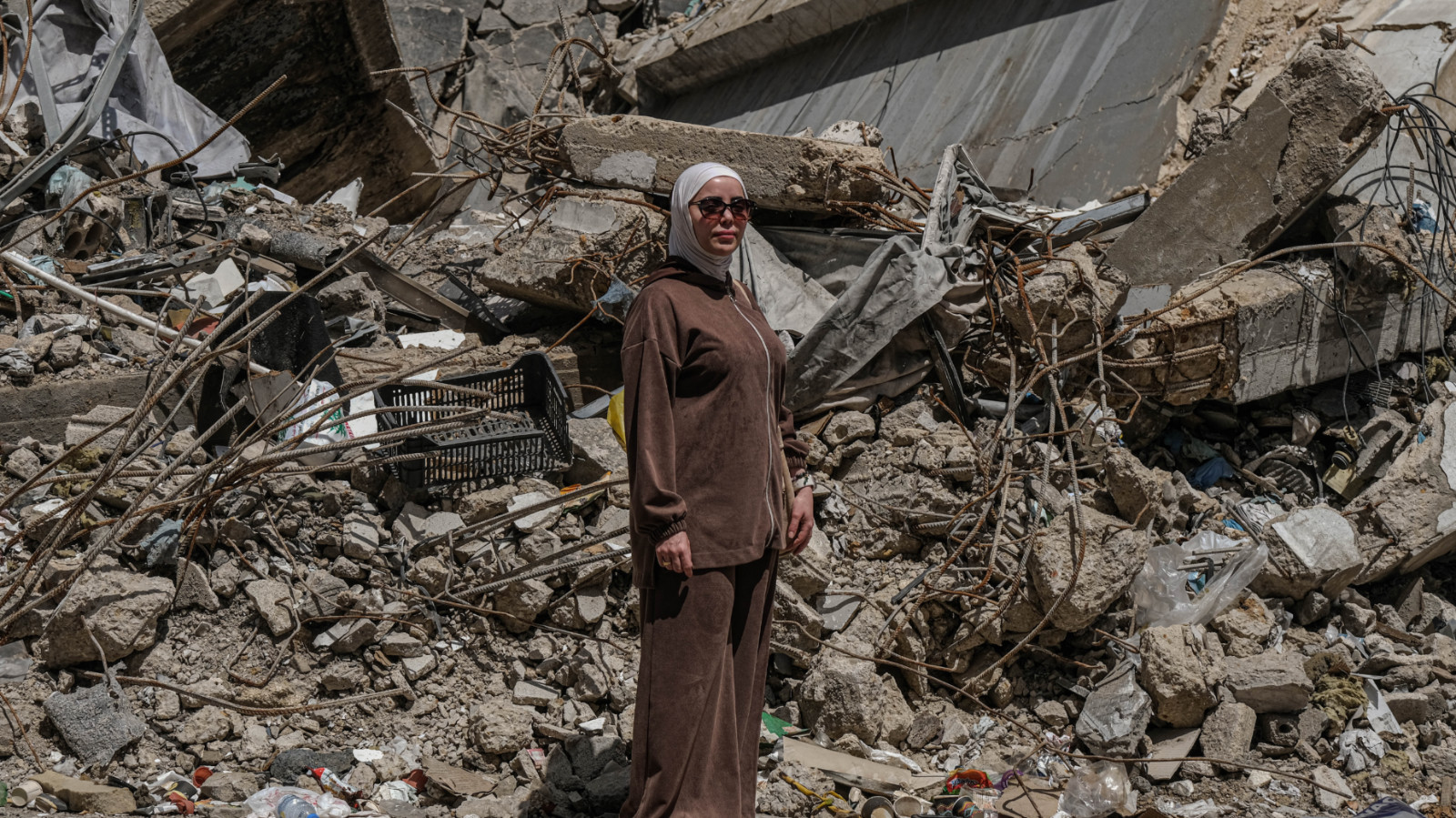
Sarah fled to her brother’s home in the mountains, where her mother 60-year-old Fatima arrived minutes after fleeing her office. When Fatima walked through the door, she turned straight to the news — and watched her lifelong home reduced to rubble in an Israeli airstrike. The home she had owned for 30 years, the first property she and her late husband had built together after decades of renting, was gone. She had designed every detail: added a custom sitting nook to the kitchen, filled the space with plants, painted custom doors, bottles, and furniture. A second-floor room housed 5,000 books, doubled as her art studio, and held her late poet husband’s un digitized handwritten manuscripts. A cabinet preserved the belongings of their son, killed by Israel in 2008 while working as a paramedic in south Lebanon: his work suit, watch, favorite fragrance, and nursing certificate. “These things will never be compensated,” Fatima said. “They will never come back to life and touch this wall, or this table.” All 100 of her completed artworks were destroyed in the strike.
Clinical psychologist and psychotherapist Elie Abou Chacra frames this sudden loss of home and irreplaceable personal mementos as a profound psychological rupture. “The home is not just a place. It is part of the psychological system. It holds memory, routine, and a sense of control,” he explained. When an evacuation warning lands, the human brain immediately shifts to survival mode: time compresses, every decision becomes instinctive, and choosing what to save and what to leave becomes an impossible, traumatic calculation. For objects tied to lost loved ones, he added, losing these emotional anchors can feel like grieving the person all over again. Watching the destruction unfold in real time via phone or television screens deepens this harm, he noted: “The brain processes it as it is happening in the moment. It closes the door to hope instantly.”
For many Lebanese civilians, the destruction comes even after they believed they had survived the worst of the conflict. In 2024, 29-year-old Nour and her husband Mohammad purchased a $115,000 flat in Haret Hreik, another Dahieh neighborhood, and invested an additional $55,000 to fully renovate the space from the ground up, updating wiring, plumbing, and interiors. “I kept reminding myself that I’m doing this once in my lifetime,” Mohammad said. The couple moved in by June 2024, but were forced to flee almost immediately when the 2024–2025 war broke out. Their expulsion order arrived on November 25, 2025 — one day before a planned ceasefire — while the couple was visiting Iraq. At first, Nour thought her brother-in-law’s news that their home was targeted was a joke. Two hours later, her father called to confirm the strike, and video of the destroyed flat flooded in. “I felt a deep, heavy helplessness when I was watching the videos,” Nour said. “We didn’t even get to enjoy it.” Beyond the crippling financial blow — Mohammad still pays off loans for a home that no longer exists — Nour lost irreplaceable personal heirlooms: her late mother’s clothing, her high school uniform signed by classmates, handwritten notes from friends. “If I were there, what would I have saved?” she paused. “Nothing. It’s either everything or nothing.”
As conflict resumed after the fragile ceasefire, Israeli evacuation warnings expanded from targeting individual buildings to entire neighborhoods and districts. According to United Nations figures, roughly 20 percent of Lebanon’s total population has been displaced, with expulsion orders covering approximately a quarter of the country’s entire territory. On March 5, 2026, Israel issued its first mass evacuation order, covering 12 neighborhoods across large parts of Beirut and ordering hundreds of thousands of civilians to flee within hours. Entire districts emptied onto a single highway, leaving widespread chaos in their wake. That same day, 36-year-old Naima lost the six-year-old skincare clinic she owned in Dahieh’s Centre Tayyar, a building that housed 90 small clinics and businesses. “I spent more time there than at my home,” she said. “I cried for a few minutes. Then I prayed and told myself: people are losing their lives.”
Official data from Lebanon’s National Council for Scientific Research confirms the scale of destruction: since March 2, 2026, more than 40,000 housing units have been partially or completely destroyed by Israeli strikes. On some days, over 1,000 homes are damaged or flattened, leveling entire neighborhoods. Widely circulated Israeli drone footage shows entire villages in south Lebanon being demolished in controlled explosions, with residents scrambling to identify their own homes in the clips. Some pay up to $200 for commercial satellite imagery just to confirm if any part of their property survived.
Brigadier General Khaled Hamadeh, a political affairs researcher, classifies these mass expulsion warnings as a deliberate new form of psychological warfare targeting civilian populations. “What began as alerts for individual buildings expanded into mass displacement orders,” he noted. Over time, civilians have adapted in small, painful ways: they keep valuables packed, essentials ready, and structure their daily lives around waiting for the next alert. “The warnings shape how civilians behave, when they leave, when they return, and how they live,” Hamadeh explained.
While international humanitarian law requires advance warnings before attacks that may put civilians at risk, legal experts note these requirements mandate specific, timely notices that allow for safe evacuation. Blanket warnings covering entire populated districts have raised questions about whether Israel is attempting to redraw Lebanon’s demographic map through forced displacement. A 2026 investigation by Amnesty International found that many Israeli warnings in Lebanon are “inadequate, ineffective or misleading”, failing to give civilians a realistic opportunity to escape. On the ground, the core question for ordinary people remains unanswerable: how do you pack up an entire lifetime in a matter of minutes?
Hamadeh adds that Lebanon’s lack of a formal national early warning or civil defense alert system leaves civilians with no alternative but to rely on warnings from the attacking military itself, eliminating any state mediation and leaving communities completely disoriented. “In the moment, you have to decide which item deserves to survive,” Sarah said.
Expulsion orders have fundamentally reshaped daily life across most of Lebanon, dictating when work ends, when schools close, and when families are forced to scatter. For Fatima, the trauma of loss did not end when her home turned to rubble. After the strike, she rented a new flat in Dahieh, and faced an impossible choice: treat it as a temporary stopgap, or build a new life there. She chose to invest fully, to push back against the pressure of displacement. “I decided to invest in it as if I am going to live there forever,” she said. “To show Israel that we are strong and their strategies will never weaken us.”
Her new home survived the latest round of conflict, with only a few broken window panes. Even when displaced again, Fatima has not stopped creating art. She bought new brushes, new paints, and new canvases, and continues to paint, even when she cannot sell her work because pieces are often left behind in destroyed homes. She still centers her work on flowers. “If I don’t see a flower during the day,” she said, “I’d die.”
This reporting was originally published by Middle East Eye, an independent outlet covering the Middle East, North Africa and global affairs.