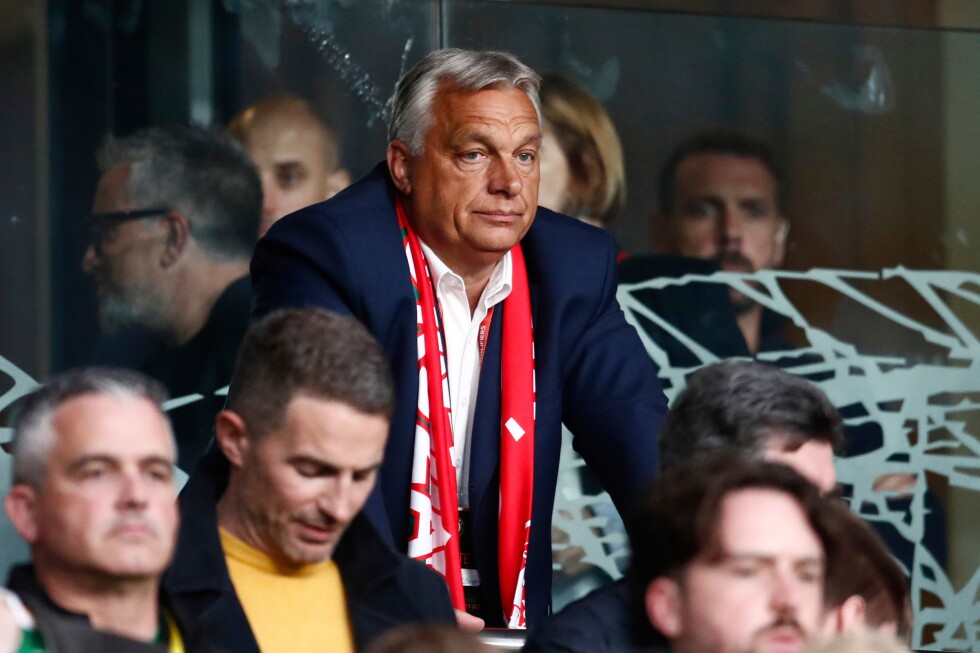
For years, Hungarian authoritarian populist leader Viktor Orbán—an avid lifelong soccer fan and a self-identified sports enthusiast who built a large part of his national legacy around hosting elite global sporting events—has been sidelined by a stunning heavy defeat in the country’s recent general election. His unexpected exit from power hands the spotlight to incoming Prime Minister Péter Magyar ahead of next month’s UEFA Champions League final, the crown jewel of European club soccer, set to take place in Budapest’s state-of-the-art Puskás Aréna on May 31. This political transition has sparked new uncertainty around the future of Orbán’s ambitious pipeline of elite sports initiatives, from upcoming track and swimming championships to a long-planned 2036 Olympic bid, and forces international sports governing bodies to adapt to a new government with sharply different priorities.
Orbán, a former lower-league Hungarian soccer player who has held a permanent spot in the VIP boxes at Champions League finals and FIFA World Cups for decades, poured billions in public funds into constructing a network of new, world-class stadiums across Hungary over his 12 years in power. The Puskás Aréna, which will host this year’s Champions League final, was always meant to be the crowning glory of his sports-focused statecraft. “That was supposed to be the icing on the cake for Orbán and his regime. He’s been working very hard to get that final to Budapest and to Hungary,” explained Győző Molnár, a professor of sport sociology at the University of Worcester. If Magyar, leader of the victorious Tisza party, takes the high-profile official spot at the final originally reserved for Orbán, Molnár added, it will serve as a clear public signal of a full regime change in the country.
For Orbán, elite international sporting events were never just about athletics: they served as a strategic counter to widespread criticism from the European Union over his government’s democratic backsliding, anti-LGBTQ+ policies, and opposition to EU support for war-torn Ukraine. By hosting major global tournaments, Orbán could frame international sports bodies’ willingness to partner with Hungary as a quiet endorsement of his rule, regardless of EU pushback. “These aren’t just sporting events for him. They were Orbán’s answer to, for instance, EU criticisms” that allowed him to argue “UEFA still trusts us with the biggest match,” Molnár noted. Still, not all of Orbán’s soccer ambitions panned out: despite tax breaks that encouraged allies to invest heavily in domestic Hungarian soccer clubs, the country’s national team has not qualified for a FIFA World Cup since 1986, a far cry from the legendary “Mighty Magyars” sides that finished as World Cup runners-up in 1938 and 1954.
Beyond the Champions League final, Orbán’s administration locked in a full slate of upcoming elite events: the inaugural track and field Ultimate Championships, which boasts the sport’s richest ever prize purse, is set for September in Budapest, with the 2025 World Swimming Championships—Hungary’s third in a decade—following the next year. Budapest has also been preparing a bid for the 2036 Summer Olympics, and over the past decade, multiple global sports governing bodies, including World Aquatics, have relocated their headquarters from Switzerland to Budapest, incentivized by generous packages including 15 years of free office space, legal immunity for official acts, and full tax benefits.
Since the election upset, however, questions have grown over whether the new Hungarian government will maintain Orbán’s focus on large-scale prestige sports projects. While Magyar has rejected opposition claims that he will cut overall sports funding, his Tisza party’s election platform marked a clear break from past policy, criticizing the Orbán administration for pouring public funds into overpriced stadiums and vanity projects while grassroots school and local sports programs have declined. Magyar has also pledged to end what he calls the systemic politicization of sports that flourished under Orbán, noting that “politics has become entrenched in the sports associations and the soccer clubs to a degree that we didn’t even see during socialism.”
So far, no scheduled events have been canceled, but long-term policy priorities are expected to shift. The new government will likely be focused heavily on addressing ongoing cost of living crises, a pressing concern across much of Europe in the current volatile global economic climate. Complicating the 2036 Olympic bid further is the political landscape in Budapest: the city’s mayor is a liberal opponent of Orbán who has no close alignment with Magyar’s party, and plans to revisit the bid next year after an earlier Orbán-backed 2024 bid was withdrawn. The International Olympic Committee has declined to comment on domestic political developments or the status of the bid.
International sports governing bodies have begun navigating the transition, with most reaffirming their commitment to upcoming events. World Athletics, which is preparing for September’s Ultimate Championships, stated that it continues to work closely with Hungarian partners to deliver a successful tournament. World Aquatics, which is scheduled to complete its relocation to Budapest by 2028, said it has a longstanding positive relationship with Hungary and “has no doubt that this relationship will continue to thrive under the new leadership of Péter Magyar, whom we congratulate on his recent victory as Prime Minister of Hungary.” UEFA, for its part, has said that planning for the Champions League final continues as scheduled, and declined to comment on whether it will extend invitations to both Orbán and Magyar for the match.