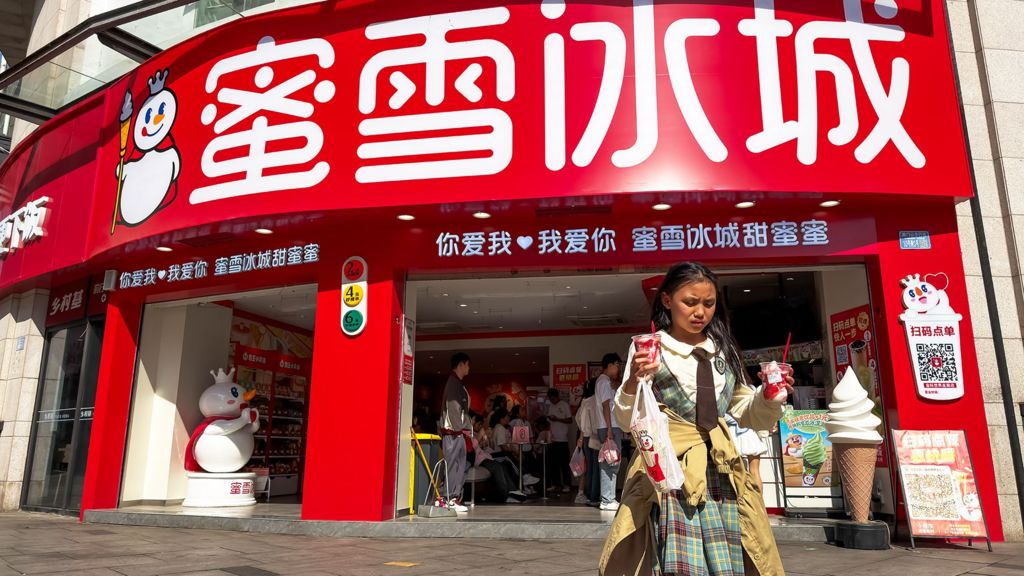
Walk through any major shopping center in Singapore today, and you will almost certainly encounter long, winding queues outside brightly branded stores with catchy, memorable names. Bubble tea chains from China, including Mixue, Chagee, and Molly Tea, are drawing massive crowds not only across Southeast Asia, but also in far-flung global hubs from Sydney and London to Los Angeles. This growing global footprint is part of a far larger trend: Chinese companies are evolving beyond their historic role as low-cost contract manufacturers for Western firms, and building globally recognized consumer brands that compete directly with long-dominant industry leaders.
Many of these new global players cut their teeth in China’s massive, fast-growing consumer market – the second largest in the world – building impressive scale and operational expertise early on. But cutthroat domestic competition, combined with a slowing domestic economy and shifting consumer demographics, has turned global expansion from an opportunity into a strategic necessity for most large Chinese consumer firms. As they enter international markets, these brands are pushing past the long-held stereotype that “Made in China” equals low-quality, low-cost goods.
“China has moved beyond a replication economy,” explains Tim Parkinson, a consultant at Storyteller China. “Its products now meet the expectations of a new generation of demanding global consumers.” For decades, China served as the world’s workshop, producing goods for Western brands to market and sell globally. In that process, local suppliers and manufacturers learned far more than just assembly: they mastered large-scale branding, global distribution networks, and mass-market sales strategies that now power their own global growth.
Retail giant Miniso, which produces licensed toys and merchandise for entertainment brands including Disney, Marvel, and Warner Bros., has leveraged this institutional knowledge to build a presence in more than half of the world’s countries. “Consumers aren’t particularly concerned about where the brand comes from,” says Vincent Huang, Miniso’s general manager for overseas markets. “They’re more focused on the shopping experience – the designs, value for money, and enjoyment.” Fast turnaround from factory to shelf and strategic global licensing partnerships sit at the core of Miniso’s successful global model.
The shift toward globally competitive Chinese brands extends far beyond fast-moving consumer goods. Electric vehicle manufacturer BYD recently overtook Tesla to become the world’s largest EV producer by volume. The company gained its edge by betting on core EV technology early in the global transition, then used China’s huge domestic market to scale production and drive dramatic cost efficiencies. Today, BYD is expanding beyond vehicle manufacturing, developing ultra-fast charging infrastructure that can add hundreds of kilometers of range in minutes, as it works to build a full mobility ecosystem around its brand.
China’s central government helped accelerate the EV sector’s growth through targeted subsidies and consumer incentives that boosted domestic demand, but that support has drawn fierce criticism from policymakers in Europe and the United States, who argue it gives Chinese firms an unfair competitive advantage. Beijing rejects these claims, noting the sector’s growth is a reflection of China’s industrial innovation and manufacturing leadership, not unfair support.
Sportswear giant Anta offers another example of this global rise. The firm now operates nearly 13,000 stores worldwide, and has climbed to become the third-largest sportswear brand on the planet, trailing only Nike and Adidas. After dominating China’s domestic market, Anta expanded its global footprint through strategic acquisitions of established international brands including Salomon and Wilson, and most recently purchased a 29% stake in German sportswear brand Puma.
For many Chinese brands eyeing Western markets, Southeast Asia has served as a critical testing ground for global expansion. The region is home to more than 650 million young, increasingly affluent consumers, offering both scale and market diversity, while intense competition from established Western brands pushes companies to maintain high quality standards. Leading hotpot chain Haidilao opened its first overseas location in Singapore back in 2012, and today is the world’s largest hotpot operator with 1,300 restaurants across 14 countries.
“Haidilao’s story is not just a restaurant success,” says Zhou Zhaocheng, vice chairman of Haidilao International. “It reflects China’s 30 years of economic transformation and internationalization.” Zhou notes the chain’s global success relies on a strong core brand, a robust operational ecosystem, and a loyal global customer base. Each overseas market brings unique complexities shaped by different cultures, legal frameworks, and consumer preferences, he says, making intentional localization of menus, ingredients, and service non-negotiable for success. To that end, Haidilao is currently pursuing halal certification for its operations in Indonesia and Malaysia, a move that will open the door to expansion across Muslim-majority markets in the Middle East.
Other Chinese consumer brands are expanding at a staggering pace. Mixue, the budget bubble tea and ice cream chain, now operates more global store locations than either McDonald’s or Starbucks, while competitor Molly Tea has built an international footprint just a few years after its founding. Market research firm Euromonitor International reports that more than 70% of Chinese firms already operating in Southeast Asia plan to expand their regional footprint further in coming years.
Southeast Asia is also home to some of the world’s fastest-growing smartphone markets, and widespread social media adoption has supercharged the popularity of Chinese consumer brands, often with almost no traditional advertising. Collectible toy brand Pop Mart’s Labubu figurines, for example, became a global viral sensation through organic social media engagement. Since 2024, Pop Mart’s sales in the United States have grown by a staggering 900%. Even as the company’s share price has dropped sharply in recent months amid investor questions about long-term growth sustainability, Pop Mart still boasts a higher market valuation than the combined worth of U.S. toy giants Hasbro and Mattel, plus Japanese entertainment firm Sanrio, the owner of the Hello Kitty brand.
This outward push, known in Chinese as “chuhai” or “going out to sea”, has been accelerated by mounting pressure at home. A sluggish domestic economy, saturated consumer markets, intense competition, and a declining birth rate have all squeezed domestic growth margins, pushing companies to seek new customer bases abroad. Even long-established global brands operating in China are feeling the impact of rising local competition. Starbucks’ domestic market share in China has more than halved since 2019, as local chain Luckin Coffee now operates almost four times as many stores across the country as its U.S. rival. Luckin’s mobile-first business model keeps overhead costs low and service speeds high, resonating with domestic consumers.
In November 2025, Starbucks announced a deal to sell a controlling stake in its China operations to Hong Kong-based private equity firm Boyu Capital. Even after a major accounting scandal in 2020 that forced Luckin to delist from the Nasdaq exchange, the brand has continued rapid expansion both at home and abroad, opening new locations in Singapore, Malaysia, and New York, and is reportedly preparing to relist on a U.S. stock exchange.
Industry analysts note that global consumer perceptions of Chinese brands are shifting dramatically. Where “Made in China” once carried an automatic association with low-cost, low-quality goods, Chinese brands are increasingly seen as innovative, design-forward, and competitive with established Western players. “Brands like BYD combine superior quality with emotional storytelling and local adaptation,” says marketing expert Foo Siew-Ting.
Even with this progress, significant challenges remain for Chinese brands expanding globally. Tariffs, political scrutiny, and ongoing debates over data security continue to complicate expansion efforts, as seen in high-profile cases of Chinese technology firms like Huawei and TikTok. Questions also linger over whether fast-growing cross-border platforms like Shein and Temu can maintain their rapid growth momentum in competitive Western markets over the long term.
Despite these headwinds, the broader trajectory is unambiguous: Chinese companies are no longer defined by low prices alone. Today, they are innovating rapidly, capitalizing on emerging global consumer trends, building recognizable global brands, adapting their offerings to fit local market needs, and competing directly with – and in some cases outpacing – long-established legacy global players.