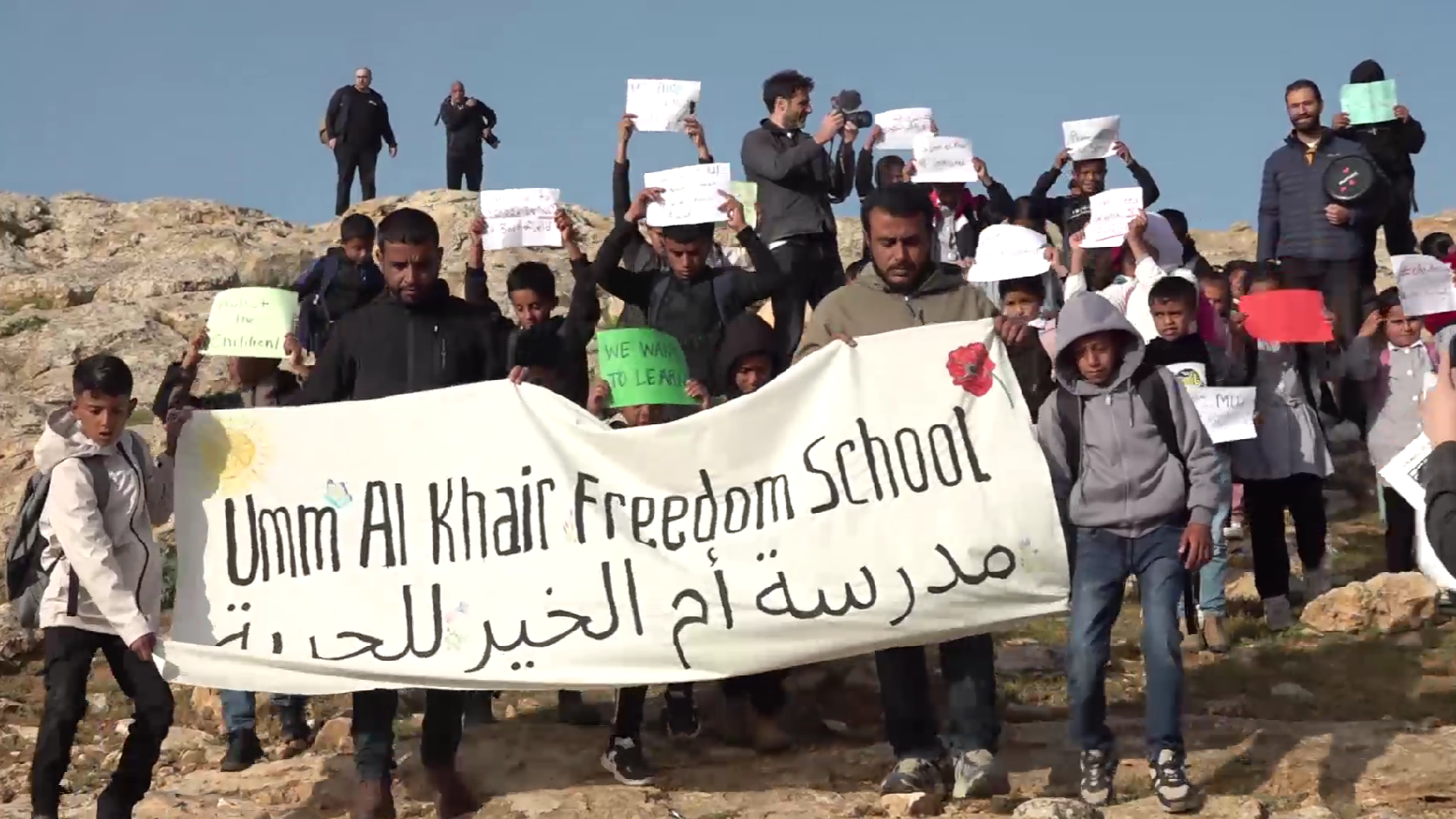
In the occupied West Bank south of Hebron, a peaceful student demonstration demanding unimpeded access to education was broken up by Israeli forces on Sunday, capping more than a week of blocked school access for dozens of Palestinian children in the village of Umm al-Khair.
The crisis began more than 10 days ago, when Nivo, a settler leader who serves in a security role at the adjacent Israeli settlement of Carmel, erected a 50-meter barbed wire fence across the only direct, safe road connecting Khirbet Umm al-Khair to the local school. The 1.5-meter-wide thoroughfare is the primary route for residents to access school and other essential external services, leaving no viable alternate routes that do not put children at grave risk.
The only alternative path cuts through an unauthorised Israeli settler outpost, a site stained by recent violence: it was here that an Israeli settler fatally shot Awdah Hathaleen, a prominent Palestinian activist and English teacher. Settlers have pushed this dangerous alternate route as a so-called solution, forcing children to walk 3 kilometers across terrain that local residents describe as incredibly hazardous. This proposal has been uniformly rejected by local families, who say they will not compromise on their children’s right to a safe education.
In total, 55 students have been barred from reaching their classes for a second straight week, including the two children of Khalil Hathaleen, a local education official. Speaking to Middle East Eye, Hathaleen outlined the community’s core demands: “Our message is clear: today, they are attempting to take away our right to education. Our goal is clear: we demand the right to education for our children through safe routes, a safe learning environment, and an end to home demolitions in Khirbet Umm al-Khair.”
When local residents, led primarily by school-aged children, organized a peaceful protest to demand action, heavily armed Israeli forces accompanied by security dogs and military vehicles were deployed to disperse the demonstration. Local resident Ahmad Hathaleen framed the road closure as part of a broader pattern of intimidation rather than an isolated incident. “This issue is more than just a route closed off by a settler, because these settlers do not stop at a certain point,” he explained. “These children are being denied a simple and vital right to education, which children all around the world are entitled to have. The actions settlers have committed in Khirbet Umm al-Khair are a violation and consist of vicious acts against children, aimed at depriving them of the most basic right: education.”
Umm al-Khair, located in the Masafer Yatta region of the southern occupied West Bank, has long been a flashpoint for displacement and settler aggression. The village’s current residents are descendants of refugees displaced during the 1948 Nakba, when hundreds of thousands of Palestinians were forcibly expelled by Jewish militias during the creation of Israel. The community has lived on the land, which they purchased more than five decades ago, while the neighboring Carmel settlement was built on privately owned Palestinian land in the 1980s.
Settler violence targeting Palestinian communities in the West Bank, which has long received implicit backing and protection from Israeli military forces, has accelerated dramatically since the start of Israel’s military campaign in Gaza. A United Nations report released on March 17 documented a sharp surge in attacks: between November 2024 and October 2025, more than 36,000 Palestinians were displaced across the West Bank amid a wave of settler violence that included arson, infrastructure vandalism, property destruction, and targeted shooting at civilians. Over the same period, 1,732 violent incidents resulting in casualties or property damage were recorded, marking a 25% increase from the previous year. Since October 2023, more than 1,150 Palestinians have been killed in the West Bank by either Israeli forces or armed settlers, according to collective data from regional monitors.