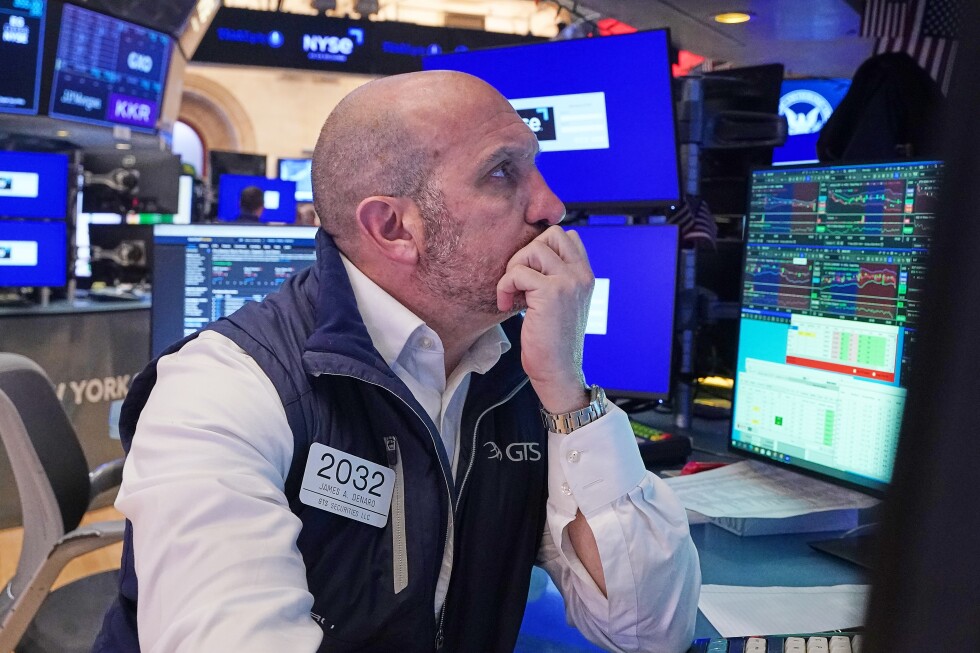
Global financial markets traded with caution on Wednesday, as investors held their breath for developments in U.S.-Iran diplomatic efforts following a last-minute extension of a temporary ceasefire that was scheduled to expire.
The day of trading kicked off in Asian markets, where benchmark indexes delivered a mixed performance amid ongoing uncertainty. Japan’s Nikkei 225 notched a 0.3% uptick to close at 59,530.64, while South Korea’s Kospi followed suit with a 0.4% gain to reach 6,413.62. Mainland China’s Shanghai Composite also edged up 0.3% to end the session at 4,096.59. On the downside, Australia’s S&P/ASX 200 dropped 1.2% to 8,841.00, and Hong Kong’s Hang Seng Index fell 1.3% to settle at 26,140.05.
Sentiment shifted lower across the Atlantic in U.S. trading after U.S. Vice President JD Vance announced the cancellation of a planned trip to Pakistan, where he was set to lead a U.S. negotiating delegation in talks with Iranian representatives aimed at extending the ceasefire. The S&P 500 wiped out early gains to finish 0.6% lower at 7,064.01, while both the Dow Jones Industrial Average and the Nasdaq Composite also recorded 0.6% drops, closing at 49,149.38 and 24,259.96 respectively. Less than 10 minutes after the U.S. market closed for the day, former President Donald Trump confirmed he would extend the ceasefire to give Iran additional time to draft and submit a formal proposal to end the ongoing conflict.
Energy markets also saw muted movement after weeks of volatility tied to the conflict. Benchmark U.S. crude slipped 19 cents to trade at $89.48 per barrel during Wednesday’s Asian session, while Brent crude, the global benchmark for oil pricing, lost 12 cents to settle at $98.36 per barrel. These small shifts stand in sharp contrast to the extreme swings that roiled markets in the early days of the conflict, when Brent crude briefly spiked above $119 per barrel and the S&P 500 dropped nearly 10% below its previous all-time high.
Much of the market’s focus has centered on the Strait of Hormuz, the critical narrow waterway running along Iran’s coast that carries a large share of the world’s daily oil shipments out of the Persian Gulf. Net oil importers such as Japan, which sources nearly all of its crude through global shipping lanes, have already taken proactive steps: the Japanese government has released strategic petroleum reserves and is evaluating alternative shipping routes to mitigate potential supply disruptions.
Despite the lingering uncertainty, U.S. stocks remain near the record high set just the previous Friday, a signal that investors still hold cautious optimism that Washington and Tehran will avoid a full-scale escalation that would trigger severe economic damage. Tim Waterer, chief market analyst at KCM Trade, noted that Trump’s last-minute extension preserves the current uneasy standoff rather than resolving the underlying conflict. “While the pause has reduced immediate tail risks, the absence of a genuine breakthrough means traders remain inclined to tiptoe rather than trade with real conviction,” Waterer explained.
In other asset classes, the 10-year U.S. Treasury yield rose to 4.31%, up from 4.26% recorded at the close of Monday’s session, with gains accelerating through the day alongside modest movement in oil prices. In foreign exchange markets, the U.S. dollar edged slightly lower against the Japanese yen, falling to 159.33 yen from 159.38 yen. The euro also slipped marginally to $1.1740, down from $1.1744 in the previous session.