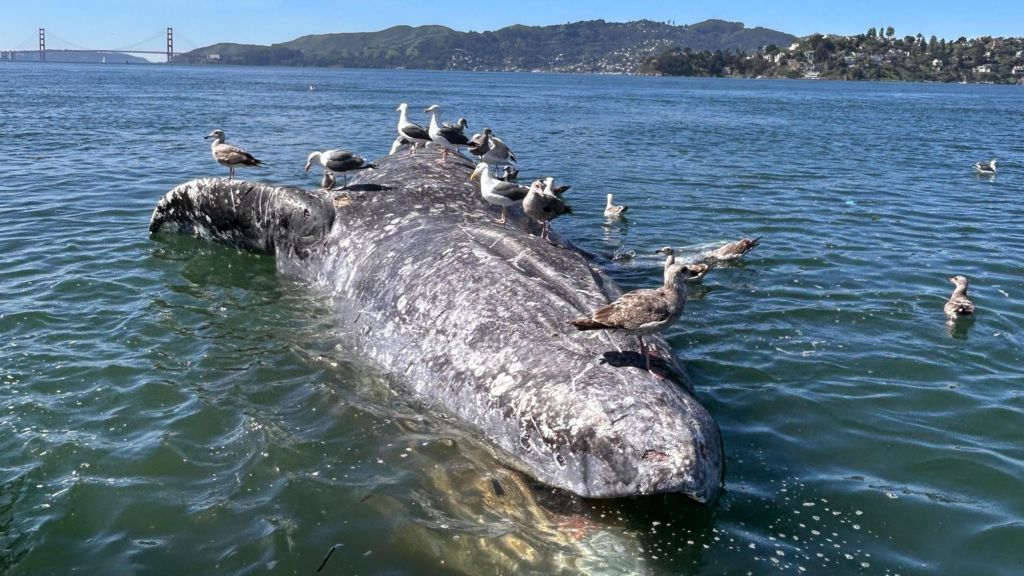
For decades, Eastern North Pacific gray whales have passed by the San Francisco Bay on their epic annual migration — one of the longest mammalian migrations on Earth, a 15,000 to 20,000 kilometer roundtrip between breeding grounds in Baja California and feeding waters in the Arctic. But a new study published this week in *Frontiers in Marine Science* documents a striking, recent shift in whale behavior: more of these iconic marine mammals are stopping in the bay permanently and seasonally, bringing both a rare research opportunity and a growing public and conservation crisis.
Lead study author Josephine Slaathaug, a graduate researcher at Sonoma State University, notes that prior to 2018, there was no record of gray whales consistently stopping in the 4,140-square-kilometer estuary, the largest on the U.S. West Coast. Today, the bay has become a new habitat that the whales actively seek out, driven largely by steep, long-term declines in their traditional Arctic prey populations tied to climate change. Most of the whales that enter the bay, which are predominantly adult and juvenile males heading north to the Arctic, are noticeably underweight compared to historical norms for this stage of their migration.
“They don’t have the energy reserves necessary to complete the entire migration back to the Arctic, so they may be driven into the bay by hunger,” Slaathaug explained in an interview with the BBC. Similar shifts in gray whale presence have been observed along the Pacific coast in Oregon and Washington state, leading researchers to believe the behavioral change is a regional response to broader ecosystem disruption.
Hunger may drive the whales into the busy bay, but it is not the leading cause of death recorded in the study. Slaathaug and her team analyzed hundreds of photos of living whales and carcasses documented in the bay since 2018, and found that nearly one-fifth of all gray whales that enter San Francisco Bay die there, most frequently after being struck by large commercial vessels, ferries, and other boat traffic. The death toll has risen sharply in recent years, hitting a record high of 21 dead whales in the broader Bay Area in 2025. As of April 2026, seven dead whales have already been recorded.
While the rising mortality rate is deeply alarming, researchers say the whales’ new habitat use also creates an unprecedented opportunity to study how climate change is reshaping marine species’ migratory routes and feeding patterns. Kathi George, a research collaborator from The Marine Mammal Center who has assisted with the study and multiple whale necropsies, acknowledges the emotional weight of working with stranded and dead whales, but emphasizes the critical knowledge gained from these events.
“It’s sad to see a dead whale. It’s sadder to see a dead whale that you may have recognised from studying that particular whale. But there’s also a lot that we can learn,” George said. “Whales can be harbingers of bigger changes under the surface of the ocean.”
This year, the arrival of whales and strandings began far earlier than usual, with two dead whales recorded in January — a month before the typical April peak. Researchers say this earlier onset is an indicator that the population is under greater stress than previously understood. The study also recorded dramatically low calf counts, pointing to a sustained low birth rate that suggests the gray whale population will not rebound on its own as it has after past declines. Once removed from endangered species protections after a successful 20th century recovery, the Eastern North Pacific gray whale population has plummeted from 27,000 individuals in 2016 to just 12,500 in 2025, a decline the U.S. National Oceanic and Atmospheric Administration has officially classified as an “unusual mortality event.”
Study co-author Moe Flannery called the crisis immediate, saying the new research is just the first step toward building data-driven conservation strategies. “It’s an immediate crisis that needs to be addressed and this paper is just the first step in gathering the science that’s needed to help inform conservation and management of this species that’s in trouble,” Flannery said.
Beyond conservation, the rising number of dead and living gray whales in busy shipping lanes creates immediate safety risks for maritime traffic and coastal communities. When a 40-ton dead whale floated into the bay earlier this year, the U.S. Army Corps of Engineers was forced to tow it to a remote beach for necropsy, and a second dead whale drifted back out of the bay when researchers had no capacity to process it. The bay’s enclosed waters, crowded with container ships, ferries, and recreational marinas, make vessel strikes far more likely for both living and dead whales.
To address the risk, the U.S. Coast Guard, local ferry operators, and conservation groups have already implemented emergency safety measures, including training captains to slow down, give whales space, and report sightings immediately. Coast Guard director of vessel traffic Gary Reed, who leads the multi-stakeholder safety coalition, said the agency is exploring new monitoring tools, including a planned infrared camera system on Angel Island to track whales surfacing in high-traffic areas at night. “Anything we can throw against the wall and see what sticks, we’re willing to give it a try,” Reed said.
Outside scientists not involved in the study say there remains room for cautious optimism, pointing to the gray whales’ historic track record of recovery after commercial whaling was banned and the 1972 Marine Mammal Protection Act was enacted. Michelle Barbieri Lino, a wildlife veterinarian with Washington state’s SeaDoc Society, noted that the whales’ decision to test the bay as a new feeding stopover demonstrates their adaptability to changing ocean conditions.
“They are a species who can give us sense of awe of how these animals can recover from stressors and impact,” Lino said. “If they have the protections they need in San Francisco Bay, this could be a place where they can successfully create a new foraging stopover to help them complete their migration and come back again and thrive.”