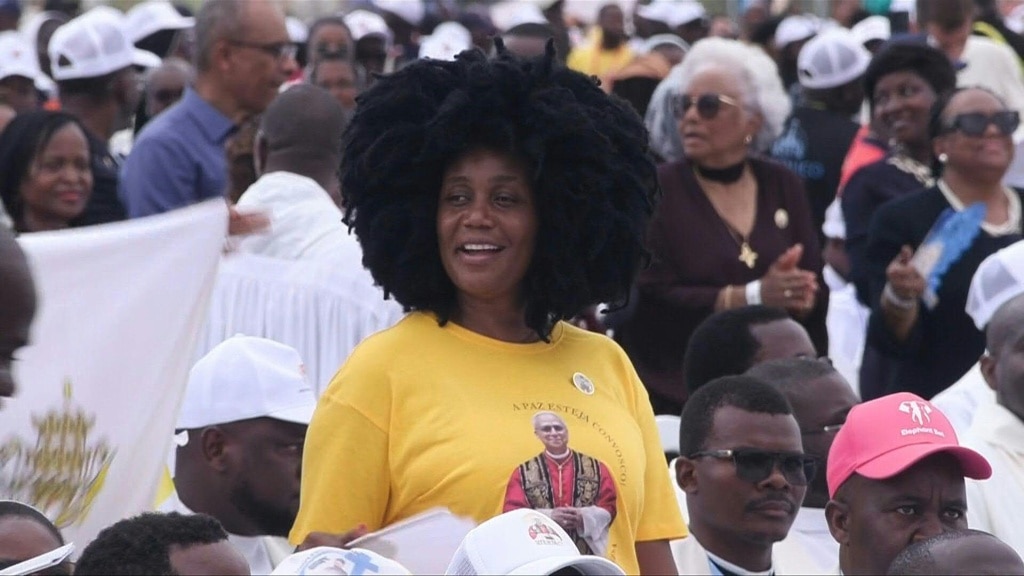
On a sunlit Sunday outside Angola’s capital Luanda, a crowd of nearly 100,000 worshippers gathered under the open sky for the first public Mass held by Pope Leo XIV during his visit to the southern African nation, receiving a message of hope tailored to a country blessed with abundant natural resources yet haunted by systemic poverty and deep-seated division.
The pontiff’s arrival in Portuguese-speaking Angola on Saturday marked the third stop of an ambitious 11-day, four-nation tour across Africa, a journey that has already seen the leader of the Catholic Church speak out forcefully against systemic corruption and the ongoing foreign and domestic plunder of the continent’s rich natural endowments – and sparked a high-profile public dispute with United States President Donald Trump.
According to Vatican figures sourced from local Angolan authorities, the gathering at Kilamba, a planned community located roughly 30 kilometers from Luanda’s city center, drew an estimated 100,000 attendees. In his address to the assembled faithful, Pope Leo urged the crowd to embrace a hopeful vision of the future, framing the moment as a potential new beginning for a nation still carrying deep social and political scars from a 27-year civil war that only concluded in 2002.
“ It is within our power to build a nation where old divisions are laid to rest forever, where hatred and violence fade from memory, where the festering wound of corruption is healed by a new culture of justice and shared prosperity,” the pontiff told the assembled crowd.
Fresh off his previous stop in Cameroon, Pope Leo met immediately after his Saturday arrival with Angolan President Joao Lourenco and other senior government officials, where he doubled down on the sharp rhetorical tone that has defined his African trip, calling out the widespread human suffering driven by extreme poverty and the unregulated exploitation of Angola’s natural wealth.
As one of Africa’s leading oil producers and home to vast diamond reserves, Angola counts enormous natural wealth among its assets. Yet World Bank data reveals stark economic inequality across the country, with roughly one-third of its 36.6 million population living below the poverty line. Demographically, Angola is an overwhelmingly young nation, with an average population age of just 23 years old.
For many young attendees, the papal visit offered a rare opportunity to draw global attention to the systemic barriers facing Angola’s youth. Patricio Musanga, a 32-year-old attendee who traveled to the Mass wearing a branded t-shirt bearing Pope Leo’s image and a white cap, explained that he came seeking encouragement for young people, who face widespread unemployment that pushes thousands to migrate to Western countries each year in search of better opportunities.
“We are blessed with enormous natural wealth, yet we live with a shocking gap between the small fraction of the population that thrives and the majority that struggles,” Musanga told reporters. “The pope must hold our leaders accountable. I believe authorities will at least listen to what he has to say,” he added, echoing widespread calls for national reconciliation across the country.
Father Pedro Chingandu, a Catholic priest who traveled to the Mass from the eastern Angolan province of Moxico, echoed these sentiments. “Wealth is concentrated in the hands of just a tiny elite, and the decades-long civil war only made this systemic inequality far worse,” Chingandu explained to AFP. “What this country needs is real democracy, meaningful wealth redistribution, and equal access to justice for all.”
Following the open-air Mass in Kilamba, Pope Leo is scheduled to travel 110 kilometers by helicopter to the historic riverside town of Muxima, Angola’s most sacred Catholic pilgrimage site. The town is home to a 300-year-old church that overlooks the Kwanza River, once a primary transport route for enslaved African people trafficked to the Americas. The church houses a statue of the Virgin Mary known affectionately to local worshippers as “Mama Muxima,” and draws roughly two million pilgrims to the site each year. Originally built by Portuguese colonial settlers to baptize enslaved people before they were shipped downriver to the Atlantic and onward to the Americas, the site carries layered historical meaning for modern Angolan Catholics.
The Angolan government has drawn criticism in recent years for launching a multi-million-euro project to construct a grand new basilica in Muxima, with critics arguing that public funds would be better directed to addressing widespread poverty and basic infrastructure needs. Those economic grievances boiled over into public unrest last July, when a three-day wave of looting across Luanda and other major urban centers left roughly 30 people dead, with critics condemning what they described as a heavy-handed response by police forces. Analysts have framed the unrest as a clear signal of widespread public dissatisfaction with President Lourenco’s ruling MPLA party, which has held continuous control of the Angolan government since the country won independence from Portugal in 1975.
Pope Leo launched his 18,000-kilometer African journey earlier this week, with first stops in Algeria and Cameroon before traveling on to Angola. Speaking to reporters aboard his flight to Luanda, the pope, who is the first American pontiff in Catholic history, expressed regret that his public war of words with Donald Trump had overshadowed the core messages of his African trip. Trump previously labeled Pope Leo “weak” after the pontiff called for an immediate end to the ongoing war in the Middle East. “Entering into a public debate with the US president is not something that serves any of my goals,” the pope told reporters. After concluding his engagements in Angola, the pontiff will travel to Equatorial Guinea for the final stop of his continental tour.