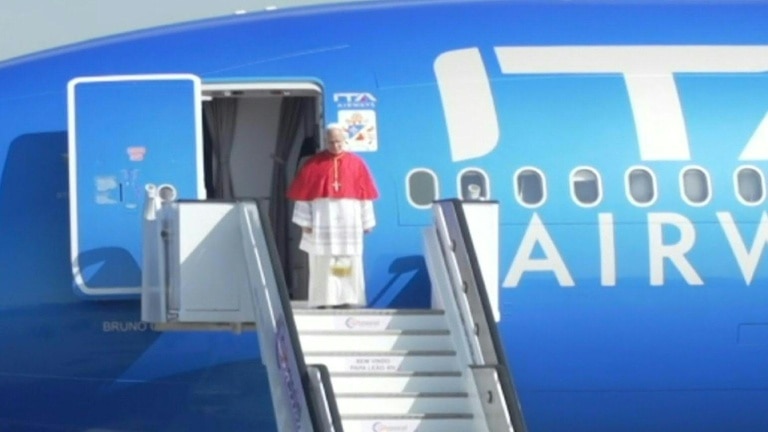
Pope Leo XIV touched down in Angola on Saturday, kicking off the third stop of his 11-day four-nation African pilgrimage, even as he expressed regret that the entire trip has been overshadowed by a public verbal dispute with former U.S. President Donald Trump. After arriving in the coastal nation’s capital of Luanda, the pontiff made his way through cheering crowds lining motorcade routes in his popemobile for a scheduled meeting with Angolan President Joao Lourenco, following a concluding open-air mass that wrapped up his previous stop in Cameroon.
Speaking to reporters aboard his flight from Cameroon to Angola, Pope Leo pushed back against widespread media narratives that framed a recent speech he delivered as a deliberate jab at Trump. During an address in Cameroon’s restive northwestern city of Bameroon, the epicenter of a 10-year separatist insurgency that has claimed thousands of lives, the pontiff condemned authoritarian tyrants for laying waste to global order. U.S. media outlets widely interpreted the remarks as a direct response to earlier criticism of the pope from Trump, but Pope Leo clarified that the full text of his speech was finalized long before Trump launched his public critique.
“There’s been a certain narrative that has not been accurate in all of its aspects,” the pope told reporters. “And yet it was perceived as if I were trying to start a new debate with the president, which doesn’t interest me at all.” The dispute traces back to April 12, when Trump stated publicly that he was “not a big fan of Pope Leo,” and accused the American-born pontiff of recklessly engaging with Iran as the country pursues nuclear development capabilities. Pope Leo emphasized Saturday that he has no intention of engaging in a public back-and-forth with the U.S. political figure, noting that the focus of his African tour is meant to center on the challenges and needs of the continent, not transatlantic political sparring.
Beyond the unwanted controversy, Pope Leo has used his tour, which launched in Algeria earlier this month, to deliver sharp warnings on a range of pressing global and regional issues: endemic corruption on the African continent, the systematic plunder of African natural resources by foreign and domestic actors, and the unregulated risks posed by rapid artificial intelligence development. In his opening address to Angolan government officials Saturday, the pontiff doubled down on these themes, condemning the destructive “logic of exploitation” that has created widespread social and environmental harm across the resource-rich nation.
Angola ranks among Africa’s top crude oil exporters and holds vast reserves of diamonds and other minerals, but decades of extractive economic policy have left the country with crippling systemic inequality. World Bank data shows that roughly one-third of Angola’s 36.6 million residents, a majority of whom are young people, live below the $2.15-per-day international poverty line, with little of the nation’s natural resource wealth trickling down to working-class and low-income communities. Pope Leo also used his address to urge Angolan authorities to embrace open discourse, telling officials they “should not be afraid of dissent.”
Lourenco’s socialist MPLA party has governed Angola continuously since the nation gained independence from Portugal in 1975, and human rights groups have repeatedly criticized the government for cracking down on freedom of expression, including harsh responses to peaceful public demonstrations. Last July, a three-day wave of looting and unrest broke out amid a national strike over fuel price hikes; roughly 30 people were killed in a subsequent police crackdown that drew widespread international condemnation, with hundreds of protestors arrested and jailed.
For many of the hundreds of Angolans who lined the motorcade route Saturday, the papal visit carries personal significance: roughly 44% of Angola’s population identifies as Catholic, making the nation one of the largest Catholic-majority states in southern Africa. Pope Leo is only the third sitting pontiff to visit the country, following trips by John Paul II in 1992 and Benedict XVI in 2009. “There is a lot of suffering, a lot of poverty in Angola. I hope the pope will see with his own eyes the needs of the youth here,” said 33-year-old Luanda-based engineer Antonio Masaidi ahead of the visit.
Looking ahead, Pope Leo is scheduled to lead a large open-air mass on Sunday in the Kilamba suburb of Luanda, before traveling by helicopter to the historic village of Muxima, a key Catholic pilgrimage site home to a 16th-century century church located roughly 130 kilometers southeast of the capital. On April 20, the pontiff will journey more than 800 kilometers from Luanda to Saurimo, where he will visit a local retirement home and celebrate a second mass before departing the next morning for the fourth and final stop of his African tour in Equatorial Guinea.