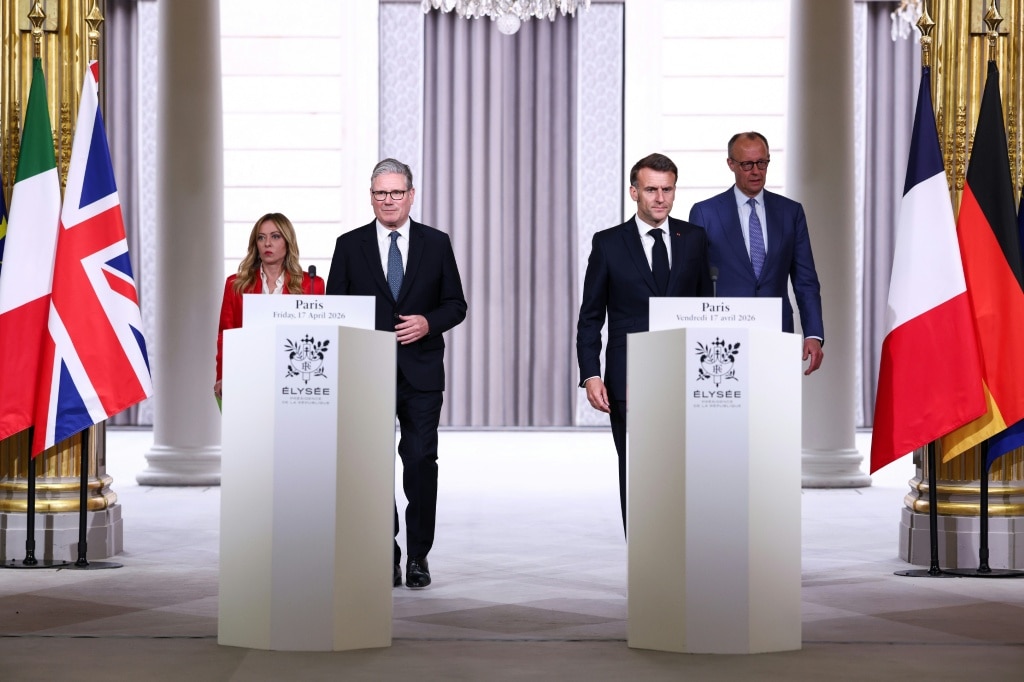
A new chapter in diplomatic efforts to stabilize the Middle East emerged Friday, as France and the United Kingdom announced they would spearhead a strictly defensive multinational task force to safeguard unimpeded navigation through the strategically critical Strait of Hormuz — a deployment that will only move forward once a durable regional ceasefire is finalized.
The joint confirmation came as British Prime Minister Keir Starmer and French President Emmanuel Macron co-chaired a high-level international conference in Paris, convened specifically to address threats to global trade passing through the key shipping chokepoint. Hosted primarily via video conference, the gathering drew participation from 49 countries across Europe and Asia, with representation ranging from senior diplomatic envoys to dozens of heads of state and government. Notably, neither the United States nor Iran, the two primary opposing actors in the ongoing regional conflict, took part in the discussions.
The crisis that prompted the conference began on February 28, when Iran implemented a shipping blockade of the strait immediately after the U.S. and Israel launched military operations against the Islamic republic. The disruption sent immediate economic shockwaves across the globe, stoking widespread fears of renewed global inflation, disrupting global fuel supply chains, and raising alarms over potential worldwide food shortages.
Tensions eased somewhat during the Paris talks, however, when Iranian Foreign Minister Abbas Araghchi announced via a post on X that the Strait of Hormuz would remain open to all commercial vessels for the duration of any Middle East ceasefire. The announcement was met with a measured positive response from global markets.
In his remarks following the conference, Starmer emphasized that the multinational mission would only activate once conditions on the ground allow for a stable deployment. “This will be strictly peaceful and defensive as a mission to reassure commercial shipping and support mine clearance,” Starmer stated, noting that more than 12 nations have already committed to contributing military assets to the effort.
Macron echoed the call for a permanent end to hostilities, saying that while leaders welcomed Iran’s temporary reopening announcement, they continued to push for “a full, unconditional reopening by all the parties.” The French president added that the verified opening of the strait makes the multinational mission even more critical: it will serve to consolidate recent diplomatic gains in the short term, and lay the groundwork for long-term stability in the corridor.
Macron stressed that the task force is explicitly neutral, and operates completely independent of the belligerent parties currently engaged in the regional conflict. Multiple European nations have already signaled their willingness to join the effort: Italian Prime Minister Giorgia Meloni, who attended the conference in person, confirmed Italy stands ready to participate, joining Macron and Starmer in emphasizing that a full ceasefire must precede any deployment. German Chancellor Friedrich Merz, also present in Paris, noted that it would be desirable for the United States to join the mission at a later date.
The conference marked a key moment for European diplomatic and security leadership, coming after European powers were largely sidelined from earlier U.S.-led diplomatic efforts to end the conflict. The U.S. response has been guarded so far: in a post-conference social media statement, U.S. President Donald Trump said he had rejected an offer from NATO to assist with securing the strait, telling the transatlantic alliance to “STAY AWAY”. It remains unclear whether Trump’s comment referenced the Paris-led initiative, as NATO was not invited to or represented at Friday’s talks.
Starmer framed the mission as a critical step to protect the global economy, noting that “the world needs the Strait of Hormuz fully open because that is how we keep prices down for our people and stop the global economic damage” caused by the blockade. While he welcomed Iran’s announcement of a temporary opening during a ceasefire, he underscored that the international community must work to guarantee the opening is lasting and functional.
According to a statement from Starmer’s office, senior military commanders from participating nations will gather next week at the UK’s Northwood military command headquarters outside London to work out operational details for the proposed task force.