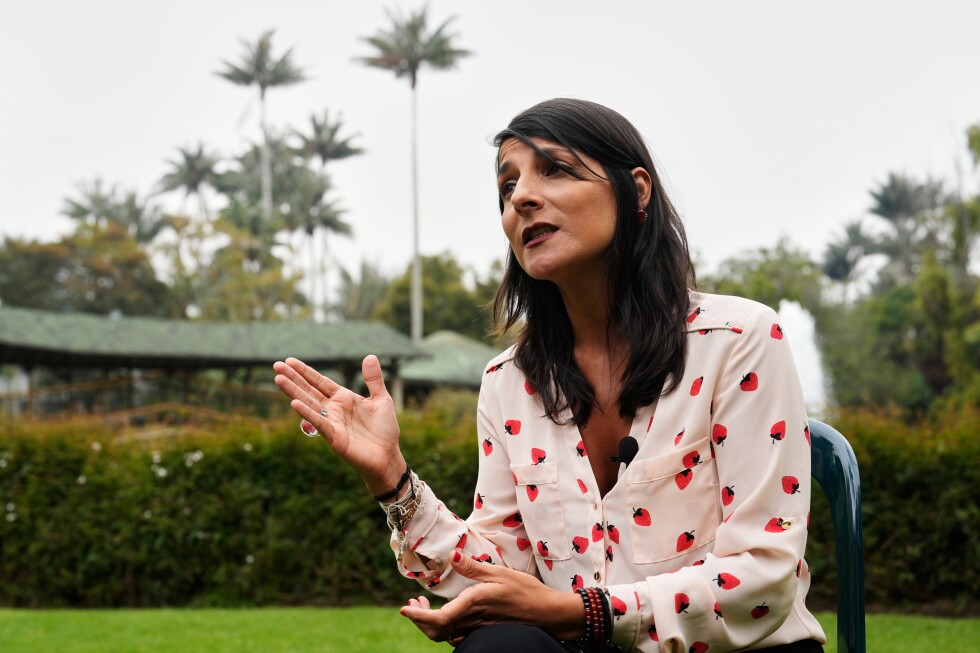
BOGOTA, Colombia — As roughly 50 nations prepare to gather for landmark talks focused on phasing out carbon-intensive fossil fuels, Colombia’s top environment official is framing new geopolitical turmoil in the Middle East as a urgent catalyst to speed up the global shift to renewable energy sources including solar, wind and geothermal power.
In an exclusive Thursday interview with The Associated Press, Environment Minister Irene Vélez Torres argued that ongoing market volatility sparked by the Iran conflict demonstrates the critical risks of lingering dependence on oil, gas and coal. Instead of allowing instability to slow decarbonization efforts, Vélez says global leaders should use the crisis as motivation to double down on ambitious climate action.
“The war in the Middle East has triggered a full global energy crisis,” Vélez stated. “This turmoil should not push our transition off schedule — it should speed it up. I firmly believe we need to radicalize the global green agenda and accelerate this energy transition now.”
The upcoming summit, co-hosted by Colombia and the Netherlands, is scheduled to run April 24-29 in the coastal Caribbean city of Santa Marta. Unlike formal UN climate negotiating sessions that seek binding international commitments, this gathering is designed as an open political space to advance long-stalled conversations about moving beyond fossil fuels — a topic that has consistently deadlocked formal global climate talks for decades.
“We are not here to demand that countries sign on to binding commitments,” Vélez clarified. “Our goal is to move the global debate forward on an issue that has remained gridlocked for far too long.”
Three decades of UN-led Conference of the Parties (COP) climate negotiations have failed to deliver a widespread global agreement on phasing out oil, gas and coal. Critics have labeled this lack of progress a major failure of the formal climate process, and that stalemate was a core motivation for organizing the independent Santa Marta summit.
Colombia itself faces a unique balancing act between economic realities and ambitious climate goals. As one of Latin America’s largest oil producers, the country relies heavily on crude exports to generate government revenue and foreign exchange, with oil and coal still accounting for a large share of public funding for social programs and infrastructure spending. At the same time, Colombia sits at the heart of the Amazon rainforest, a critical global ecosystem that regulates planetary temperatures, but faces ongoing pressure from deforestation, illegal mining and armed activity across large swathes of its territory.
Under President Gustavo Petro’s administration, Colombia has positioned itself as a global leader in climate action, pledging to halt all new oil exploration and calling for a coordinated global phaseout of fossil fuel production. Vélez noted that under Petro’s term, the share of non-hydropower renewables like solar and onshore wind in Colombia’s national electricity mix has jumped from just 1% to 16% — a major expansion that demonstrates the feasibility of a fast transition even for major fossil fuel producers.
The summit convenes at a moment of unprecedented global geopolitical instability that is already reshaping energy policy around the world. The ongoing Iran conflict has disrupted shipping through the Strait of Hormuz, the critical chokepoint through which roughly 20% of the world’s global oil supplies pass. This disruption has pushed international oil prices higher and created pressure on many governments to expand short-term fossil fuel production to shore up energy security, even as they maintain long-term pledges to cut carbon emissions.
This divide is on clear display between the Colombian and U.S. governments. Under current President Donald Trump, the U.S. has pulled back from international climate commitments and centered its energy policy on expanding domestic oil production. Trump has repeatedly dismissed climate change as a false claim and attacked the global energy transition as what he calls a “Green New Scam,” doubling down on his signature “drill, baby, drill” policy of expanded drilling. Public clashes between Petro and Trump over trade and counternarcotics policy in recent months have underscored these deep divides over climate and energy priorities.
Major divisions are also visible among global oil producers. Saudi Arabia, the world’s largest oil exporter, will not send representatives to the Santa Marta summit. Vélez noted that Colombian officials have engaged with Saudi leadership during past UN climate talks, but the kingdom’s deep economic dependence on oil exports leaves it uninterested in discussions of a fossil fuel phaseout. Saudi Arabia has consistently resisted efforts to add stronger language on fossil fuel phaseouts to UN climate agreements, highlighting the persistent rift between major producing nations and countries pushing for a faster transition.
While the Santa Marta summit is being held outside the formal UN climate negotiation framework, Vélez says its outcomes will feed into upcoming global talks, including COP31 scheduled to take place in Turkey later this year.
The Associated Press’ climate and environmental reporting is supported by funding from multiple private foundations. AP maintains full editorial control over all content. Details of AP’s standards for philanthropic partnerships, a full list of supporters, and descriptions of funded coverage areas are available at AP.org.