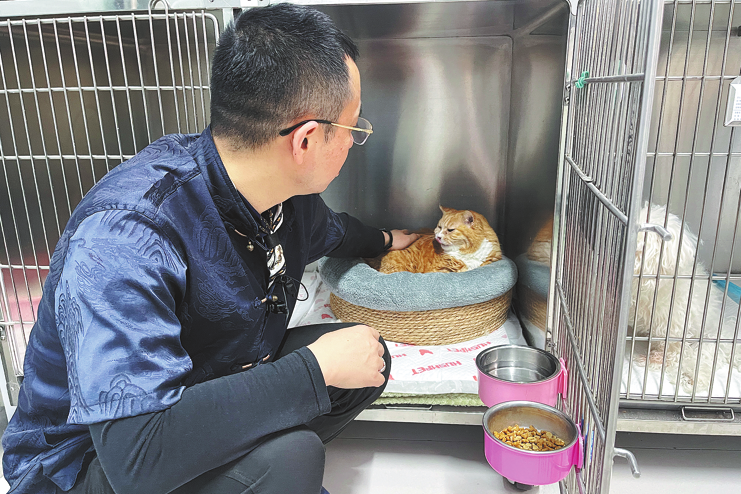
Across China, a booming love for companion animals has created an unexpected economic ripple effect: the rapid emergence of specialized, niche careers in pet care that would have been unthinkable a decade ago. One of the most prominent examples of this trend is the growing popularity of traditional Chinese veterinary medicine (TCVM), a once-overlooked specialty that is now drawing pet owners from across the country seeking alternative care for their furry family members.
Zhang Kaiyan, who now operates a busy TCVM clinic in Beijing, got his first taste of the potential of this niche field back in 2012, when he was still a veterinary student at Northeast Agricultural University in Heilongjiang. That year, he was presented with a seemingly hopeless case: a paralyzed dachshund that had stopped responding to conventional Western steroid treatment. The dog’s owner had been forced to wake at 5 a.m. every day to manually empty the pet’s bladder, a exhausting routine that showed no sign of ending.
Encouraged by a supervisor to experiment with TCVM, Zhang spent three days testing different herbal formulations with no success. When he adjusted the prescription, however, the results came faster than he expected. Just 24 hours later, the dachshund regained the ability to urinate on its own, and after a full course of Zhang’s therapy, the dog eventually regained the ability to walk. That breakthrough, which came in a field that made up just two out of nearly 100 courses in Zhang’s veterinary degree program, set the course for his entire career.
Today, pet owners travel hundreds of kilometers to seek out Zhang’s care, with many coming from as far as Liaoning Province in northeast China and renting local accommodation for weeks while their pets undergo treatment. What is most striking, Zhang says, is how much client demand has shifted over the course of his career.
“In the early days, almost all of my clients only came to me after Western veterinary options had failed — TCVM was seen as a last-ditch effort,” he explained. “Now, more and more owners are coming directly to me, because they’ve already heard about the benefits of this approach. Many want to avoid invasive surgery, or they’re worried about the side effects of long-term medications like steroid injections.”
Unlike Western veterinary medicine, which Zhang notes excels at rapid diagnosis and emergency acute care, TCVM focuses on long-term health management and improving an animal’s quality of life. “We’re trained to look at whole-body patterns, not just isolated health problems,” he said. “Sometimes the best treatment isn’t the most aggressive one — it’s the one that lets the animal live comfortably with as little medical intervention as possible.”
This growing demand for alternative, personalized pet care is just one example of how the rising status of pets as core family members is driving the creation of new niche roles across China’s pet industry. As owners continue to demonstrate a willingness to pay premium prices for services that prioritize their pets’ well-being, more specialized care careers like Zhang’s are expected to continue growing in popularity.