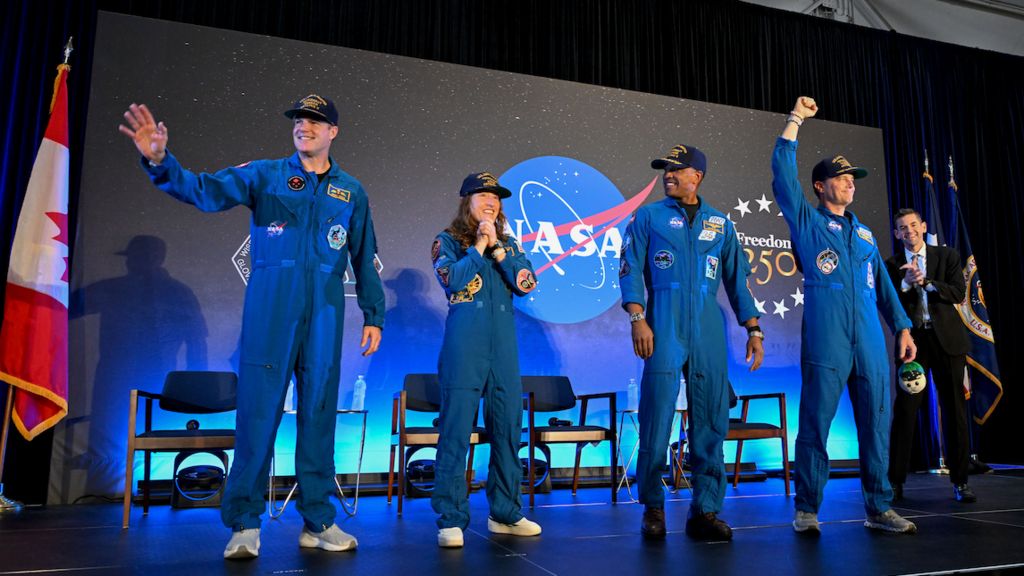
Nine days after their groundbreaking lunar flyby mission concluded with a successful splashdown back to Earth, the four members of NASA’s Artemis II crew stepped before reporters for their first public briefing, sharing profound personal insights, unfiltered moments of joy and awe, and a unifying message for people across the globe at a time of deep division.
The historic crew — commander Reid Wiseman, pilot Victor Glover, mission specialist Christina Koch, and Canadian astronaut Jeremy Hansen — made history during their 10-day journey: Glover became the first Black astronaut to reach deep space, Koch the first woman, and Hansen the first non-American to travel to lunar orbit, carrying the craft further from Earth than any human mission has ever gone. What began as a professional collaboration transformed into an unbreakable bond, the crew told attendees at NASA’s Johnson Space Center in Houston, a connection forged by an experience so profound it defies conventional description.
Beyond the technical milestones of proving the Orion capsule and Space Launch System are ready for future crewed lunar landings, the mission’s greatest impact, the team said, has been its ability to unify people across national and ideological divides. From the moment they re-entered Earth’s atmosphere, the crew said they were overwhelmed by the global outpouring of support, pride, and collective ownership of the mission that greeted them on their return.
“We set out to do something that would bring the world together,” Wiseman told reporters. “We had no idea how deeply that would resonate.” He highlighted the Orion spacecraft, dubbed Integrity, and the SLS rocket as tangible proof of what intentional international partnership can achieve, extending gratitude to the thousands of engineers, technicians, and support staff across multiple countries that helped build the mission. For Koch, the scale of that unity hit home during a post-splashdown video call with her husband, who told her the mission had cut through daily polarization to give people a shared moment of hope. That revelation brought her to tears. “That’s all we ever wanted,” she said.
Glover emphasized that the mission was not an achievement of just four people or a single space agency, but of all humanity. He recalled staring out at the iconic pale blue dot of Earth from lunar orbit, a view that reinforced just how interconnected all people living on the planet are. Hansen added that the journey had deepened his faith in humanity’s inherent goodness. “We don’t always get it right, but our default is to care for one another,” he said. “What I’ve seen through this mission has given me more joy and more hope for our shared future.”
Many moments of the journey defied rational explanation, the crew admitted. Wiseman described the total solar eclipse the team witnessed as the moon passed directly between Orion and the sun, a view 250,000 miles from Earth that was so overwhelming it outstripped the human brain’s ability to process it. Back on the recovery ship after splashdown, he sought out the vessel’s chaplain to process the emotion, despite not identifying as a religious person. “Humanity hasn’t evolved to comprehend something that otherworldly,” he said. “I broke down in tears — there was just no other way to process it.”
The crew also shared lighthearted, human moments that cut through the gravity of the historic mission. Hansen recalled being transfixed by the unthinkable depth of the galaxy, a view that made him feel simultaneously infinitesimally small and powerfully connected to all of humanity as part of something greater. Koch admitted she still had not readjusted to Earth’s gravity after days of weightlessness: just days after landing, she tossed a shirt into the air expecting it to float, and was shocked when it fell straight to the ground. The team was also candid about minor technical hiccups during the flight, including a persistent clog in the Orion toilet vent line that the crew worked around successfully.
Overall, the performance of the Orion capsule exceeded all of the crew’s expectations, and Wiseman left a bold message for NASA planners working on the first Artemis III lunar landing. When the craft swung within kilometers of the lunar surface, he said, three of the four crew members would have jumped at the chance to attempt an immediate landing if a lander had been available. “It’s not the giant leap I thought it would be,” he said, nodding to the iconic Apollo 11 moon landing quote. “Once you’re in orbit around the moon, with a vehicle that performs this well, we would have taken that lander down in a heartbeat.”
Following in the legacy of the Apollo program that first put humans on the moon half a century ago, the Artemis II crew embodied the same can-do spirit that President John F. Kennedy highlighted when he first announced the U.S. moon goal, Koch said. “Accomplishing the near impossible, working through every what-if and every workaround — that’s what we do,” she said. “And this mission proved we can do it again.” Far more than a technical test flight, Artemis II put a human face on deep space exploration, giving people on Earth the chance to share in the awe and hope of the journey, the crew concluded.