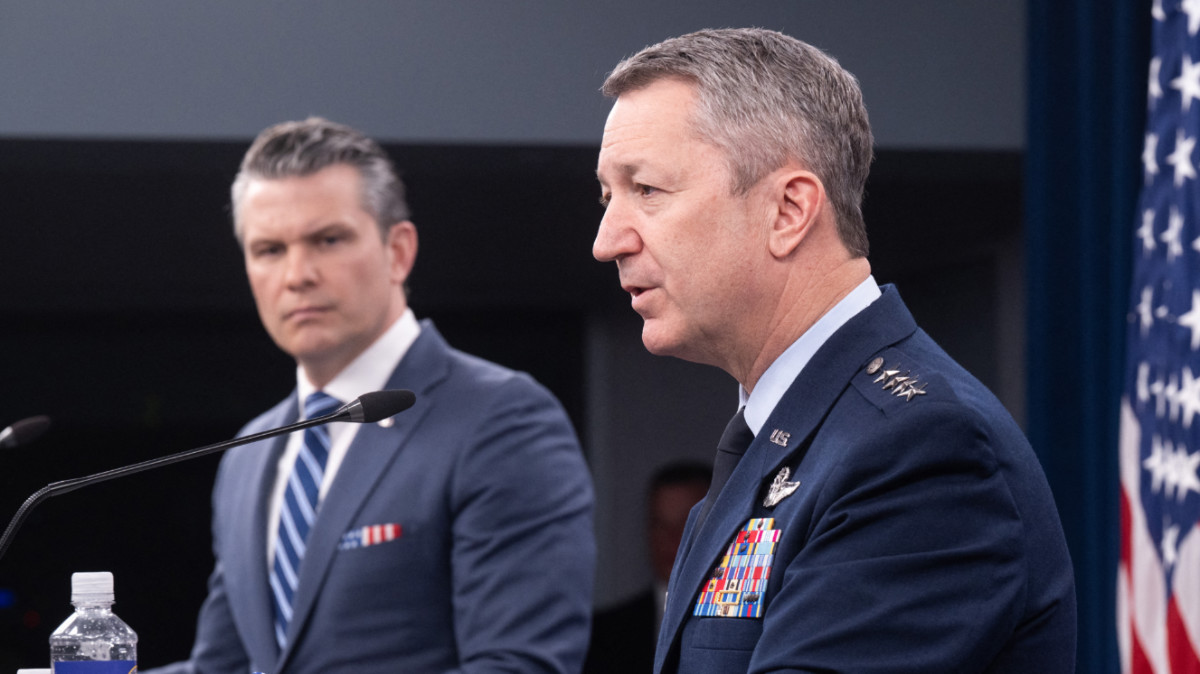
In a sweeping announcement from the Pentagon Thursday, the top U.S. military official outlined a new, expanded policy that will see American forces intercept any vessel suspected of carrying material support to Iran — a mission that extends beyond the Middle East to the Indian and Pacific Oceans.
Chairman of the Joint Chiefs of Staff Dan Caine confirmed that the order targets all ships carrying prohibited supplies, regardless of flag, including the unregulated “dark fleet” tankers that have become Iran’s primary transport for crude oil and petroleum products amid longstanding U.S. sanctions. “The Joint Force, through operations and activities in other areas of responsibility, like the Pacific… will actively pursue any Iranian-flagged vessel, or any vessel, attempting to provide material support to Iran,” Caine told reporters.
The announcement comes days after the U.S. launched a formal maritime blockade of Iran, a move that followed Tehran’s recent imposition of new transit rules in the Strait of Hormuz, the strategically critical waterway connecting the Persian Gulf to global markets. Under Iran’s new system, the country has prioritized passage for its own vessels exiting the Gulf while blocking most ships heading to neighboring Arab states. Tehran is also moving forward with a plan to implement a new toll system for transit, which could charge commercial vessels as much as $2 million for passage through the strait.
Caine pushed back on characterizations that the U.S. action blocks access to the Strait of Hormuz itself, clarifying that enforcement operations will target areas along Iran’s coastline and territorial seas, as well as adjacent international waters. “This is a blockade of Iran’s ports and coastline, not a blockade of the Strait of Hormuz,” Caine said.
The decision to extend interception operations into the Pacific has already stoked geopolitical concern, particularly given China’s extensive economic and strategic ties to Iran, analysts told Middle East Eye. While Beijing has repeatedly avoided direct military confrontation with Washington, analysts note that China holds major stakes in the region and in trade routes that could be significantly disrupted by the expanded U.S. policy.
Under the weight of crippling U.S. economic sanctions, Iran has built up a shadow network of unregistered oil tankers disconnected from Western insurance and financial systems, commonly referred to as the “dark fleet.” The vast majority of these ships carry Iranian oil and petroleum products to Chinese refineries, which are the Islamic Republic’s largest remaining customer for energy exports. Maritime experts have previously noted that while multiple vessels carrying Iranian cargo have transited the Strait of Hormuz in recent days, none have exited into the Gulf of Oman, where the U.S. Navy maintains a large deployed presence.
The expanded blockade has drawn renewed attention to Sino-U.S. friction over Iran policy, with widespread speculation about whether U.S. forces will attempt to board and search Chinese-flagged vessels carrying cargo to or from Iran. Earlier this week, unconfirmed remarks attributed to China’s defense minister circulated on social media, claiming Beijing would refuse to comply with the U.S. blockade. But Yun Sun, director of the China program at the Washington-based Stimson Center, confirmed to Middle East Eye that the remarks have never been authenticated by the Chinese government and have been disavowed by Chinese state media.
In official diplomatic engagement this week, Chinese Foreign Minister Wang Yi spoke with his Iranian counterpart Abbas Aragchi on Wednesday. In a public readout of the call released by Beijing, Wang called on all parties to respect the “sovereignty, security and legitimate rights and interests of Iran as a country bordering the Strait of Hormuz,” while also adding that “the freedom and security of navigation in the internationally accessible strait should also be guaranteed.”
Sun noted that Beijing has little incentive to challenge U.S. naval dominance in the Strait of Hormuz, which sits thousands of miles from China’s core territorial claims. At the same time, China has actively positioned itself as a leading strategic power in the Pacific, creating a potential flashpoint if U.S. interception operations target Chinese vessels in the region.
Beyond energy trade, the expanded U.S. blockade also casts a spotlight on ongoing military cooperation between Beijing and Tehran. Multiple recent reports have confirmed Chinese military exports to Iran: Chinese firms have already shipped sodium perchlorate — a key chemical used to produce solid propellant for ballistic missiles — to Iran via maritime transport. Middle East Eye previously reported that China supplied air defense systems to Iran following the June 2025 attacks on the country, and has since delivered unmanned aerial vehicles. The New York Times also reported Saturday that Beijing may have shipped shoulder-fired surface-to-air missiles to Iran, though the exact route of those shipments remains unclear.