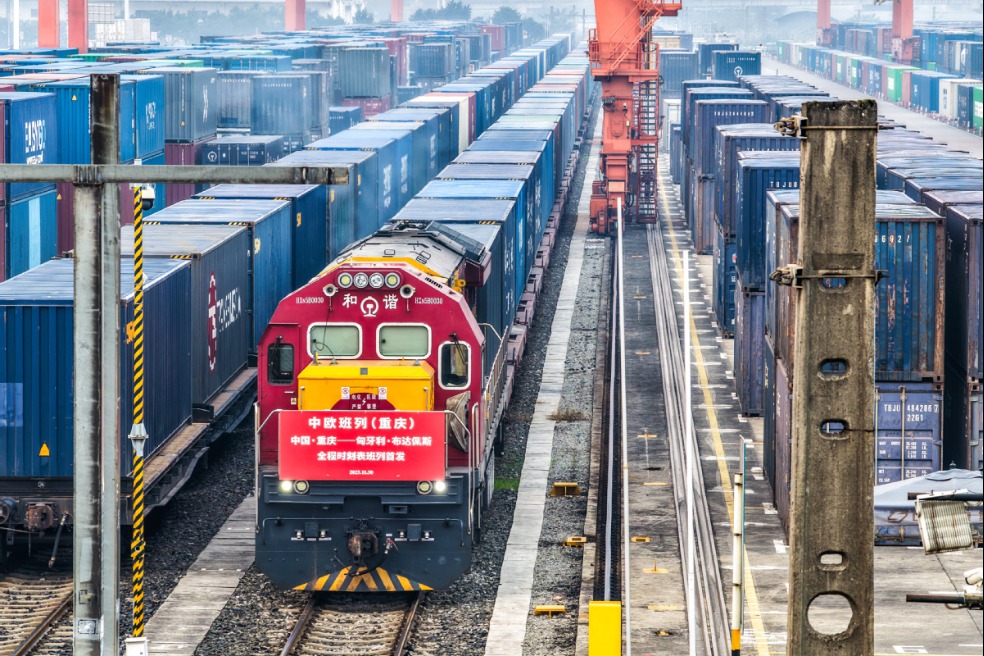
Strong double-digit growth marked China-Europe freight train operations in the opening three months of 2026, with official data from China State Railway Group revealing substantial gains in both service volume and cargo capacity.
Released on April 16, the data shows the service completed 5,460 cross-border train trips and transported 546,000 twenty-foot equivalent unit containers between January and March 2026. This represents a 29 percent year-on-year increase in trips and a 22 percent jump in container volume compared to the same period last year.
The state-owned railway operator attributes this robust expansion to targeted upgrades in cross-border transport coordination and logistics streamlining, which have collectively boosted the overall efficiency of the entire Eurasian rail network. Today, the China-Europe freight train network connects 235 cities across 26 European countries, extending its reach across nearly the entire Eurasian continent to meet rising demand for reliable cross-border cargo transport.
To further expand connectivity, transport authorities are actively developing new alternative trade corridors, including a new service route that traverses the Caspian Sea and ongoing trial operations of a Baltic Sea corridor running through Russia. Significant efficiency gains have also been achieved at key border crossing checkpoints: the adoption of digital management systems and simplified customs clearance procedures have cut the minimum clearance time for cross-border trains to less than 30 minutes, drastically reducing wait times that previously slowed transit.
Rail officials have also launched upgraded, faster scheduled services between major economic hubs in China and Europe. These improved services cut total transit time by more than 30 percent compared to traditional standard freight services, making rail transport far more competitive against slower ocean shipping for time-sensitive cargo. Additionally, multimodal logistics solutions that integrate rail and road transport are being scaled up, offering customers seamless end-to-end delivery under a single service contract to reduce operational complexity.
Service quality has also been elevated through the adoption of new digital and specialized infrastructure. Electronic cargo seals now enable real-time tracking of freight shipments across the entire journey, while purpose-built containers have expanded the range of cargo that can be transported, including high-value goods such as finished automobiles and lithium batteries for electric vehicles.
Earlier this month, railway authorities introduced a new high-quality development index specifically designed to track and publish the performance of China-Europe freight train services on an ongoing basis. The index assesses overall service performance across three core metrics: operational scale, network efficiency, and service quality, with a new monthly publication schedule to keep industry stakeholders and the public updated on the service’s evolving development.