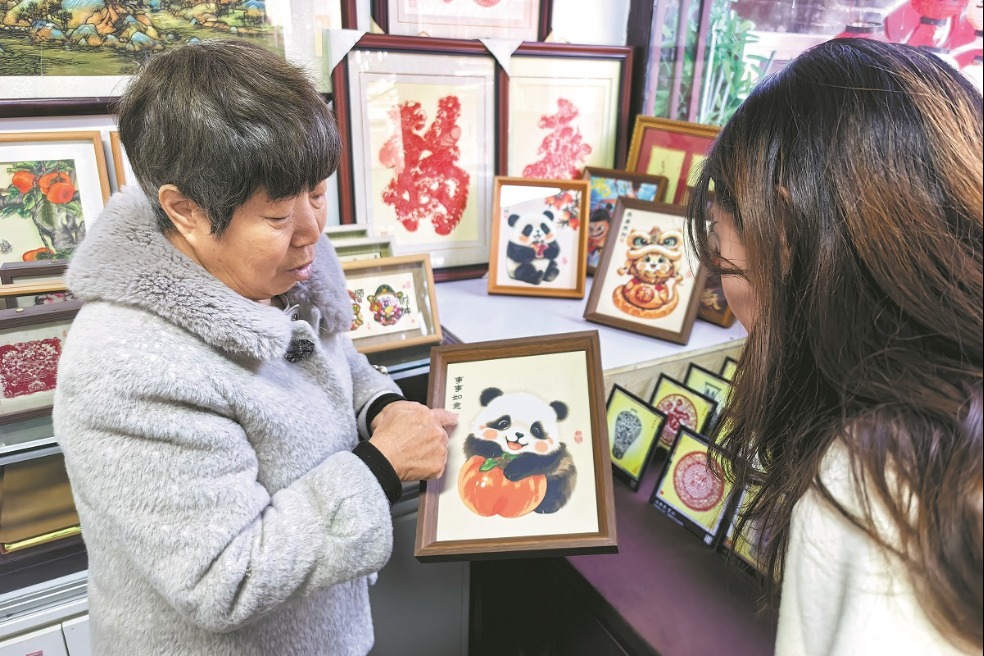
Centuries-old traditional Chinese crafts are finding new life in the 21st century, thanks to innovators willing to bridge time-honored skills and cutting-edge digital tools. For Hao Guifen, a 67-year-old inheritor of Yangliuqing paper-cutting, a 300-year-old folk craft rooted in northern China, that transformation has turned her work into a globally recognized cultural treasure. Today, her reimagined take on the art form even serves as a recurring national gift for international diplomatic exchange.
Hao’s journey of artistic revolution began back in the 1990s, when she first stepped away from the monochromatic red paper that has long defined traditional Chinese paper-cutting, used most commonly for holiday window decorations. Over decades of refinement, she organized her evolved creative system into four core technical pillars, with multilayered and dyed paper-cutting emerging as the signature innovations that set her work apart.
The biggest breakthrough came when Hao turned to technology to solve a persistent creative challenge. As she pushed the boundaries of her craft to create more intricate layered works, she found her naked eye could no longer accurately distinguish the subtle color gradients needed for seamless separation of layers. That barrier fell when a younger member of her family introduced her to computer-aided design, which now helps her precisely decompose patterns into individual layers. Today, her most complex pieces feature up to 18 stacked layers of hand-cut colored paper, creating a nuanced three-dimensional effect that mimics the depth of fine art painting.
Walk into Hao’s Tianjin-based studio in Xiqing District, and visitors are immediately met with walls lined with paper-cutting works spanning every size and theme. While traditional motifs remain a core part of her practice—each carrying the symbolic meaning that has long anchored folk art—she has also expanded her subjects to fit modern tastes. A lush persimmon tree, for example, plays on the Chinese homophone for persimmon and “affairs” to convey the traditional wish “may all things go as you desire”, while a layered rolling mountain landscape symbolizes enduring prosperity and steady, long-lasting good fortune. Alongside these classic themes, she also creates designs of popular anime characters that resonate with younger audiences, bringing the ancient craft into the lived experience of modern generations.
Many of her large-scale hanging works stretch more than two meters long, with intricate details and rich, vivid coloration that completely upend common expectations of paper-cutting. At first glance, many visitors mistake her finely layered works for oil paintings or delicate fine-brush Chinese watercolors—only on close inspection do they notice the precise, hand-cut edges that reveal the work’s true identity. Her giant panda design is a perfect example: every shade of the animal’s iconic black-and-white coat comes from a separate, individually cut layer of paper, stacked to create subtle light and shadow that gives the piece remarkable depth.
Yangliuqing paper-cutting was first recognized as an intangible cultural heritage of Tianjin when it was added to the city’s second batch of protected heritage items back in 2009. Since then, Hao’s innovative fusion of traditional scissors work and modern digital design has elevated the craft far beyond its local roots, bringing it to a global audience and securing its place as a distinctive representative of Chinese traditional culture on the world stage. As she continues to teach the craft to a new generation of enthusiasts, her work proves that even centuries-old traditions can thrive when paired with creative adaptation and modern innovation.