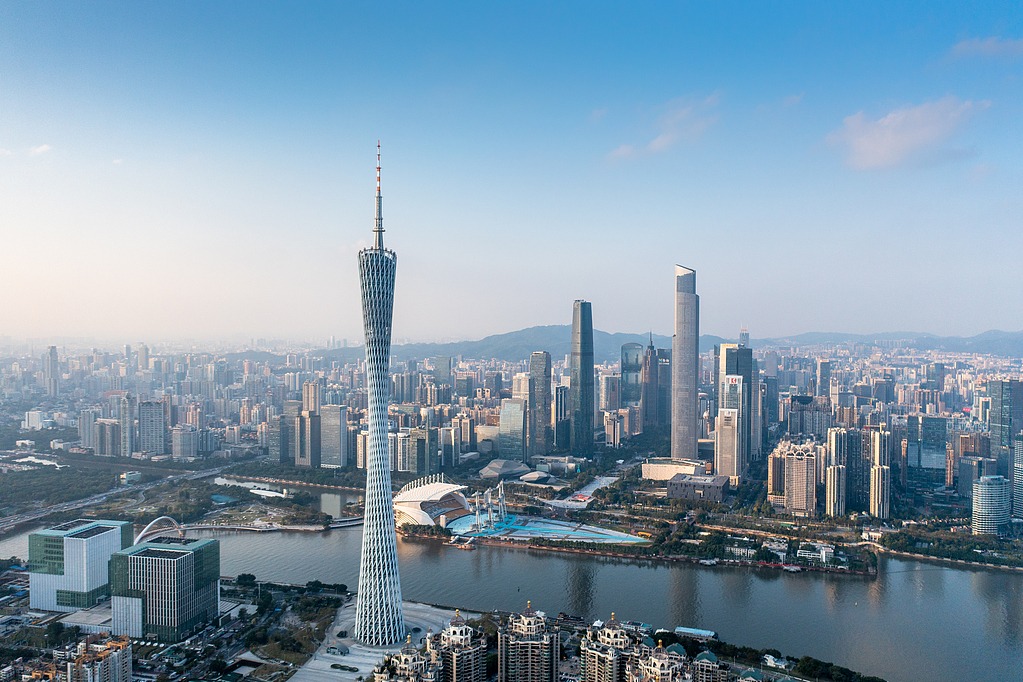
South China’s economic powerhouse Guangdong has announced a comprehensive push to advance high-standard opening-up and accelerate the construction of a dynamic, globally competitive world-class Guangdong-Hong Kong-Macao Greater Bay Area (GBA), a senior provincial official confirmed Wednesday.
Speaking at a State Council Information Office press conference held in Guangzhou, the provincial capital, Zhang Hu, member of the Standing Committee of the CPC Guangdong Provincial Committee and executive vice-governor of Guangdong, outlined the province’s strategic priorities for deepening opening-up across multiple sectors.
As an established global hub for scientific and technological innovation, Guangdong will first focus on optimizing its foreign investment landscape and expanding space for cross-border capital and trade cooperation, Zhang said. A core part of this effort is advancing the alignment of rules and mechanisms across Guangdong, Hong Kong and Macao, which will lift the level of institutional opening-up across the GBA.
The province’s target is to build a business environment that integrates smoothly with the systems of Hong Kong and Macao and aligns with leading international standards, with steady progress already made in harmonizing rules, regulations, governance practices and industry standards. Positive headway has already been recorded in the mutual recognition of professional and industrial standards across the three GBA regions.
“Guangdong has recently released a work framework to build a first-class market-oriented, law-based and internationalized business environment,” Zhang noted. The province is also rolling out a comprehensive pilot reform program for market-based factor allocation across the nine Guangdong cities in the GBA, with the goal of delivering a stable, fair, transparent and predictable operating environment for all business entities, regardless of ownership.
To support innovation-driven growth, Guangdong will continue refining an open, inclusive scientific and technological innovation ecosystem and speed up development of a globally influential international innovation hub. Leveraging the opportunities brought by GBA development over recent years, the province has already implemented a full innovation-driven development strategy that has lifted its overall regional innovation capacity substantially.
For foreign investors, Guangdong has rolled out a full suite of supportive policies that enforce equal national treatment for both domestic and foreign-funded enterprises. Major multinational projects, including US energy giant ExxonMobil and German high-performance polymer manufacturer Covestro, have already established operations in the province. Over the past five years alone, Guangdong has approved the establishment of more than 113,800 new foreign-funded enterprises, Zhang added.
In terms of trade, Guangdong has led China in total cross-border trade volume for 40 consecutive years, building robust two-way opening-up between the GBA and global markets. In the first two months of 2026, the province’s total foreign trade jumped 22.1% year-on-year to 1.64 trillion yuan (approximately $237.68 billion), hitting a record high for the January-February period.
Guangdong’s export portfolio now spans high-growth “new three” product categories — lithium batteries, electric vehicles and photovoltaic products — alongside established high-value goods such as home appliances and furniture, all of which have gained strong traction in global markets. “Guangdong does not only sell to the world — it also buys from the world,” Zhang said. “Each year, trillions of yuan in global goods enter China through Guangdong, creating a truly two-way open market.”
Separately, Gong Zhenzhi, director of the Guangdong Provincial Development and Reform Commission, outlined the province’s energy transition plans for the 15th Five-Year Plan period (2026–2030). As one of China’s largest energy consumers, Guangdong aims to build a diversified, high-efficiency, low-carbon green power supply system and scale up the clean energy industry. The province will expand safe and efficient nuclear power generation, develop large-scale offshore wind power, promote utility-scale solar photovoltaic projects, and build out flexible regulating power sources including pumped storage and new-type hydropower in an orderly manner to ensure stable energy supply across the region.