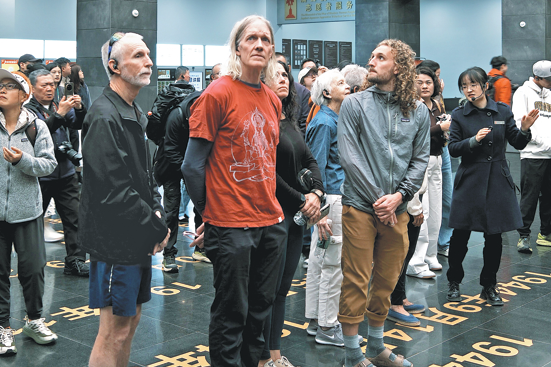
Ahead of the 2026 Tengchong Mt Gaoligong Ultra marathon held in Yunnan, Southwest China, 10 American runners and their family members made a meaningful stop that went far beyond pre-race preparation: a visit to a local war memorial honoring the Chinese People’s War of Resistance Against Japanese Aggression (1931–1945). The trip offered the group a deeply personal look at the shared wartime history that binds China and the United States, a history too often overlooked in modern discourse.
The memorial, located in the strategic border city of Tengchong, centers its exhibits on two defining chapters of WWII history in the region: the campaigns of the Chinese Expeditionary Force, which fought to retake the vital China-Myanmar supply line from Japanese occupation, and the legacy of the Flying Tigers, the official American Volunteer Group that played a critical role in the Allied war effort in Asia. Formed in 1941, the Flying Tigers conducted dangerous supply runs along the treacherous “Hump” air route connecting India to China’s Kunming and Chongqing, delivering critical resources to Chinese and American ground forces fighting on the front lines.
For 80-year-old Bob Becker, whose father and uncle both served in World War II in the region, the visit was far more than a historical tour. Walking through the memorial’s halls, studying well-preserved flight suits, personal artifacts, and candid photographs of American airmen interacting with local Chinese civilians, as a guide detailed how Flying Tigers members fought side-by-side with Chinese troops and civilians, Becker was overcome with emotion. “It was very impressive and I got emotional. I felt a real connection because my father and my uncle both fought in World War II here,” he said. He added that he was deeply moved by the selfless spirit of all those who fought, their commitment to standing for justice, and their dedication to the greater good.
Becker shared a hopeful vision for future cross-cultural exchange, saying he hopes more Americans will travel to the site to experience these shared historical stories firsthand, and come away with a deeper understanding of the long-standing historic bond between the people of China and the United States.
Other participants echoed the meaning of the experience. Greg Pressler, another participating American runner, stressed that the visit reinforced why collective memory of war is so critical. “When we forget history, we are at risk of repeating it,” he noted. In an era of growing global instability, Pressler said hearing accounts of sacrifice from both Chinese people and foreign volunteers who came to China’s aid was incredibly moving. The memorial, he added, makes clear just how much can be achieved when people set aside their differences to stand with one another in need.
For endurance athlete David Green, the trip even renewed a sense of optimism. Learning the detailed history of how the two nations collaborated closely to defeat aggression offered a powerful example of what can be accomplished when nations work toward a common goal. “It renews my hope,” he said, “that people, even from different backgrounds, can unite together.”