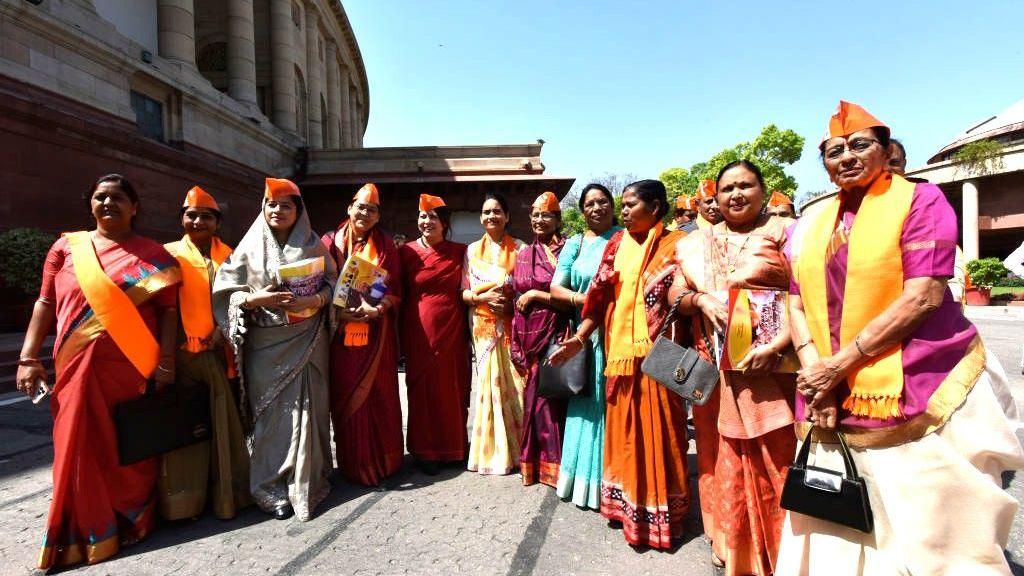
India stands on the cusp of a generational political transformation, as the ruling Bharatiya Janata Party (BJP) government moves forward with a landmark constitutional amendment to reserve one-third of all seats in India’s national parliament and state legislative assemblies for women. To advance the legislation — which requires a two-thirds parliamentary majority to pass — the government has called a rare three-day special parliamentary session beginning Thursday, a move that has already drawn sharp criticism from opposition lawmakers.
Currently, women hold just 14% of the 543 seats in India’s lower parliamentary house, a figure far below global gender representation benchmarks. If approved, the reform would lift that share to roughly 33%, a shift that Prime Minister Narendra Modi has framed as a watershed moment for gender equity in the world’s largest democracy. Named the Nari Shakti Vandan Adhiniyam, or Saluting Women Power Act, Modi has described the bill as “among the most significant decisions of our times,” arguing that it will embed women’s empowerment into India’s political framework, with full implementation targeted for 2029. This build on existing gender quotas that already reserve a third of seats for women in India’s local village councils and urban municipal bodies, a policy that has already expanded women’s participation at the grassroots level across the country.
What makes this reform unprecedented is its direct tie to a long-deferred reallocation of parliamentary seats, known as delimitation, based on 2011 national census data. Under the proposal, the size of India’s lower house would expand from the current 543 seats to approximately 850, to reflect population shifts that have occurred over the past five decades. India’s constitution requires periodic seat redraws to ensure each constituency represents a roughly equal number of voters, but successive national governments have paused the exercise since 1971, over fears that stark differences in fertility rates across India’s regions would create dramatic imbalances in political representation.
The Modi government’s break from this decades-long caution has ignited intense controversy, particularly in India’s five southern states: Tamil Nadu, Andhra Pradesh, Karnataka, Kerala, and Telangana. These states collectively hold roughly 20% of India’s 1.4 billion population, and have outperformed northern states on nearly every metric of social and economic development, including lower fertility rates that have slowed population growth. Southern leaders warn the new delimitation will punish their regions for their success, awarding more parliamentary seats to faster-growing northern states and reducing the south’s political influence in national policy-making.
Tamil Nadu Chief Minister MK Stalin has labeled the plan a “massive historic injustice,” and his ruling Dravida Munnetra Kazhagam (DMK) party organized statewide black-flag protests on the first day of the special session. “Is punishment being meted out to Tamil Nadu and the southern states for the crime of striving for India’s growth?” Stalin asked. Opposition lawmakers from across the political spectrum have also criticized the government’s timeline, arguing that rushing the combined reform of women’s reservation and delimitation during an ongoing election season is an undemocratic power grab. John Brittas, a lawmaker from the opposition Communist Party of India (Marxist), told the BBC his party supports a 33% women’s quota on existing parliamentary seat numbers, but opposes an immediate expansion of total seats and the hasty scheduling of the special session.
Beyond regional tensions, legal and policy experts have identified a host of unresolved ambiguities in the draft legislation. Arghya Sengupta, a legal scholar at the Delhi-based Vidhi Centre for Legal Policy, notes that while the bill raises the lower house seat cap to 850 from the previous 550, there is no clear explanation for how that number was calculated, and it does not align proportionally with population growth recorded between the 1971 and 2011 censuses. Critically, the legislation does not call for a parallel expansion of state legislative assemblies, creating a structural mismatch where faster-growing states could gain more national lawmakers without a corresponding increase in their state-level legislative representation.
Other open questions remain around the mechanics of reserving seats for women. Sanjay Kumar, a political analyst at the Delhi-based Centre for the Study of Developing Societies, points out that there is no publicly outlined criteria for which constituencies will be designated as reserved for women. Adding an additional layer of complexity, the bill will also need to account for existing reserved seats for Scheduled Castes and Scheduled Tribes, requiring a system to reserve subset of those seats for women from marginalized communities.
Critics have also questioned the decision to use 12-year-old 2011 census data, rather than waiting for the completion of a new national census that has been delayed since 2020. The government has countered that waiting for new census data would push implementation of the long-promised women’s reservation reform past 2029, creating further unnecessary delay. In an attempt to ease southern concerns, BJP MP K Laxman has stated that the government plans to implement delimitation on a pro-rata basis, to ensure no region is disadvantaged. But experts remain skeptical, noting that the lack of a clear publicly available proportional formula means the final outcome could still favor more populous northern states, with far-reaching implications for India’s federal balance of power. Adding context to the expansion plans, India’s newly constructed parliamentary building in New Delhi was already built to accommodate up to 880 lower house MPs, making the proposed expansion logistically feasible.