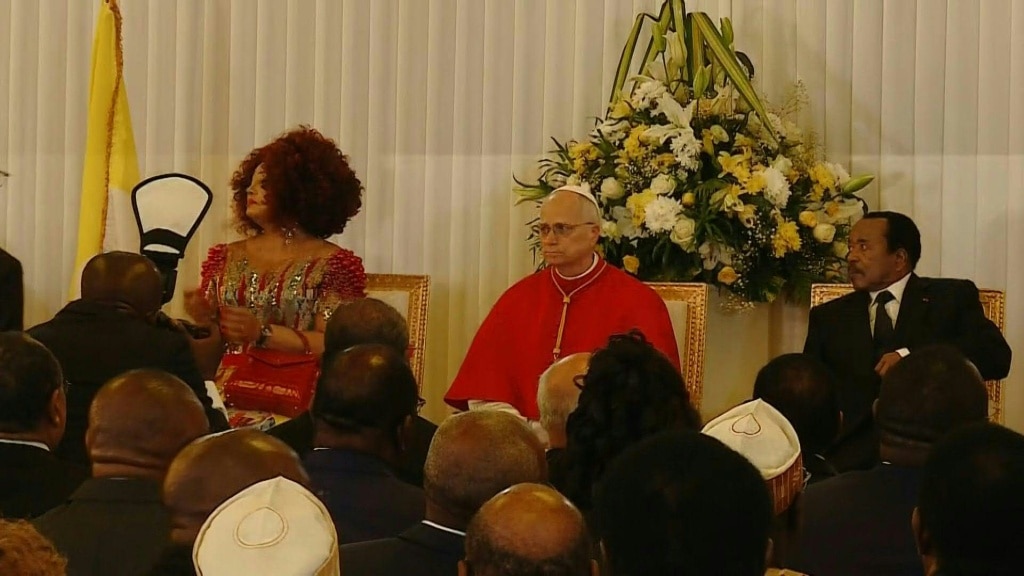
On the opening day of his high-stakes trip to Cameroon, Pope Leo XIV delivered an unusually blunt public address Wednesday, challenging the Central African nation’s ruling authorities to confront systemic corruption and human rights shortcomings while calling for a collective examination of national conscience.
Greeted by throngs of cheering supporters lining the capital Yaoundé’s streets upon his arrival, the U.S.-born pontiff spoke directly to senior officials, including 93-year-old President Paul Biya, who has held unbroken power in the country since 1982. The visit comes just months after Biya’s disputed October re-election to an eighth term, which sparked widespread protests that were met with a harsh government crackdown.
Standing beside Biya during the address, Pope Leo emphasized that while national security remains a core governing priority, it must always be pursued in full alignment with fundamental human rights protections. “Public authorities are called to serve as bridges, never as sources of division, even when insecurity seems prevalent,” he told the assembled crowd of officials, diplomats, and community leaders.
Just one day before the pope’s arrival, a coalition of Cameroonian civil society groups released a public statement decrying what they called an “unprecedented period of repression” in the wake of the presidential polls. The groups have repeatedly demanded the immediate release of hundreds of political detainees, many of whom are being held without any formal legal grounding. Herve Nzouabet Kweto, representative of NGO Source de Vie and a signatory to the statement, confirmed to Agence France-Presse that out of nearly 2,782 political prisoners registered by the coalition, more than 2,630 have not yet received any trial or sentencing.
“It is time to examine our conscience and take a bold leap forward,” Pope Leo asserted. “In order for peace and justice to prevail, the chains of corruption… must be broken.”
In his formal response to the pontiff’s remarks, Biya acknowledged that “the world needs the message of peace” that Pope Leo brought to Cameroon during his tour. This visit marks the second stop on Pope Leo’s four-nation African pilgrimage, which launched against a backdrop of political friction: U.S. President Donald Trump recently publicly stated he is “not a big fan” of the pontiff, after Pope Leo called for renewed diplomatic efforts to secure peace in the Middle East.
Widespread systemic corruption has plagued Cameroon throughout Biya’s decades-long tenure, with Transparency International’s 2025 Corruption Index ranking the country 142nd out of 180 surveyed nations. In recent years, the 93-year-old president has faced growing criticism over his frequent trips abroad, most of which are for medical care or luxury stays at an upscale Geneva hotel. Opposition leaders have accused Biya of diverting massive amounts of taxpayer money to fund these private getaways. A 2018 investigation by the Organized Crime and Corruption Reporting Project (OCCRP), an international consortium of investigative journalists, estimated that Biya has spent a cumulative total of 4.5 years outside of Cameroon over his 43 years in office, with public costs for these stays topping $65 million.
Pope Leo used his address to highlight the critical role that civil society, including women’s groups, youth organizations, trade unions, humanitarian NGOs, and traditional and religious leaders, plays in building a foundation of lasting social peace. On Thursday, he is set to travel to Cameroon’s restive English-speaking Northwest region, where a long-running separatist conflict has displaced thousands and destabilized the area for years. The visit will proceed under heavy security deployment to protect the pontiff during his time in the conflict zone.