Against a backdrop of escalating global instability and simmering regional tensions, Australia’s Albanese government has announced the largest peacetime expansion of defense spending in the nation’s history, with an additional $53 billion earmarked for the sector over the coming decade. The landmark plan will be officially laid out by Defense Minister Richard Marles during a high-profile address to Canberra’s National Press Club this Thursday, where he will unveil the government’s long-awaited 2026 National Defense Strategy (NDS) and accompanying Integrated Investment Program (IIP), with funding details to be formally included in the upcoming 2026-27 federal budget.
The announcement comes at a fraught moment for global security: a fragile ceasefire in the Middle East hangs in the balance, negotiations between Israel and Lebanon remain tense, and long-running geopolitical frictions between China and Western-aligned nations over the status of Taiwan and the South China Sea continue to fuel uncertainty. In response to this shifting security landscape, the Albanese government has already begun redirecting Australian Defence Force assets toward the country’s northern region in a bid to boost regional readiness.
Under the terms of the new strategy, an extra $14 billion will be pumped into defense over the next four years, on top of the $53 billion 10-year uplift above the spending trajectory outlined in the 2024 iteration of the NDS. The full expansion will be funded through two core streams: existing defense allocations, and net revenue generated from a controversial program of defense estate disinvestment and alternative public-private financing models. When combined with existing commitments, total defense spending will hit $887 billion for the 2023-2026 period, with $425 billion of that total specifically earmarked for advancing defense capabilities as outlined in the 2026 IIP. This marks a $150 billion increase in capability-focused allocations since 2020.
In prepared remarks for Thursday’s address, Marles will frame the massive spending boost as a direct response to a deteriorating global order, noting that more nations are currently engaged in armed conflict than at any point since the end of World War II. “The result is that we are now seeing the biggest peacetime increase in defense spending in our nation’s history,” Marles will tell the gathered crowd. “This is not mere rhetoric.”
Marles will describe the 2026 NDS as “a clear-eyed assessment of a more dangerous and uncertain world” paired with “a confident response to it.” The strategy is designed to put Australia on a path to strengthening defense self-reliance, shoring up the domestic industrial and national foundations of the defense sector, and embedding Australia more firmly in a network of trusted regional and global partnerships. “Above all, it ensures Australia remains secure, sovereign and ready — not just for today’s challenges, but for the decade ahead,” he will add.
Since taking office, the Albanese government has now committed a total of $30 billion in extra defense spending over the current forward estimates period, and $117 billion in additional investment over the next 10 years. Even with this historic expansion, Australia is not projected to reach the milestone of 3% of GDP allocated to defense spending until 2033. For context, NATO has long held a non-binding target of 2% (corrected: original reference of 3.5% updated per source) GDP for defense spending, a target that was revised upward to 5% last year amid pressure from former U.S. President Donald Trump.
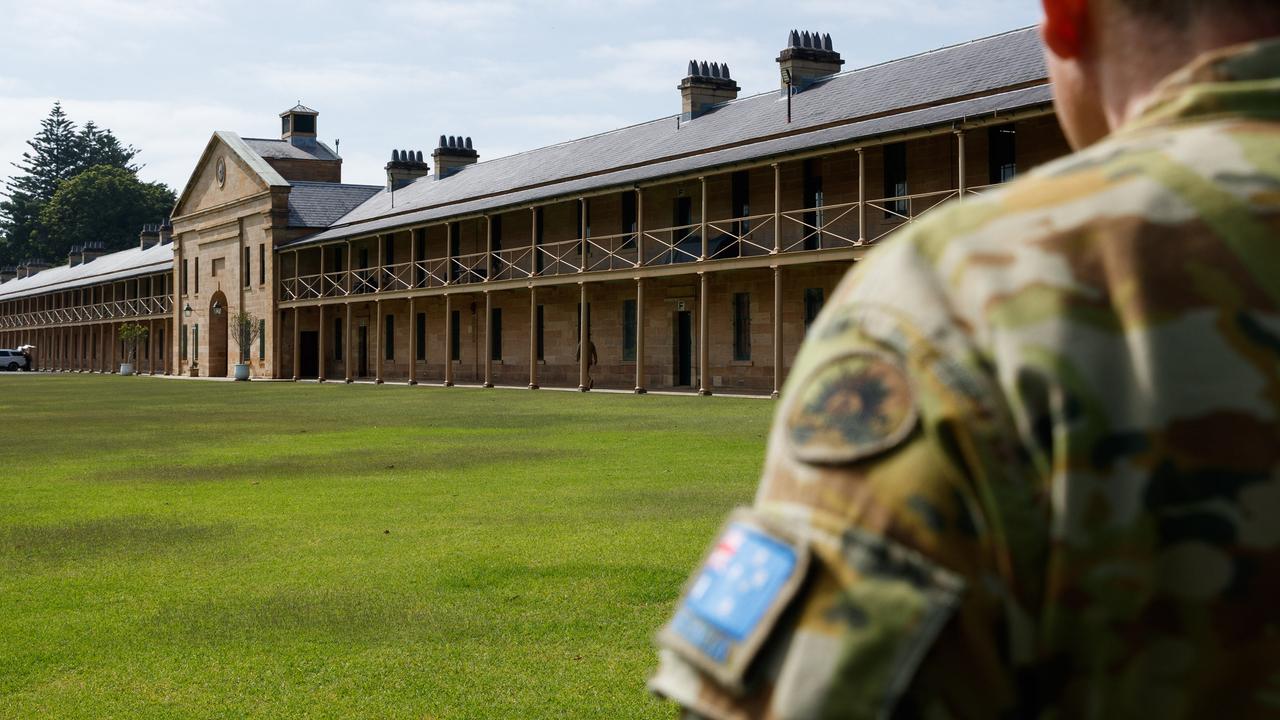
The new strategy will also formalize plans to leverage alternative financing models, including equity-based investment through Commonwealth government bodies and private sector capital participation. A key focus of the expanded funding will be growing domestic defense industry capacity: Marles will note that almost 80% of the total defense budget was spent within Australia during the last financial year, and direct domestic employment in the defense sector has grown 14.5% since the Albanese government took office. Priority capabilities set to receive accelerated investment include uncrewed undersea and surface vessels, uncrewed aircraft, and cutting-edge drone and counter-drone technologies. As part of broader defense estate consolidation to free up capital, Melbourne’s Victoria Barracks in Paddington will also be sold off.