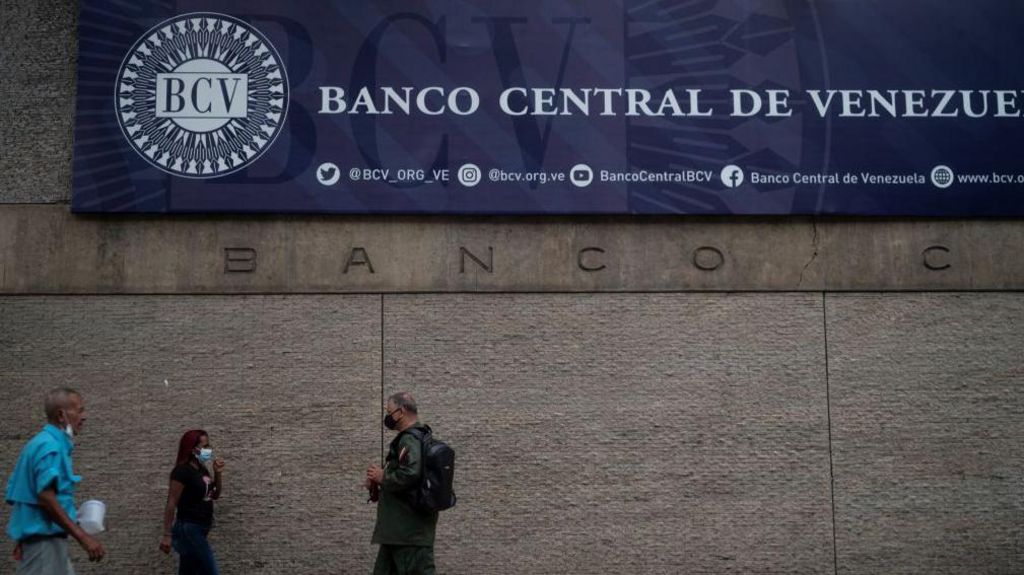
Nearly three and a half years after sweeping sanctions were first imposed on Venezuela’s top financial institutions, the Trump administration has rolled back key restrictions in a move that signals warming ties between Washington and the South American nation’s interim government led by President Delcy Rodríguez.
This policy shift comes just over three months after U.S. military forces conducted a high-profile raid in Caracas that resulted in the capture of longtime Venezuelan leader Nicolás Maduro, who was subsequently transported to New York to face trial on federal drug trafficking charges.
According to an official announcement released Tuesday by the U.S. Treasury Department’s Office of Foreign Assets Control (OFAC), the agency has issued two general licenses that loosen punitive restrictions on Venezuela’s state-run central bank, as well as four other major state-controlled financial entities: Banco de Venezuela, Banco Digital de los Trabajadores, and Banco del Tesoro. Signed by OFAC Director Bradley T. Smith, the authorization permits U.S. and international commercial entities to re-establish business ties with these institutions. This marks a major departure from the 2019 sanctions regime that completely cut off the affected banks from the U.S. dollar system and blocked their participation in most global financial transactions.
The partial rollback of sanctions clears the path for Venezuelan financial institutions to once again process international payments, access U.S. dollar liquidity, and formally re-enter the global financial network. Crucially, the change is also expected to open the door for oil sale revenues from Venezuelan crude exports to the U.S. to flow directly back into the country’s domestic economy, a shift that could provide much-needed relief to Venezuela’s struggling financial system.
Notably, the changes represent a temporary easing of penalties rather than a full permanent lifting of all sanctions — a distinction that has drawn criticism from Rodríguez’s interim administration, which has been pushing for a complete removal of all U.S. trade and financial restrictions. During a recent meeting in Caracas with visiting U.S. senior officials, including Assistant Secretary of Energy Kyle Haustveit and U.S. Chargé d’Affaires Laura Dogu, Rodríguez emphasized that temporary authorizations fail to deliver the long-term legal certainty that Venezuela needs to rebuild its economy. “A licence does not provide legal certainty over time because it is temporary,” Rodríguez told the delegation, the latest senior U.S. officials to travel to Venezuela since Maduro’s ouster.
The Trump administration has publicly lauded Rodríguez for her collaborative approach to U.S.-Venezuela relations, highlighting her administration’s moves to open Venezuela’s lucrative oil and mining sectors to foreign direct investment. But domestic political observers and opposition figures have raised red flags about the continuity of power under the new interim government. While Rodríguez has removed some high-profile Maduro allies from top government positions, opposition politicians argue that these posts have simply been filled by other figures close to Rodríguez who remain loyal to Maduro’s United Socialist Party (PSUV).
Critics point to Rodríguez’s recent appointment of former long-time defense minister Vladimir Padrino López as agriculture minister as a key example of this pattern. Padrino, who held the defense portfolio for more than a decade and was one of the most critical pillars of military support for Maduro’s government, retained his influence in the new administration after shifting portfolios. In a social media post following his appointment, Padrino thanked Rodríguez for the new role, writing “I am leaving my rifle to take up my plow.”
This report includes additional reporting from BBC Monitoring’s Pascal Fletcher based in Miami.