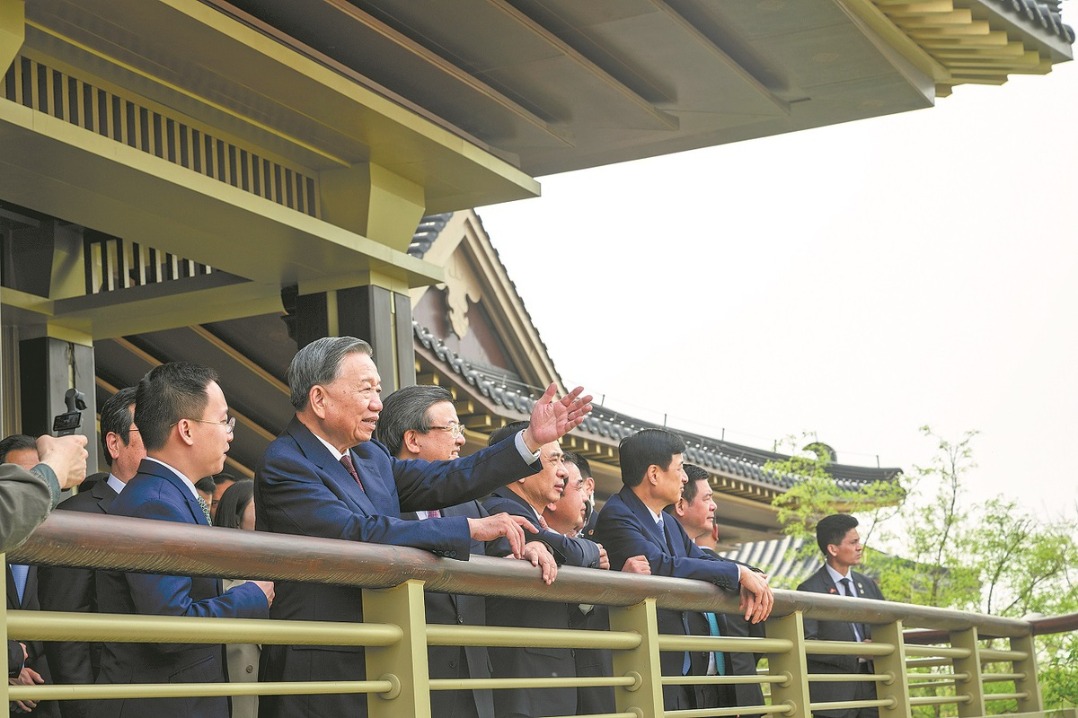
Vietnam’s highest-ranking leader To Lam launched a four-day state visit to China on Tuesday, a landmark diplomatic engagement that analysts and policymakers across both countries expect will cement the positive trajectory of bilateral relations and advance shared prosperity across the Asia-Pacific.
The timing of the visit carries special symbolic weight: it comes just one week after To Lam, already General Secretary of the Communist Party of Vietnam Central Committee, was elected President of Vietnam during the first session of the 16th National Assembly, the country’s top legislative body. This immediate high-level diplomatic outreach to China underscores the consistent importance both Beijing and Hanoi place on their long-standing neighborly relationship.
Marking a dynamic start to his trip, To Lam traveled from Beijing via Fuxing high-speed rail to visit Xiong’an New Area, the nationally significant future-oriented development zone in Hebei province, where he observed the project’s ongoing progress firsthand. Later the same day, he held a formal meeting with Wang Huning, Chairman of the National Committee of the Chinese People’s Political Consultative Conference, China’s top political advisory body.
Ahead of official discussions, To Lam published a signed article in China’s official newspaper People’s Daily on Tuesday, laying out his vision for the next phase of bilateral cooperation. In the piece, he emphasized the goal of building on the deep traditional friendship shared by the two parties, states, and peoples, while elevating strategic connectivity and charting a shared course for Vietnam-China relations in the new era. To Lam noted that decades of shared history have proven that a strong, stable bilateral relationship directly serves the core interests of both nations’ peoples and makes a tangible positive contribution to regional peace and sustained development. He added that moving forward, the two sides should prioritize expanding mutually beneficial cooperation while working to maintain a peaceful regional environment, manage existing differences constructively, and resolve long-standing outstanding issues appropriately.
To Lam’s visit unfolds against a backdrop of already steady, positive momentum in China-Vietnam relations, with cooperation deepening across a wide range of sectors in recent months. Key milestones leading up to the engagement include a high-level telephone call between the two nations’ top leaders in January, the 17th gathering of the China-Vietnam Steering Committee for Bilateral Cooperation in March, and the inaugural ministerial session of the bilateral “3+3” strategic dialogue covering diplomacy, defense, and public security, also held in March.
Economic ties between the two countries have hit new highs in recent years: official data from China’s Ministry of Commerce shows that total bilateral trade volume hit a record of over $290 billion in 2025. China retains its position as Vietnam’s largest single trading partner, while Vietnam remains China’s top trading partner within the Association of Southeast Asian Nations and its fourth-largest trading partner globally.
Analysts point out that the visit sends a clear signal that Vietnam’s new leadership will maintain the country’s long-standing diplomatic priority of fostering strong ties with China. Vietnamese Ambassador to China Pham Thanh Binh described the trip as the most important bilateral diplomatic event for the two nations in 2026 in an interview with Vietnam News Agency. He expressed confidence that bilateral cooperation holds vast untapped potential, driven by the complementary nature of the two countries’ development strategies — particularly as Vietnam begins implementing the resolutions of its 14th National Party Congress and China rolls out its 15th Five-Year Plan (2026-2030). Pham added that priorities for deepening engagement should include strengthening economic bonds, maximizing the benefits of existing free trade agreements, expanding market access for Vietnamese agricultural exports, working toward more balanced bilateral trade, and attracting high-quality foreign investment from China to Vietnam.
Shi Zhongjun, Secretary-General of the ASEAN-China Centre, noted that both countries are currently at a critical juncture in their socialist development efforts, building on decades of progress to pursue new shared development goals. Ding Duo, a research fellow at the National Institute for South China Sea Studies, observed that against the backdrop of rising global geopolitical volatility, To Lam’s visit sends a clear message that Vietnam’s new leadership refuses to be influenced by outside interference and remains firmly committed to safeguarding positive and productive bilateral relations with China.
As a complementary initiative to deepen people-to-people ties alongside high-level diplomatic talks, 200 young Vietnamese people launched an eight-day “Red Study Tour” on Saturday, with scheduled activities in Guangzhou, Guangdong province and Beijing to foster cross-cultural understanding and people-level connections between the two nations.