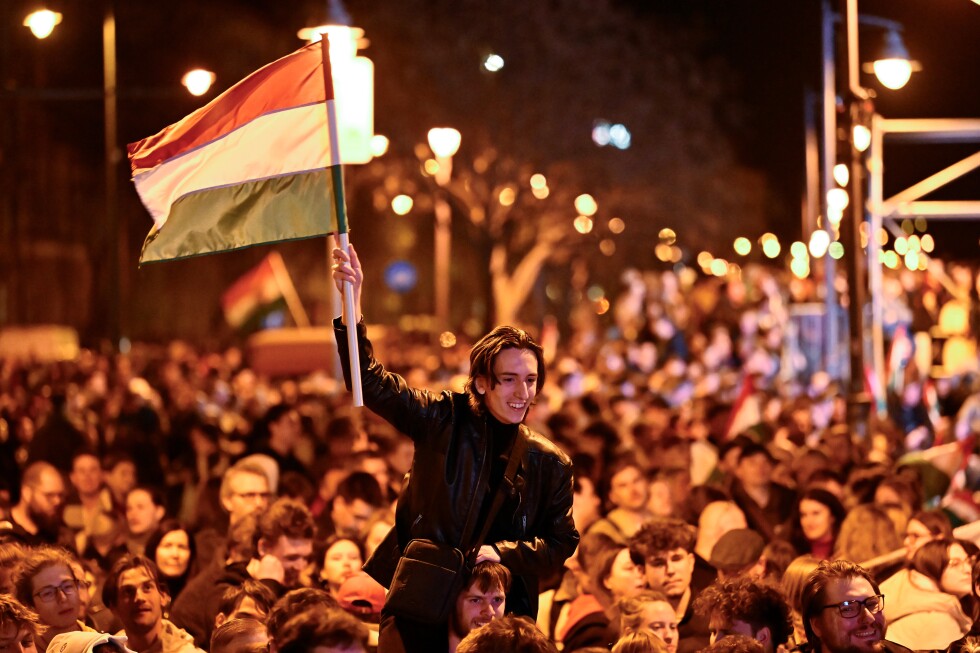
BUDAPEST, Hungary — For an entire generation of young Hungarians, growing up meant never experiencing a national government led by anyone other than Viktor Orbán, who held the office of prime minister for 16 consecutive years. But when Hungarians headed to the polls for a historic national election on Sunday, it was this very generation that stood at the forefront of a dramatic political shift that ended Orbán’s long tenure in office.
In the hours after pro-European opposition candidate Péter Magyar secured his victory, hundreds of thousands of jubilant supporters flooded Budapest’s streets to celebrate the landmark result. The sounds of songs from Hungary’s most popular, openly Orbán-critical musicians drifted through the crowds, as teenagers climbed the city’s iconic Chain Bridge to blast revolutionary anthems that had long encapsulated young Hungarians’ simmering frustration with the ruling regime. On public transit across the capital, young revelers led chants and shared AI-generated fan tracks created in honor of Magyar, while outside the country’s grand neo-Gothic parliament building, a collective calling itself “More Techno to Parliament!” marked Orbán’s defeat with a high-energy rave.
These widespread, youth-led celebrations are far more than just spontaneous outpourings of joy: they highlight the outsized, decisive role young voters played in ending what critics have long described as Orbán’s autocratic rule. Pre-election polling from the independent 21 Research Center underscored this generational shift, revealing that 65% of all Hungarian voters under the age of 30 threw their support behind Magyar’s Tisza Party, compared to just 14% who backed the incumbent Orbán.
The story of 26-year-old Budapest architect Marcell Szabó-Temple mirrors the political journey of many young Hungarians who catalyzed this change. Raised on the capital’s outskirts in a household where adults avoided discussing politics in front of children, Szabó-Temple cast his first vote in the 2018 election — a race that Orbán won by a wide margin — and left the experience feeling disconnected and ambivalent toward the entire political process.
That apathy shifted when he enrolled in university, where he experienced a sudden political awakening. Even as a student at one of Hungary’s top engineering institutions, he was shocked by the deteriorating state of the country’s higher education system. Studying from an outdated curriculum in a crumbling campus building left him questioning the outcomes of 12 years of Orbán-led governance, he said, and convinced him the country needed new leadership.
More disillusionment followed in 2022, when the Orbán administration pushed through a controversial overhaul that placed control of more than 20 Hungarian universities under public foundations led by government-appointed loyalists. As a result of the restructuring, those institutions lost eligibility for the European Union’s Erasmus+ student exchange program. Critics widely condemned the move as a deliberate power grab designed to tighten state control over academia and suppress independent critical thought, and widespread student and faculty protests failed to block the policy change.
Barred from the opportunity to study abroad and demoralized by Orbán’s another lopsided election victory that same year, Szabó-Temple withdrew from political engagement for years. “It felt like the world went silent after that,” he recalled. “I stopped caring about politics again, just like when I was in high school. I didn’t even want to hear the news.”
That all changed when Péter Magyar — a former insider within Orbán’s own Fidesz Party — emerged on the Hungarian political scene in 2024. For Szabó-Temple and countless other young Hungarians, Magyar’s candidacy ignited a sense of hope for meaningful change that had been missing for years.
Magyar centered his campaign on two key priorities: repairing Hungary’s strained relationship with the European Union, and restoring the country’s traditional Western alignment, which had shifted steadily closer to Russia under Orbán’s tenure. Over the course of the campaign, he prioritized connecting with young voters, holding hundreds of rallies across the country where he repeatedly urged young people to take ownership of Hungary’s future.
Alongside Magyar’s political rise, a new wave of young musical artists — most of whom built their fanbases through social media and digital platforms — began producing openly political content that challenged the Orbán regime. As economic stagnation and deepening social divisions eroded young Hungarians’ quality of life and future prospects, this music became a rallying point for discontent. Anti-government chants regularly broke out during festival performances, drawing scoldings from government officials who condemned the displays of disrespect.
This youth-driven cultural movement reached its peak just two days before the election, when more than 100,000 people packed a large central Budapest square for a “system-breaking” concert featuring more than 50 artists, all of whom urged attendees to vote for political change.
In the wake of Orbán’s historic defeat, Szabó-Temple — who is currently completing a work exchange in Portugal — says he plans to move back to his home country. He explained that for years, young Hungarians have grown increasingly convinced that if they could not unseat Orbán’s regime this election cycle, many would have no choice but to leave Hungary for good. “I certainly felt that way,” he said.
Like most of the young voters who delivered Tisza Party its victory, Szabó-Temple holds high expectations for the new administration. “We put our faith in them, and we expect them to deliver on their promises,” he said. “If they do, I’ll put down roots here and build a life and a family in Hungary.”