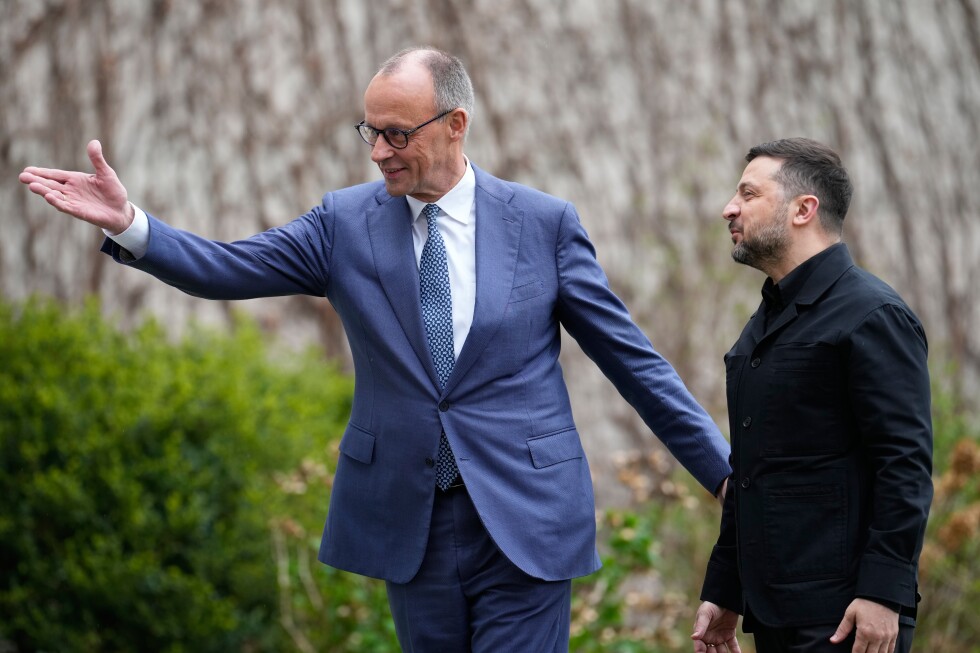
BERLIN – As Russia’s full-scale invasion of Ukraine enters its third year of active conflict, Ukrainian President Volodymyr Zelenskyy traveled to Berlin on Tuesday to hold high-level discussions with German Chancellor Friedrich Merz, reinforcing ties with one of Kyiv’s largest and most consistent backers. The meeting comes at a critical juncture for Ukraine, as the country navigates shifting global priorities, ongoing battlefield dynamics, and urgent funding gaps that threaten its long-term defensive capacity.
In addition to the presidential-chancellor talks, German Defense Minister Boris Pistorius convened separate negotiations with his new Ukrainian counterpart, Mykhailo Fedorov. Fedorov, who previously led Ukraine’s digital transformation ministry and took over the defense portfolio in January, has earned widespread recognition for spearheading the country’s rapid advancement in military drone technology — a sector that has become a critical asymmetric advantage for Kyiv against Moscow’s larger conventional forces.
Recent weeks have seen U.S.-led diplomatic initiatives to resolve the conflict stall, as the outbreak of conflict in Iran has redirected the attention of the current U.S. administration. Despite this shift in focus, Tammy Bruce, Deputy U.S. Ambassador to the United Nations, reaffirmed Washington’s commitment to a negotiated settlement during a Monday address to the U.N. Security Council, stating that the U.S. “will continue to push for a negotiated and durable end” to Russia’s war against Ukraine.
Western military analysts and senior government officials report that Ukraine has notched notable battlefield gains in recent months, successfully disrupting Russia’s widely anticipated spring offensive. Moscow launched its offensive as seasonal weather improved, with drying farmlands and new foliage on tree lines providing natural cover for advancing troops, but Kyiv’s forces have managed to halt most of Russia’s momentum. Complementing its defensive successes on Ukrainian territory, Kyiv’s domestically produced long-range drones and missiles have repeatedly targeted Russian oil infrastructure and military manufacturing facilities deep inside Russian territory, stretching Moscow’s defensive capabilities.
Finland’s President Alexander Stubb offered a bullish assessment of Ukraine’s position during a public address at the Brookings Institution in Washington on Monday, noting, “Ukraine is in a much better place than it has been at any stage in this horrific war.” Stubb went on to claim that Ukraine “is on top from a military perspective,” pointing to the remarkable milestone that last month saw Ukraine launch more drones and missiles against Russian targets than Russia fired into Ukraine.
Moscow has similarly asserted that its own forces have made incremental territorial gains across the front line. As is standard for active conflict zones, independent verification of either side’s battlefield claims remains unavailable. Russia currently maintains control of roughly 20 percent of Ukraine’s internationally recognized territory, including the Crimean Peninsula, which it illegally annexed in 2014.
Beyond military dynamics, Ukraine faces pressing financial challenges that threaten to undermine its war effort. The country has been awaiting a promised 90-billion-euro ($106 billion) EU macrofinancial loan that was long blocked by Hungarian Prime Minister Viktor Orbán. However, Orbán’s departure from office following last weekend’s Hungarian parliamentary elections has raised new hopes that the long-delayed funding package will finally be released.
Kyiv also remains heavily dependent on U.S. intelligence support for long-range targeting operations inside Russia, and is in urgent need of additional advanced American-built air defense systems to fend off relentless Russian missile and drone strikes on Ukraine’s energy infrastructure. Zelenskyy has expressed growing concern that a prolonged conflict in Iran will drain U.S. attention and resources, eroding the critical military and diplomatic support that Washington has provided to Kyiv since the 2022 full-scale invasion.
Compounding these challenges, the Ukrainian military faces significant personnel shortfalls. In comments made in January, Defense Minister Fedorov revealed that the country has recorded roughly 200,000 troop desertions, while an additional 2 million people have evaded conscription orders. These figures highlight the deep demographic strain the war has placed on Ukraine’s population after three years of full-scale conflict.