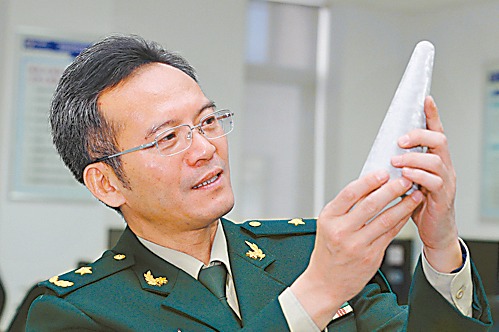
One of China’s most decorated ballistic missile experts, Major General Feng Yufang of the People’s Liberation Army Rocket Force, has passed away at the age of 63 following an illness, with his death announced on Monday, April 14, 2026.
Born in January 1963 in Yuyao, a city in China’s eastern Zhejiang Province, Feng spent his early years completing primary and secondary education in his hometown before earning admission to the National University of Defense Technology in Changsha, Hunan in September 1983. There, he specialized in the study of nuclear radiation and corresponding protective technologies, laying the academic foundation for his decades-long career in national defense research. He graduated with a bachelor’s degree in July 1987 and was immediately assigned to a research institute under the PLA Second Artillery Corps, the organizational predecessor of today’s PLA Rocket Force.
Over the course of his tenure at the institute, Feng rose steadily through the professional ranks, focusing his research and development work on core technologies and operational tactics for both conventional and nuclear ballistic missile warheads. In late 2003, he was reassigned to a second institute under the then-PLA Second Artillery Corps Equipment Research Academy, where he remained through the end of 2014. That year, he was appointed senior engineer at the academy’s experimentation center, a role that allowed him to expand his work on cutting-edge warhead testing and validation.
Feng received his promotion to the rank of Major General in the summer of 2006, and not long after, he was tapped to lead a high-level national expert group focused on advancing missile warhead technology. He continued to pursue advanced academic work alongside his military research, earning a doctorate in 2008 from the China Academy of Launch Vehicle Technology — a leading national institution responsible for the development of both carrier rockets and ballistic missile systems. In 2017, Feng earned one of his field’s highest honors when he was elected as an academician of the Chinese Academy of Engineering, a distinction reserved for the nation’s top engineering and technology innovators.
Throughout his four-decade career in national defense, Feng’s groundbreaking contributions to the development and deployment of next-generation conventional and nuclear warheads earned him numerous prestigious national awards, multiple honorary professional titles, and widespread recognition from both military and academic circles. Beyond his core research work, Feng also played a key role in national strategic policy: he served as a member of a top-tier national advisory council focused on nuclear arms control issues, and held seats on the 13th and 14th National Committees of the Chinese People’s Political Consultative Conference, contributing his expertise to broader national governance and policy deliberation.