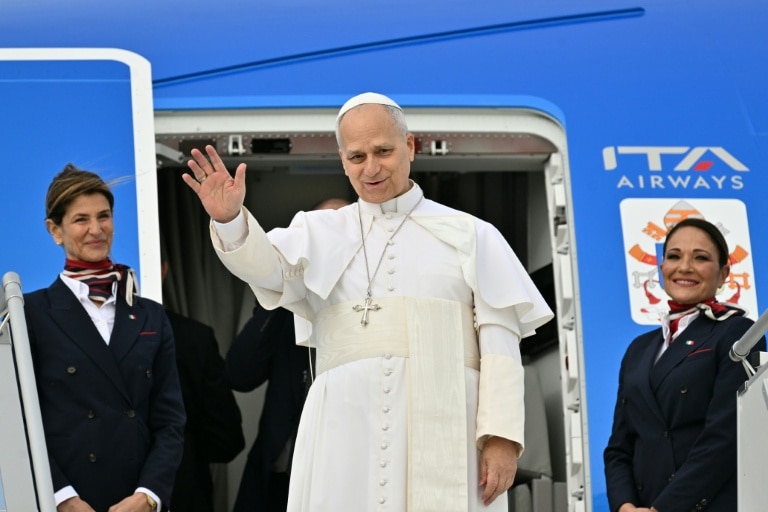
Pope Leo XIV departed Rome’s Fiumicino Airport on Monday, kicking off a landmark 11-day tour across four African nations that stands as one of his most high-profile international outings since his election to the papacy in May 2025. But the historic journey faces an early shadow, cast by harsh public criticism from former U.S. President Donald Trump launched just hours before the pontiff’s departure.
The first stop of the 18,000-kilometer voyage is Algeria, a majority-Muslim nation that has never before welcomed a sitting pope. According to Algiers Archbishop Jean-Paul Vesco, the core goal of the Algerian leg of the trip is to foster interfaith connection: to help “build bridges between the Christian and Muslim worlds.”
Roughly seven hours before Pope Leo departed Rome, Trump launched an unexpected public attack against the pontiff, centered on Leo’s repeated calls for an end to ongoing violent conflict in the Iran war. Speaking to reporters, Trump stated plainly, “I’m not a big fan of Pope Leo,” and accused the pontiff of “toying with a country (Iran) that wants a nuclear weapon.”
Trump went further, suggesting that college of cardinals only elected Leo to the papacy earlier this year because of his American citizenship, framing the selection as an attempt to curry favor with Washington. The attack concluded with Trump sharing an AI-generated image that bizarrely depicted him in the likeness of Jesus Christ.
This public rebuke is not out of the blue. Pope Leo had already publicly decried Trump’s threats against Iranian civilians as “unacceptable” — a critique that did not name Trump but left little ambiguity about its target. The pontiff has also previously condemned the Trump administration’s “inhuman” approach to migrant policy.
In a surprising show of solidarity even from a political ally of Trump, Italian Prime Minister Giorgia Meloni, a far-right leader with well-documented close ties to Trump, released a public statement Monday morning wishing the pope a successful trip across Algeria, Cameroon, Angola and Equatorial Guinea. “May the Holy Father’s ministry foster the resolution of conflicts and the return of peace, both internally and between nations, following the path traced by his predecessors, and provide support and comfort to the Christian communities he will encounter during his journey,” Meloni wrote.
Beyond its global diplomatic and interfaith goals, the tour carries deep personal meaning for Pope Leo. Algeria is the birthplace of Saint Augustine, the 4th and 5th-century Christian theologian whose spiritual thinking has shaped the entire course of Leo’s ministry. Augustine founded the theological tradition that underpins the Augustinian Order, the monastic community Pope Leo has belonged to for decades; he even served as head of the order before his election to the papacy, and has visited Algeria twice previously in that role. In his inaugural address as pope, Leo introduced himself as a “son” of Augustine, and regularly cites the theologian’s writings in his public messages.
Ahead of the pope’s arrival in Algiers, the capital has been abuzz with festive preparation: city walls have been repainted, road surfaces refreshed, and public green spaces decorated with fresh plants and flower arrangements to welcome the historic visit. After meeting with Algerian President Abdelmadjid Tebboune, addressing the diplomatic corps, and paying respects to those killed in Algeria’s 1954-1962 war of independence against France, Pope Leo will travel Tuesday to Annaba, the modern city built atop the ancient Roman town of Hippo Regius where Saint Augustine lived and worked for much of his career. There, he will celebrate mass at the Saint Augustine Basilica.
Father Fred Wekesa, rector of the Annaba basilica, noted that the visit will be a powerful moment of encouragement for Algeria’s small Christian community, bringing “a message of encouragement and solidarity.”
Monday’s itinerary in Algiers also includes stops at the iconic Great Mosque of Algiers, home to the world’s tallest minaret, and the Basilica of Our Lady of Africa, which overlooks the city’s bay. The pontiff will also hold a private prayer service in a chapel honoring 19 priests and nuns who were killed during Algeria’s brutal 1992-2002 civil war, an internal conflict that claimed an estimated 200,000 lives. Notably, he will not visit the Tibhirine monastery, where seven monks were kidnapped and murdered in 1996, a killing whose full context remains unresolved decades later.
Wekesa pointed out that while many global observers still see Algeria through the lens of its “dark years” of civil conflict, Pope Leo’s visit will give the world a chance to see the nation differently. “We are capable of living together in peace,” he said, noting the visit will highlight “the hospitality and generosity of the Algerian people.”
Even so, human rights organizations have raised ongoing concerns about religious freedom in Algeria. While the country’s constitution enshrines formal guarantees of freedom of worship, multiple groups say repression of religious minority communities remains a persistent issue. Last week, three major human rights organizations publicly called on Pope Leo to raise these concerns during his meetings with Algerian leadership.