As Hungarians prepare to cast their ballots in a landmark general election on Sunday, the nation stands at a pivotal crossroads. After 16 years of unbroken rule under Prime Minister Viktor Orbán, the outcome of this vote has the potential to upend the country’s domestic trajectory and send ripples of change across Europe, transatlantic relations, and global geopolitics centered on Russia’s war in Ukraine.
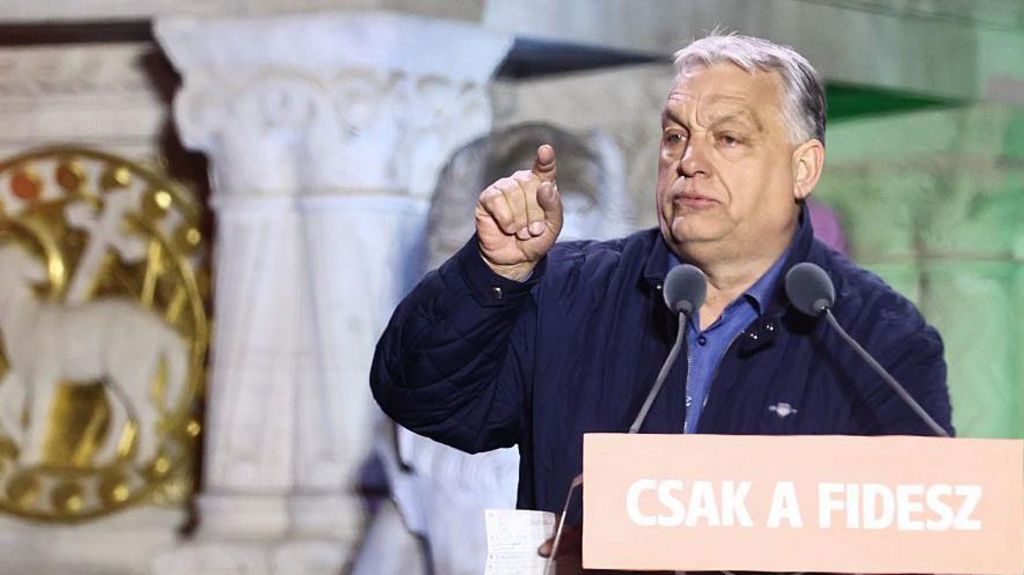
Most leading public opinion surveys point to a narrow but clear advantage for challenger Péter Magyar, the founder of the grassroots Tisza party, who launched his political movement after splitting from Orbán’s ruling Fidesz party. Yet in the final hours of campaigning, the long-serving incumbent showed no sign of backing down, striking a defiant tone before thousands of gathered supporters in Budapest’s Castle Hill. “We are going to achieve such a victory that will surprise everyone, perhaps even ourselves,” Orbán told the crowd, leaning into the familiar, polarizing campaign themes that have defined his political career for over a decade.
Voting will open at 6 a.m. local time (4 a.m. GMT) and close at 7 p.m. local time, with preliminary results expected to begin trickling in later that evening. In the days leading up to the vote, Orbán amplified rhetorical tensions, claiming the opposition would “stop at nothing to seize power.” In response, Magyar issued a plea to supporters, urging them not to cave to what he called “Fidesz pressure and blackmail.”
During Orbán’s 16 years in office, the European Parliament has repeatedly labeled his administration a “hybrid regime of electoral autocracy.” Magyar and Tisza have centered their campaign on a promise of “regime change”: a full reset of Hungary’s strained relationship with the European Union and an end to Orbán’s close bilateral ties to Moscow, a policy that has put Budapest at odds with its NATO and EU allies.
In a sign of shifting momentum, Magyar’s final campaign rally in Debrecen, Hungary’s second-largest city, drew a far larger crowd than Orbán’s closing event in the capital. The incumbent, however, retains high-profile international backing: former U.S. President Donald Trump has publicly urged Hungarian voters to turn out for Orbán, whom he called his “true friend, fighter, and WINNER.”
Addressing supporters on the final Saturday of campaigning, Orbán doubled down on his core messaging targeting Brussels and Kyiv, reiterating his hardline stance that “we don’t give our children, we don’t give our weapons and we don’t give our money” to Ukraine. The message resonated with his base, with long-time Fidesz supporter Johanna telling reporters she backed Orbán’s policies on family protection and his approach to the ongoing war in Ukraine.
While Orbán has secured four consecutive election victories, political analysts broadly agree that a fifth term is far from guaranteed. Hungary is currently grappling with persistent economic stagnation, and Fidesz has been battered by a string of high-profile corruption scandals in recent months. Most notable is the public revelation that Foreign Minister Péter Szijjártó held regular off-the-record talks with his Russian counterpart before and after every EU summit, a detail Szijjártó has since confirmed.
Orbán’s continued veto of a €90 billion EU aid package for Ukraine has left his European allies furious, deepening the rift between Budapest and the bloc. Róbert László, an election specialist at Budapest-based independent think tank Political Capital, notes that Hungary’s three most reputable polling firms all point to a “huge lead” for Tisza. Contrary to most analysts’ predictions that Fidesz would close the gap as the election neared, László says that narrowing has failed to materialize.
Magyar has framed his campaign around the need for a two-thirds supermajority in Hungary’s 199-seat parliament — not just a simple absolute majority — to roll back the sweeping constitutional changes Fidesz enacted over the past 16 years that weakened judicial independence, consolidated state control over media, and centralized power in the ruling party. Hungary consistently ranks near the bottom of Transparency International’s annual Corruption Perceptions Index, a reflection of widespread concerns about graft in the Orbán administration.
László says the most likely outcome is a comfortable absolute majority for Tisza that falls just short of the two-thirds threshold, though he adds that a supermajority cannot be ruled out entirely. In recent weeks, current and former figures from Hungarian law enforcement, the military, and the business community have all publicly broken with Fidesz, a shift László calls a clear sign that the national mood has turned definitively against Orbán.
Hungary’s complex electoral system has long benefited Fidesz, a fact Orbán himself has acknowledged. Of the 199 parliamentary seats, 106 are filled by direct constituency elections, while the remaining 93 are allocated via national party lists, with votes open to Hungarians living both at home and abroad. Votes from losing parties in constituency races, as well as excess votes from winning candidates, are transferred to the national list, a mechanism that has historically delivered additional seats to Fidesz. Parties must clear a 5% national vote threshold to gain any parliamentary representation.
One of the only polling firms that still projects a potential Orbán victory is the Nézőpont Institute. Its director, Ágoston Mráz, points to 22 competitive “battleground constituencies” that will decide the race. If Fidesz can win a majority of these swing seats, Mráz says Orbán could still secure a fifth term. Because 5% of votes in these key districts will not be counted immediately, a final official result may take several days to emerge.
Mráz also argues that Fidesz’s support is undercounted in most polls, thanks to a large bloc of “hidden voters.” “Conservative voters are not normally as enthusiastic or their self-confidence is probably limited. They are more hidden voters, they are not ready to answer questions of pollsters, and among the Fidesz voters there are more, in percentage, blue-collar voters than in the Tisza party voter camp,” he explained.
The northwestern city of Györ, Hungary’s sixth-largest city located near the Slovak border, has emerged as a critical battleground that will likely shape the final result. Orbán put the city in the national spotlight last month when he lost his temper amid jeers from protesters, accusing the crowd of “pushing Ukrainian interests.” Just weeks later, Magyar drew a massive crowd for a rally in Györ’s central square, showcasing his strength in the once-safe Fidesz area.
For many young and first-time voters in the city, ousting Fidesz is the top priority. Gergely Németh, a 20-year-old university student, told reporters he and his family have faced persistent financial hardship under Orbán’s policies, even with the prime minister’s widely promoted pro-family tax breaks for households with multiple children. “I think it’s not the man, Péter Magyar, who’s most important. More important is that someone changes these politicians in the parliament,” Németh said, adding that nearly every young person he knows supports removing Fidesz from power.
Györ has been led by an independent mayor and deputy mayor for the past two years, though Fidesz still holds a majority on the local city council. Deputy Mayor Roland Kósa, an independent, has criticized Fidesz for its arrogant approach to power, saying that even after independent leaders were elected, “Fidesz basically looked through us and said and thought we do not exist – this is still their city, this is still their country.” Kósa accuses the ruling party of squandering massive public funds and years of economic opportunity in the city.
Magyar’s political ascent has been built on a broad, cross-partisan appeal. A former center-right Fidesz insider who broke with the party just two years ago, he has attracted disaffected voters from across the ideological spectrum, allowing even voters who are skeptical of him personally to back Tisza as a unified movement to oust Orbán.
Unlike Orbán, who built his opposition movement decades ago through local “citizen circles,” Magyar built Tisza from the ground up through a network of local “Tisza islands” — small activist cells embedded in Fidesz’s traditional strongholds. While the model is not new, it has grown into a robust national movement that has challenged Fidesz’s decades-long hold on local political organizing. Unlike many established opposition parties, Tisza’s candidates are largely non-career politicians: the party’s slate includes practicing surgeons, public school teachers, and local business leaders with direct experience addressing gaps in Hungary’s healthcare and education systems.
This election has defied many conventional European campaign norms. Notably, the two leading candidates have refused to face off in a nationally televised debate, with the entire race being fought out on social media and in open-air rallies across the country. While other minor parties are competing in the election, only Fidesz and Tisza hold enough support to win parliamentary power.
Outwardly, Fidesz officials maintain they are confident of victory, but Balázs Orbán, the party’s political director, has already pre-emptively suggested that the opposition would refuse to accept a Fidesz win. Mráz, from Nézőpont Institute, shares concerns about post-election unrest, warning that Tisza supporters may reject an Orbán victory by claiming widespread fraud. “I’m really afraid of getting violence on the streets because tension is in the air. I hope very much that every politician will be smart enough to help voters avoid violence on the street,” he said.
So far, large opposition gatherings have remained peaceful: at least 100,000 anti-Fidesz supporters packed Budapest’s Heroes’ Square on Friday for a pre-election concert and rally, with no reported incidents. Magyar has repeatedly urged his supporters to remain calm and avoid falling for any provocations that could lead to unrest, regardless of the final outcome.