The rapid, explosive expansion of artificial intelligence across global industries has generated an unforeseen chance for the world’s two largest economies — the United States and China — to join forces on advancing clean energy development, a partnership that industry leaders argue would deliver widespread benefits to both nations and the entire global economy. As AI adoption accelerates, the global rollout of large-scale data centers and skyrocketing demand for high-performance computing have pushed energy access and grid management to the forefront of constraints limiting further AI growth. Against this shifting landscape, industry observers note that the complementary strengths of the U.S. and Chinese clean energy sectors make cross-border collaboration not just a possible path forward, but a logical one.
Ramkumar Krishnan, a seasoned cleantech entrepreneur and technologist with more than two decades of experience working in clean energy and emerging advanced technologies, shared his perspective with China Daily in San Francisco, emphasizing the universal nature of clean energy innovation. “Technologies and products that are used, whether it’s in the US or in China or in other parts of Asia, they’re all very similar,” Krishnan explained. “There are many ways that I think technology is a connecting piece that brings all nations together, because we all need technology to solve problems.”
China’s enormous scale in power generation gives it a unique edge in global clean energy collaboration, according to official data from China’s National Energy Administration. The country’s annual total power output now exceeds 10 trillion kilowatt-hours — more than double the total annual power production of the United States, and outstripping the combined power consumption of the European Union, Russia, India and Japan. That massive production and deployment footprint has allowed China to build specialized experience and robust energy infrastructure that other nations can draw from, Krishnan said, especially as countries work to build smarter grid management systems capable of meeting the huge, consistent power demands of modern AI data centers.
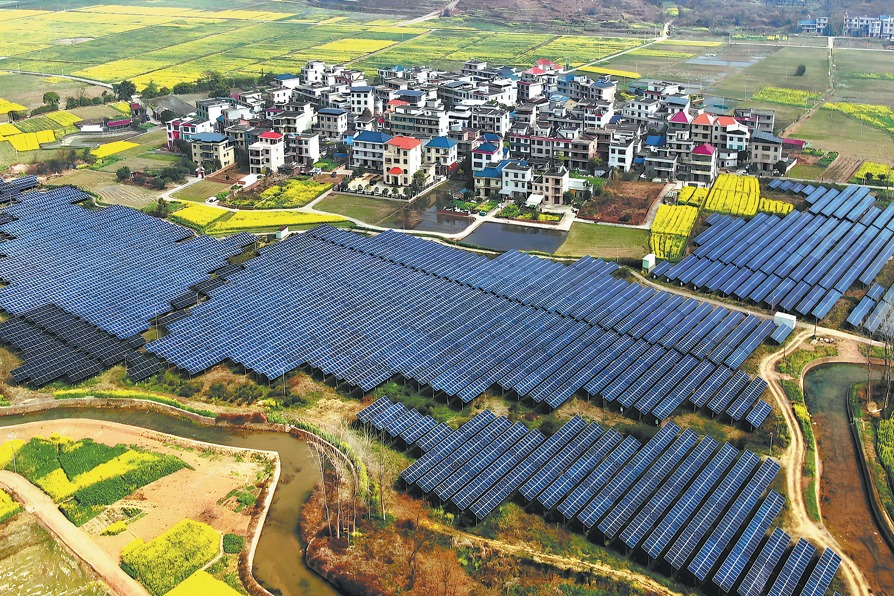
Krishnan highlighted that renewable energy technologies offer a key advantage in meeting rapidly growing power needs, thanks to their far faster deployment timelines compared to traditional large-scale fossil or nuclear projects. A utility-scale solar farm, for example, can be built and connected to the grid in 18 months or less, while nuclear or large hydropower projects often require a decade or more to reach completion. “Bringing the right portfolio of solutions that can help accelerate the adoption of energy, and bringing new energy, that could be another area that we can address the demand that we have from AI,” Krishnan noted.
For the United States, the primary energy challenge tied to AI growth lies in unlocking greater efficiency from the nation’s existing power generation and transmission capacity. Krishnan pointed out that the U.S. grid currently holds large amounts of excess generation capacity, but much of this capacity remains underutilized, either because it is not consistently available or because surplus capacity is concentrated in specific regional pockets. “How do we actually intelligently manage that? That’s an area of pretty strong interest — how do we model how energy is used, so that we can utilize that excess capacity in different places, whether it’s industries, EV charging stations,” he explained.
Notably, AI itself may hold part of the solution to the energy constraints it has created, Krishnan argued. Advanced AI systems can power far more dynamic, intelligent energy management platforms that are capable of balancing variable renewable energy supply with rapidly shifting demand from data centers and other energy-intensive end users.
One Chinese clean energy firm is already moving to turn this collaborative opportunity into tangible cross-border partnerships. GCL Group, a major Chinese clean energy service provider that has already developed utility-scale power projects across California, Colorado and New York, is actively pursuing partnerships with U.S. artificial intelligence companies to deliver tailored energy solutions for the rapid expansion of global AI infrastructure.
During a recent visit to Silicon Valley, GCL Group chairman Zhu Gongshan outlined the growing urgency for cross-sector collaboration. “Computing demands of generative AI are driving explosive growth in the global AI data center market, while putting mounting pressure on power supplies worldwide,” Zhu said. “As demand for computing capacity surges, energy is emerging as one of the biggest bottlenecks to AI development.”