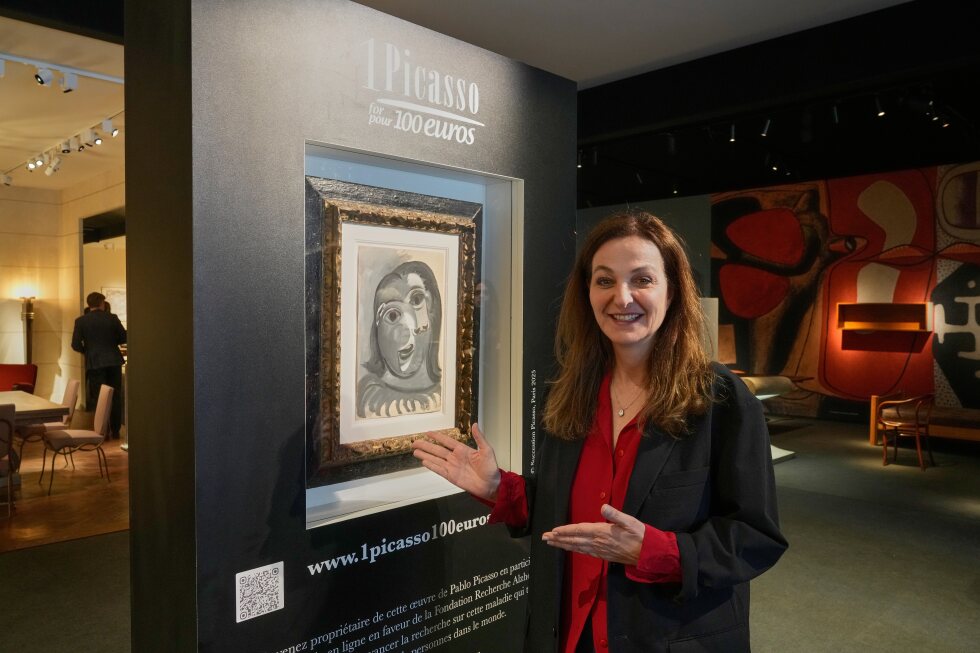
PARIS – For art lovers and casual ticket buyers alike, a once-in-a-lifetime opportunity has arrived in France: a charity raffle offering Pablo Picasso’s original 1941 work “Tête de Femme” (Head of a Woman) as the grand prize, with every 100-euro ticket going directly to cutting-edge Alzheimer’s medical research.
The draw, scheduled for 6 p.m. Tuesday at Christie’s Paris auction house, marks the third iteration of the highly popular “1 Picasso for 100 euros” initiative, which first launched in 2013 to open access to world-class fine art while raising funds for good causes. The public will have a chance to preview the 1941 gouache-on-paper portrait a day early, when it goes on display starting Monday at Christie’s Paris galleries.
To ensure the initiative remains accessible and the prize holds its unique value, organizers have capped total ticket sales at 120,000. If all tickets are sold, the raffle will generate 12 million euros (approximately $14 million) in total revenue. Of that total, 1 million euros will go to Opera Gallery, the international art dealer that owns the portrait being offered. All remaining proceeds will be directed to Alzheimer’s research, overseen by the Alzheimer Research Foundation.
Based out of one of Paris’s top public hospitals, the Alzheimer Research Foundation has grown into France’s largest private funder of Alzheimer’s studies since its founding in 2004, a position that gives the charity unique impact in advancing treatments and understanding of the neurodegenerative disease.
The concept of raffling off Picasso’s work to reach a broad audience has strong backing from prominent members of the art collecting community. When the second raffle was held in 2020, billionaire art collector David Nahmad — who sold the 1921 Picasso still life “Nature Morte” for that draw — shared his support in a rare interview with the Associated Press, arguing the iconic Spanish artist would have wholeheartedly approved of the model. Nahmad noted that Picasso, who died in 1973, was famously generous with his work, gifting pieces to everyday workers like his driver and tailor rather than restricting access only to wealthy patrons. “He wanted his art to be collected by all kinds of people, not only by the super-rich,” Nahmad explained.
Past iterations of the raffle have delivered fairy-tale wins to ordinary art fans from across the globe. The 2013 inaugural event saw a fire sprinkler system worker from Pennsylvania take home Picasso’s 1914 Cubist-period work “Man in the Opera Hat.” The 2020 raffle of “Nature Morte” gave a sweet surprise to Claudia Borgogno, an Italian accountant: her son purchased the winning ticket as a Christmas gift, making her the new owner of the valuable still life.
Beyond bringing iconic art into the hands of everyday collectors, the first two raffles also delivered major global public good, raising more than 10 million euros combined. Those funds supported cultural preservation initiatives in Lebanon and clean water and hygiene programs across communities in Africa, proving the model’s ability to deliver widespread impact beyond its core mission.