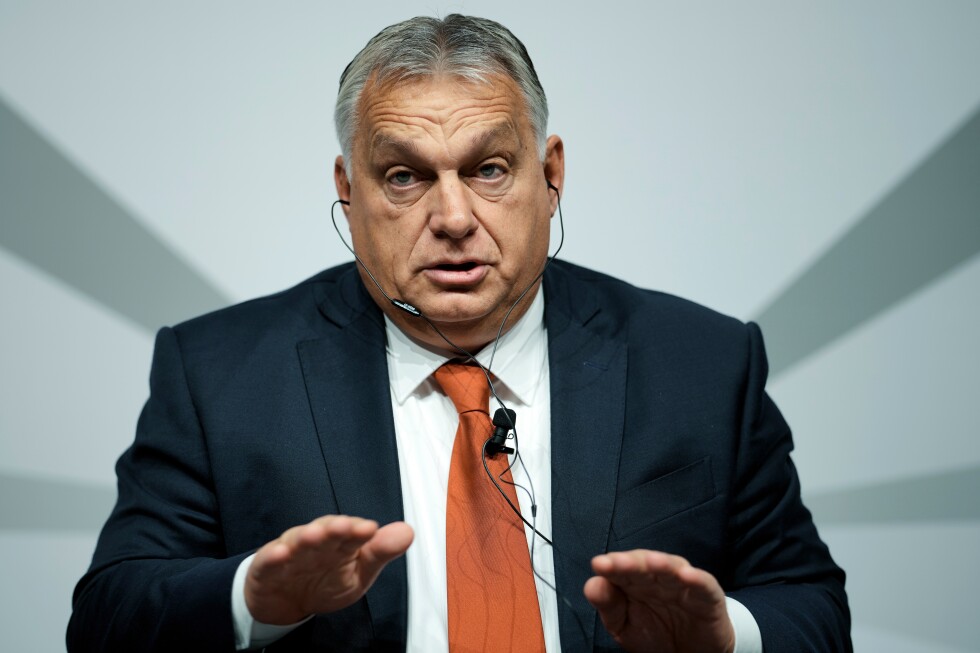
BUDAPEST, Hungary — As Europe’s longest-serving head of government and one of the European Union’s most persistent and high-profile critics, Hungarian Prime Minister Viktor Orbán has traveled a stark ideological arc: from a young liberal firebrand organizing against Soviet occupation to a Russia-aligned nationalist icon adored by far-right movements across the globe. Now, after more than 20 years of unchallenged control over Hungarian politics, the 62-year-old leader faces what could be a career-ending defeat in Sunday’s parliamentary election, a contest that will shape not just Hungary’s future but the balance of power across the European Union.
Most pre-election polls place Orbán and his ruling Fidesz party more than 10 points behind the opposition center-right Tisza Party, led by charismatic challenger Péter Magyar — a gap that even a high-profile campaign visit from U.S. Vice President JD Vance, designed to shore up Orbán’s support, has failed to close. Facing unprecedented headwinds, Orbán has pulled out all the stops to hold power: he has deployed a widespread disinformation campaign, released AI-generated attack ads smearing his opponent, and issued dire warnings to voters that an opposition win would plunge Hungary into national bankruptcy and draw the country directly into the ongoing war in Ukraine.
The transformation of Orbán’s politics from his anti-communist youth to the illiberal leader of today would have shocked his earliest supporters, analysts agree. Born in 1963 to a working-class family in the small rural town of Felcsút, just outside Budapest, Orbán was a gifted law student and lifelong soccer enthusiast who earned a scholarship to study political science at the University of Oxford through a foundation run by Hungarian-born financier George Soros — a figure Orbán would later demonize as the mastermind of a global plot against Hungarian sovereignty.
In 1988, at the height of Cold War unrest across Eastern Europe, Orbán co-founded Fidesz as a liberal, anti-communist youth movement. A year later, at just 26 years old, he delivered a thunderous public address to a crowd of tens of thousands in Budapest’s central square, openly demanding that Soviet troops withdraw from Hungarian soil — a risky act of defiance that cemented his reputation as a leading voice of the pro-democracy movement. When Hungary held its first post-communist democratic elections in 1990, Orbán entered parliament as Fidesz’ caucus leader, and by 1998 he became one of the youngest prime ministers in European history at age 35.
As the Hungarian political landscape shifted and new liberal parties crowded the political center, Orbán gradually steered Fidesz sharply to the right, remaking the party into a vehicle for populist, nationalist conservatism. His narrow 2002 election loss to the Hungarian Socialist Party is widely viewed as a turning point in his approach to power. In a closed-door address to Fidesz members after the defeat, he laid out a blueprint for permanent control: “We only need to win once, but we need to win big,” he told attendees.
It would take eight years in opposition for that big win to arrive. Riding widespread public anger over the aftermath of the 2008 global financial crisis and a series of corruption scandals that brought down the ruling Socialist government, Orbán led Fidesz to a landslide victory in 2010, winning a two-thirds supermajority in parliament that allowed him to reshape Hungary’s political system without opposition support. That victory launched the Orbán era, a period of radical transformation that rewrote the rules of Hungarian democracy.
With his unchecked parliamentary majority, Fidesz unilaterally drafted a new national constitution, redrew electoral district maps to favor the ruling party, and stacked the national judiciary with political loyalists. Orbán also channeled billions in European Union infrastructure and development funds into private companies owned by his inner circle and political allies. Those allies in turn consolidated control over Hungary’s media landscape: by the end of the 2010s, independent analysts estimated that Fidesz and its supporters controlled up to 80% of the country’s private media market, forcing hundreds of independent outlets to shut down.
Orbán’s government also transformed state-run media into a full-time propaganda mouthpiece for the ruling party, spending billions of public forints on billboards, targeted advertising, and direct mail to households to spread his nationalist, anti-EU narrative. Global press freedom watchdog Reporters Without Borders has named Orbán a “predator of press freedom,” and in 2022 the European Parliament officially designated Hungary an “electoral autocracy” over widespread concerns about democratic backsliding. Despite these international criticisms, Orbán retains strong support among older and rural Hungarian voters, who view him as a defender of traditional Christian values and national independence against what he frames as overreach from globalization, Brussels, and mass migration.
Orbán has positioned himself as the EU’s most disruptive internal critic, building anti-immigrant policies as a core pillar of his political brand. He ordered the construction of fortified border fences to block refugee arrivals in the 2010s, enacted harsh restrictions on asylum, and has repeatedly pushed the “great replacement” conspiracy theory, which claims global elites are seeking to replace Europe’s white native population with non-European migrants. In a 2022 speech to a party gathering in Romania, he stated plainly: “we do not want to become peoples of mixed-race.”
On the international stage, Orbán has built close, long-standing alliances with other populist nationalist leaders, including former U.S. President Donald Trump and Russian President Vladimir Putin. His government has repeatedly blocked EU efforts to deliver military aid to Ukraine and impose harsh economic sanctions on Russia following Moscow’s 2022 full-scale invasion, a policy that has put him at constant odds with Brussels. The EU has frozen more than €30 billion in cohesion funds for Hungary over ongoing rule-of-law and corruption concerns, a move that Orbán has weaponized on the campaign trail, comparing Brussels’ pressure to the decades of Soviet occupation that followed World War II.
Critics have long accused Orbán of prioritizing Moscow’s interests over the EU and Western consensus, and recent reporting ahead of the election has reinforced those concerns: multiple media outlets have revealed that Orbán’s foreign minister has repeatedly shared classified details from closed-door EU meetings with his Russian counterpart, and Western intelligence assessments have suggested Russian intelligence services are meddling in the election to boost Orbán’s chances — a claim the Kremlin has denied.
For his part, challenger Péter Magyar has centered his campaign on reversing Orbán’s pro-Russia shift and restoring Hungarian democracy. His rallies regularly feature crowds chanting “Russians go home!”, and Magyar has framed Sunday’s vote as a defining national choice: “This election is a referendum on whether Hungary continues sliding toward full autocracy, or reclaims its place as a full, democratic member of the European community,” he told supporters in a recent campaign stop. While polling favors the opposition, a Magyar victory is far from guaranteed, and the outcome of the vote will have ripple effects across Europe for years to come.