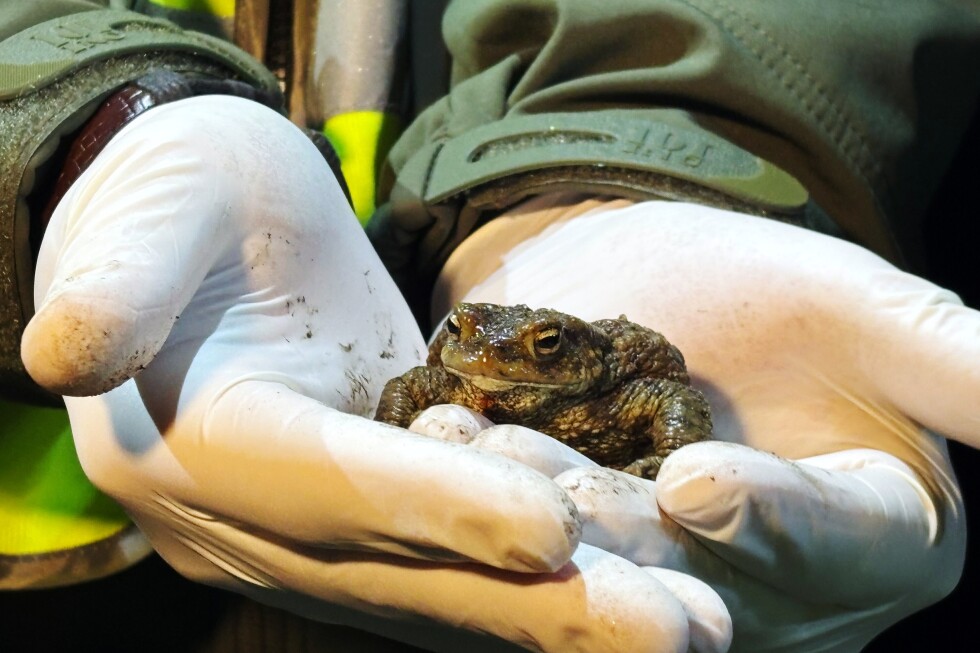
Each wet, rainy spring night in a quiet forest 30 kilometers west of Warsaw, Poland, an extraordinary grassroots volunteer initiative swings into action: the citizen “Frog Patrol,” a group of local nature lovers dedicated to guiding thousands of migrating amphibians safely across a deadly highway that cuts through their ancient mating route.
When rising spring temperatures thaw Mlochowski Forest, thousands of toads and frogs emerge from months of winter hibernation to begin their arduous annual journey to the shallow marshes where they have reproduced for millennia. The trek is an unequal one: far smaller male toads cling tightly to the backs of their larger female partners, clinging on to avoid being displaced by rival males once the group reaches the spawning waters. For generations, this migration proceeded uninterrupted — but a new highway carved across the path just over a decade ago turned the seasonal journey into a massacre. At the start of each mating season, thousands of migrating amphibians were crushed under vehicle tires, leaving roadsides lined with decomposing bodies that shocked local nature enthusiasts.
Four years ago, those shocking scenes pushed local resident Łukasz Franczuk and a group of friends to action. Three years ago, they formally organized the Frog Patrol, mobilizing hundreds of local volunteers to intervene during migration season. Because amphibians breathe through their skin, which requires constant moisture, they only migrate during rainy nights — which is when patrol members spring into action. Wearing reflective yellow vests marked with the group’s name, equipped with headlamps and buckets, volunteers fan out along the narrow forest road each rainy evening, collecting amphibians from the roadside and carrying them safely to the marshside on the other side of the highway. Even local residents out during the day, including children, now carry gloves to rescue any migrating frogs they find in harm’s way.
For participants, the work is as much about connection as it is about conservation. “It’s really impressive to see whole families with kids walking in the rain, with buckets, in these lovely jackets to make them visible because it’s pretty unsafe, this road is narrow, and they carry the frogs from one side of the road to the other,” said Katarzyna Jacniacka, a long-time patrol participant. “When the frogs are migrating, there are a lot of people here.” Fellow volunteer Aleksandra Tkaczyk added that the patrol offers “the kind of connection with nature about which some of us care deeply.” Since the initiative launched three years ago, local volunteers estimate they have saved more than 18,000 amphibians from being killed on the road.
Biologists confirm the volunteer effort is critical to protecting this local amphibian population. Krzysztof Klimaszewski, a biologist at Warsaw University of Life Sciences who has joined multiple patrols, noted that the work “actually allows this local population of amphibians to survive” in an ecosystem increasingly fragmented by human infrastructure.
Poland’s Frog Patrol is far from unique: similar citizen-led conservation efforts to protect migrating amphibians have popped up across the globe. In the U.S. state of New Hampshire, volunteers with the Harris Center for Conservation Education rescue a wide range of amphibian species, including salamanders, from busy roads. In Bavaria, Germany, conservation group BUND Naturschutz reports rescuing up to 700,000 frogs, toads, newts and salamanders from traffic every year. Even in France, where frog legs are a traditional culinary delicacy, local volunteer groups protect wild migrating populations; in the southern Provence-Alpes-Côte d’Azur region, volunteers have installed roadside nets to collect amphibians before they reach busy roadways. In Tallinn, the capital of Estonia, city authorities recently broke ground on new amphibian fencing along a busy migration route, designed to guide frogs and other wildlife to safe underground crossing tunnels and cut down on traffic-related deaths.