For decades, Cold War geopolitics framed the 20th century around a sharp ideological split: the U.S.-led model of decentralized, market-driven capitalism stood opposed to the Soviet Union’s centralized, state-planned communism. Each system positioned itself as the correction for the other’s flaws, yet both ultimately developed fatal internal contradictions that undermined their long-term stability.
The Soviet Union did not fall because it lacked military or material power; at its peak, it controlled vast natural reserves, a robust industrial base, and one of the world’s most formidable standing militaries. Its collapse stemmed from inherent structural design flaws: by sidelining private entrepreneurs, the engine of market innovation and exchange, the Soviet system eliminated the incentives that sustain long-term economic vitality. Over time, production became rigid, resource allocation was driven by political favor rather than need, and widespread scarcity coexisted with systemic waste. Most critically, a gradual psychological erosion set in: ordinary citizens stopped believing the system worked to serve their interests. By the time large-scale reform was attempted, the system had grown too inflexible to adapt, and it unraveled.
Today, the United States faces a structurally analogous, if inverted, systemic imbalance. Where the Soviet order sidelined entrepreneurs, the modern American system has increasingly marginalized ordinary wage-earning workers, the backbone of the country’s real economy. Since the closing decades of the 20th century, three forces — globalization, offshore outsourcing, and the rising dominance of the financial sector — have remade the U.S. economic landscape. Capital has become hyper-mobile across borders, but labor remains rooted in place; manufacturing jobs have shifted overseas, while Wall Street has expanded its size and political influence exponentially.
The outcome of this shift is not immediate collapse, but deep structural imbalance. The U.S. continues to generate unprecedented levels of aggregate wealth, but that wealth is increasingly concentrated in a tiny share of the population. Federal Reserve data confirms this: the top 1% of U.S. households now hold 31.7% of total national household wealth, a record high not seen in more than a century. The historic link between worker productivity and wage growth has snapped, and for a majority of American households, broad national economic growth no longer translates to rising living standards. Stagnant wages and pervasive economic insecurity have become the norm for working and middle-class communities across the country.
Like the late Soviet Union, this imbalance is not merely economic — it is a crisis of systemic legitimacy. Polling data reflects a profound erosion of public trust: roughly 60% of Americans now believe the country is moving in the wrong direction, a stark contrast to Russia where, even amid ongoing war and international sanctions, 61% of citizens still view their country as on the right track. A growing share of the U.S. public has concluded that the current system does not work to advance their interests.
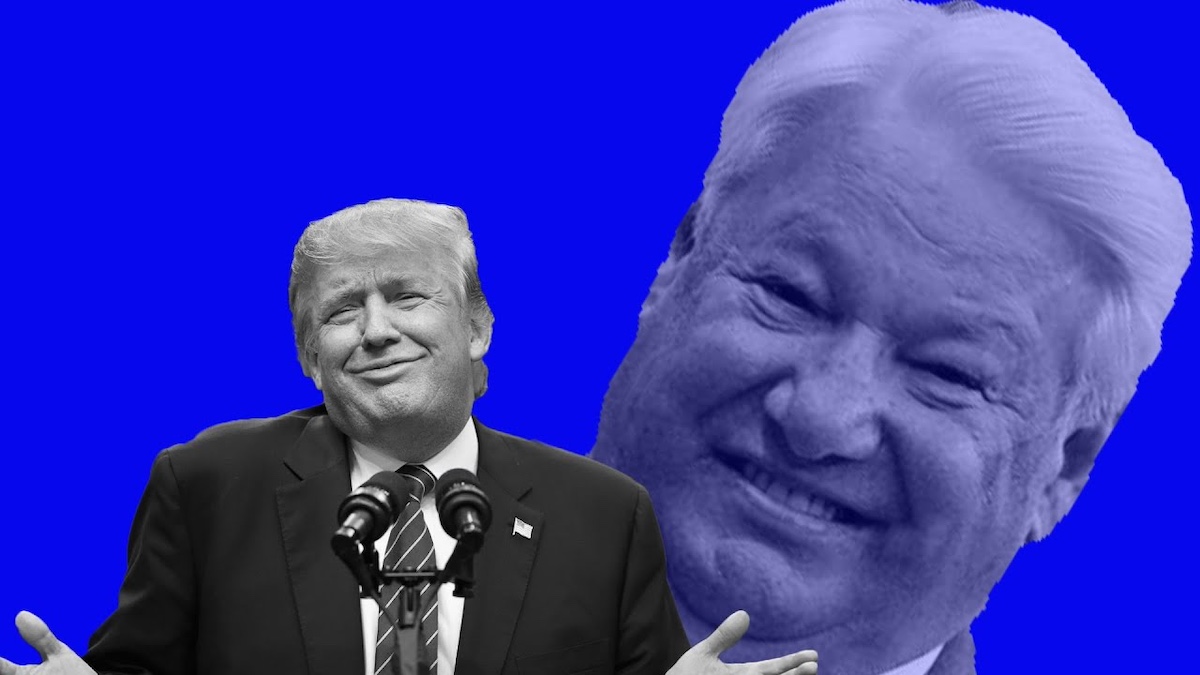
Political outsiders like Donald Trump do not create these systemic crises; they emerge as symptoms of underlying societal strain. In the Soviet Union, Boris Yeltsin rose to power at a moment when the communist system had already lost ideological and institutional coherence. He did not engineer the collapse of the old order — he embodied the public anger that the collapse had generated. His tenure accelerated the disintegration of the old regime, but the rapid, unregulated privatization of state assets that followed gave rise to a powerful oligarchic class, leaving most ordinary Russians facing widespread economic dislocation rather than prosperity.
Vladimir Putin’s subsequent rise addressed that immediate crisis: he reasserted central state authority, reclaimed state control over strategic economic sectors, restored fiscal discipline, and pulled Russia out of the chaotic post-collapse stagnation. While his model carries long-term tradeoffs, it responded directly to the systemic breakdown that preceded it.
Trump’s political ascent follows a comparable structural sequence, even within a vastly different national context. His core base draws heavily from communities that have been economically and culturally displaced by the shifts reshaping the U.S. economy. His rhetoric upends longstanding trade frameworks, alliance structures, and domestic governance norms that many voters see as unresponsive to their needs. This analysis is not an moral or political equivalence between Trump and Soviet-era leaders — it is an observation of historical sequence: Trump functions not as a stable, long-term solution to the U.S.’s systemic imbalance, but as a transitional figure, far closer to Yeltsin than to Putin. He is the type of leader that emerges when a longstanding system begins to break its own rules.
For decades, the U.S. has been buffered from the full impact of its internal imbalances by a unique global advantage: the U.S. dollar’s role as the world’s primary reserve currency. Since the 1970s, global oil trade has been overwhelmingly denominated in dollars, creating constant, structural demand for dollar-denominated assets. Today, the dollar still accounts for roughly 60% of global foreign exchange reserves, and U.S. financial markets remain the deepest and most liquid in the world. This petrodollar system has allowed the U.S. to run persistent large fiscal deficits while keeping borrowing costs low, acting as a financial cushion that has delayed the pressure for painful structural adjustment. But no such cushion is permanent.
In recent years, a gradual but meaningful shift has begun. China has expanded the use of the yuan in cross-border energy transactions, Russia has slashed its dollar holdings following Western sanctions, and a growing number of countries are exploring alternative currency settlement mechanisms. These changes remain incremental today, but they point toward an increasingly diversified global monetary system that will erode the dollar’s unique advantage over time.
Unlike Putin, who cut Russia’s national debt to just 20% of GDP and restored long-term fiscal discipline, Trump has put forward no serious plan to address the U.S.’s soaring $40 trillion national debt, where growing interest payments now consume an ever-larger share of federal spending. Instead of tackling this fiscal burden, Trump has pushed for further expansion of the U.S. defense budget, adding even more strain at the exact moment the petrodollar cushion is beginning to thin. This combination of soaring debt, rising military spending, and a lack of structural economic reform leaves the U.S. more vulnerable to a sudden financial shock than at any point since the 2008 global financial crisis. Deep political polarization further blocks any possibility of coordinated, long-term policy action, leaving the country exposed if global demand for dollar assets declines faster than currently projected.
The core lesson of the Soviet collapse is not that great powers collapse suddenly; it is that they weaken gradually when their core institutional systems stop aligning with the interests of their population. If the Yeltsin analogy holds, it carries a sobering warning: transitional figures do not fix the crises they embody. They only clear the ground for what comes next. The outcome will depend on whether the next era of U.S. politics brings genuine structural rebalancing — a serious reckoning with the gap between concentrated capital and stagnant worker wages, between aggregate growth and shared prosperity — or merely a harder entrenchment of the existing unequal order.
The Soviet precedent makes clear that existing systems rarely reform themselves from within until the cost of inaction becomes unavoidable. For the United States, that threshold has not yet been reached, but it is closer than most policymakers and analysts acknowledge. A meaningful reckoning would require rebalancing power between capital and labor, restoring broad-based wage growth, and stabilizing a debt trajectory that neither major U.S. political party has yet been willing to address seriously.
The question facing the United States is not whether it will eventually face this reckoning. It is whether it will recognize the urgency of the moment enough to address the imbalance on its own terms.