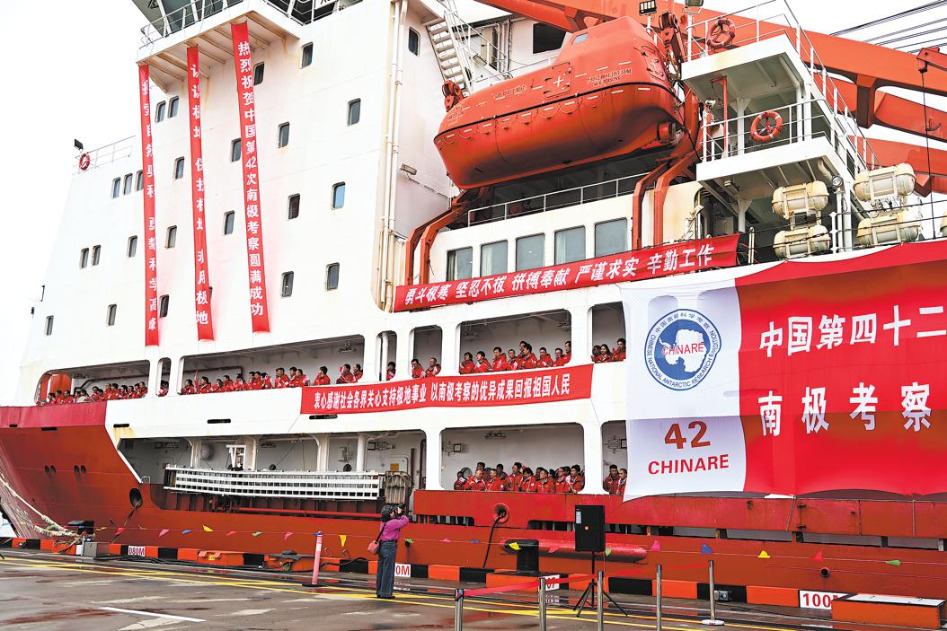
After more than five months traversing the remote, ice-choked waters of the southernmost continent, China’s polar research icebreaker Xuelong (Snow Dragon) sailed back to its home berth in Shanghai on Thursday, bringing a successful close to the primary voyage of China’s 42nd Antarctic expedition and delivering a wealth of critical scientific data collected in one of Earth’s most extreme environments.
A small but official welcoming ceremony was held on the Shanghai docks to greet the returning crew and research team, with senior representatives from both China’s Ministry of Natural Resources and the Shanghai municipal government in attendance to mark the expedition’s achievements.
The 42nd expedition launched in early November 2025, deploying two state-of-the-art icebreaking research vessels, Xuelong and Xuelong 2, to carry a total cohort of 550 scientists and specialists drawn from 125 domestic and international research institutions. Both vessels arrived at their Antarctic research zones by the end of the same month, after a long crossing from Shanghai.
According to official briefing from the Ministry of Natural Resources, the research team overcame extraordinary environmental challenges to complete their work. Navigating unpredictable, tangled sea ice formations, battering storm swells, persistent gale-force winds, and sub-zero temperatures that tested both equipment and personnel, the team carried out extensive, multi-disciplinary ecological and geological surveys across three key regions: the Antarctic Peninsula, the Cosmonaut Sea, and the Amundsen Sea.
Beyond pure scientific research, the expedition also fulfilled a number of logistical operational goals: completing scheduled infrastructure upgrades at onshore research stations, delivering critical resupplies to ongoing field missions, and rotating personnel stationed at Antarctic outposts back to civilization.
By the time Xuelong docked in Shanghai, the vessel had logged a total distance of 63,000 nautical kilometers across its entire voyage. In contrast, after fulfilling its assigned Antarctic research and logistical tasks, the Xuelong 2 icebreaker remained in southern waters to embark on a separate specialized mission focused on studying the unique and understudied marine ecosystems of the Southern Ocean.
This successful expedition marks another major milestone in China’s long-term collaborative polar research program, expanding global scientific understanding of Antarctica’s rapidly changing environment and its role in regulating global climate and ocean systems.