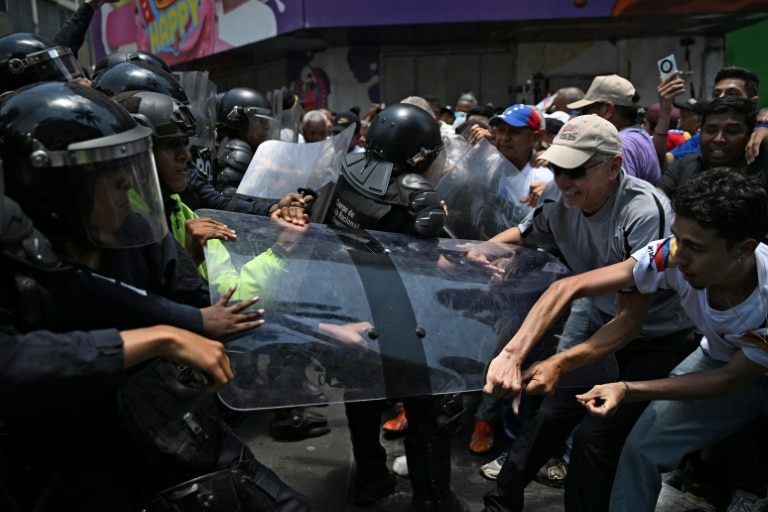
On April 8, 2026, a massive demonstration of roughly 2,000 Venezuelans marched through central Caracas toward the Miraflores Presidential Palace, demanding urgent increases to stagnant baseline salaries and pensions – only to be dispersed with tear gas by riot police, according to on-the-ground reporting from Agence France-Presse.
The confrontation marks the largest show of public dissent against interim President Delcy Rodriguez’s administration since August 2024, reflecting a sharp shift in public mood: after years of violent crackdowns on opposition under ousted former president Nicolas Maduro that deterred public protest, Venezuelans have begun to openly voice their long-simmering frustrations with economic hardship. As protesters pushed forward within kilometers of the presidential compound, helmeted riot police officers equipped with shields moved to block their path, triggering scattered clashes between demonstrators and law enforcement.
Rodriguez, who took power in January 2026 after Maduro was ousted and captured during a U.S. military raid, has already faced mounting criticism for failing to address Venezuela’s crippling cost-of-living crisis, which has left most working and retired citizens unable to cover basic needs. Just one day before the protest, Rodriguez addressed the nation on television to confirm a planned wage increase would take effect on May 1 – but she declined to reveal the size of the adjustment, a choice that further fueled public anger.
Venezuela’s official monthly minimum wage has remained frozen at 130 bolivars, equivalent to just $0.27 USD, since 2022. This figure is roughly 330 times lower than the United Nations’ $90 per month (equaling $3 per day) extreme poverty threshold. Even public sector workers, who earn up to $150 per month when including state-mandated bonuses, still take home far less than the $645 per month that independent economic estimates calculate a Venezuelan family needs to cover basic food costs alone. The nation currently grapples with annual inflation exceeding 600%, eroding any limited purchasing power workers have managed to retain.
Protesters emphasized that they are demanding increases to base salaries, not just adjustments to one-time or monthly bonuses – a workaround past administrations have repeatedly used to claim wage growth while leaving core pay stagnant. “Enough of this deception about salary increases. They want to pass off our government bonuses as a salary. That is completely unheard of,” 71-year-old retiree Mauricio Ramos told AFP, echoing the sentiment of many demonstrators.
The interim administration has framed its cautious approach to wage hikes as a measure to avoid worsening already sky-high inflation, a policy shaped in large part by U.S. influence. After the January raid, former vice president Rodriguez was endorsed by then-U.S. President Donald Trump to take power, in exchange for granting Washington expanded access to Venezuela’s vast oil reserves. Since taking office, she has followed through on commitments to roll back repressive policies from the Maduro era, granting amnesty to political prisoners and rolling out a series of market-aligned economic reforms. But these changes have yet to deliver tangible relief to everyday Venezuelans, who continue to struggle to afford essential goods including food and medicine.
Thursday’s demonstration signals a new wave of public assertiveness in Venezuelan politics. After the brutal crackdown on anti-Maduro protests that followed his disputed 2024 presidential election victory, public protests had largely ceased for nearly two years as citizens feared state repression. With the previous regime removed, that fear has begun to fade, allowing long-unmet demands for economic justice to move back into the public sphere.