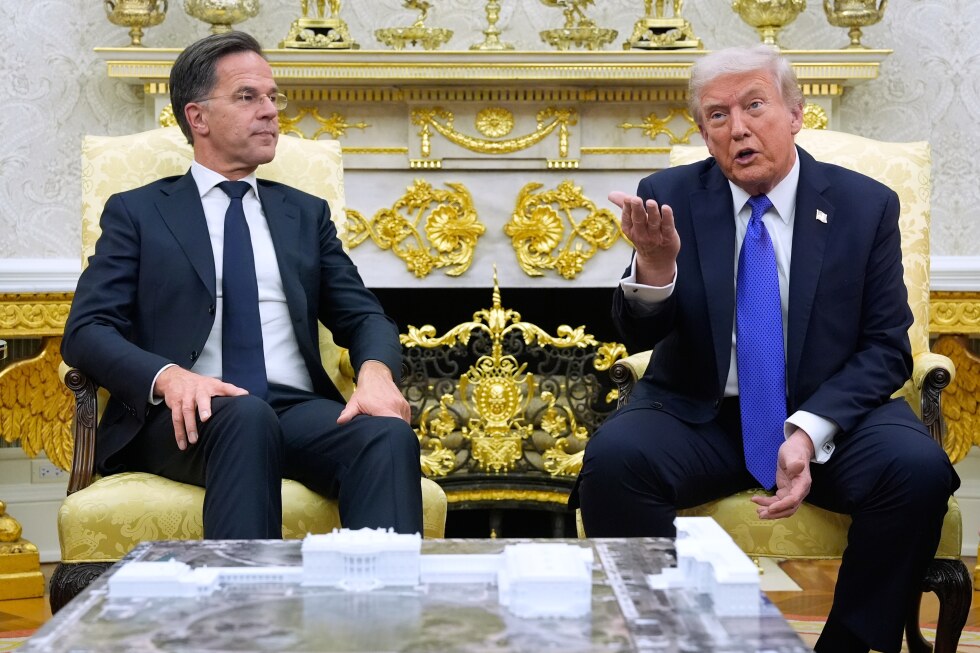
WASHINGTON — Tensions between former and current U.S. President Donald Trump and the trans-Atlantic military alliance NATO boiled over into public view Wednesday, following a closed-door meeting between Trump and NATO Secretary-General Mark Rutte that had been widely expected to defuse Trump’s fury over the alliance’s response to the recent Iran conflict.
In the lead-up to the private talks, Trump opened the door to a potential U.S. withdrawal from the 75-year-old alliance, after NATO member states rejected his call to join U.S. military actions when Iran blocked the Strait of Hormuz — a critical global shipping chokepoint that carries roughly one-fifth of the world’s daily oil supplies. The blockage triggered a sharp spike in global energy prices, amplifying Trump’s frustration with alliance partners.
Shortly after the meeting concluded, Trump took to social media to voice his lingering anger in an unfiltered all-caps statement. “NATO WASN’T THERE WHEN WE NEEDED THEM, AND THEY WON’T BE THERE IF WE NEED THEM AGAIN,” the post read. The White House declined to offer additional context or clarification on Trump’s remarks immediately after the meeting.
The talks came just one day after the U.S. and Iran reached a tentative two-week ceasefire agreement that includes the full reopening of the Strait of Hormuz. The ceasefire was finalized only after Trump issued a stark threat to target Iran’s critical infrastructure, warning that “a whole civilization will die tonight” if Tehran did not back down.
Earlier Wednesday, White House Press Secretary Karoline Leavitt confirmed that Trump had raised the possibility of a U.S. exit from NATO ahead of the meeting, telling reporters “I think it’s something the president will be discussing in a couple of hours with Secretary-General Rutte.”
Trump’s long-standing criticism of NATO dates back to his first presidential term, and U.S. law passed by Congress in 2023 explicitly blocks any sitting U.S. president from withdrawing from the alliance without congressional approval. Despite the legal restriction, Trump has repeatedly claimed he holds unilateral authority to pull the U.S. out of the 32-member bloc, which was founded in 1949 to deter Soviet expansionism during the Cold War. NATO’s core founding commitment is its mutual defense clause, which states that an armed attack against one member is considered an attack against all — a provision that has only been invoked once, in 2001, to support the U.S. following the September 11 terrorist attacks.
Beyond the Iran conflict, Trump also renewed his grievances over NATO’s stance on Greenland, the semi-autonomous Danish territory that Trump attempted to secure U.S. control over earlier this year, before backing down following negotiations with Rutte. In a separate social media post Wednesday, Trump railed, “REMEMBER GREENLAND, THAT BIG, POORLY RUN, PIECE OF ICE!!!”
It remains unclear whether the Trump administration will move to challenge the 2023 law blocking unilateral presidential withdrawal from NATO. Notably, that legislation was championed by current Secretary of State Marco Rubio, who was serving as a U.S. Senator from Florida when the bill passed. Rubio met separately with Rutte Wednesday morning at the U.S. State Department ahead of the White House meeting. In a post-meeting statement, the State Department said the pair discussed the Iran conflict, ongoing U.S. diplomatic efforts to end the Russia-Ukraine war, and “increasing coordination and burden shifting with NATO allies.”
Top Republican leaders have already broken with Trump over his NATO stance. On Tuesday night, Senate Minority Leader Mitch McConnell of Kentucky, who serves on the Senate Armed Services Committee, issued a statement reaffirming his support for the alliance. “Following the September 11th attacks, NATO allies sent their young servicemembers to fight and die alongside America’s own in Afghanistan and Iraq,” McConnell wrote. The senior Republican urged Trump to remain “clear and consistent” on U.S. alliance commitments, arguing it is not in the United States’ national interest to “spend more time nursing grudges with allies who share our interests than deterring adversaries who threaten us.”
NATO has already faced significant instability since Trump returned to the presidency, over his cuts to U.S. military support for Ukraine and repeated threats to seize Greenland from Denmark, a long-standing NATO ally. Trump’s criticism of the alliance intensified sharply after the outbreak of the U.S.-Iran war in late February, with the president arguing that securing the Strait of Hormuz should fall to the European and regional nations that depend on its oil shipments, not the United States. “Go to the strait and just take it,” Trump told supporters last week.
Additional friction emerged when two NATO members, Spain and France, moved to ban or restrict U.S. access to their national airspace and joint military facilities for operations related to the Iran war. While those nations have joined a broader international coalition to help secure the strait once the conflict ends, their refusal to back immediate U.S. action further stoked Trump’s anger. British Prime Minister Keir Starmer, another frequent target of Trump’s criticism, was scheduled to travel to the Gulf region Wednesday to support the newly brokered ceasefire, as the U.K. leads efforts to draft a post-conflict security framework for the strait.
This is not the first time Trump has threatened to walk away from NATO. The president has repeatedly vowed to abandon alliance partners that fail to meet the bloc’s target of spending 2% of their gross domestic product on defense. In his recently published memoir, former NATO Secretary-General Jens Stoltenberg revealed he personally feared Trump would withdraw the U.S. from the alliance as early as 2018, during Trump’s first term in office.
Contributions to this reporting were provided by Associated Press journalists Aamer Madhani and Matthew Lee in Washington, and Lorne Cook in Brussels.