Deep in Brazil’s northern Amazon state of Amapá, along the remote border with French Guiana, the small riverside city of Oiapoque is undergoing a chaotic transformation sparked by a single prospect: offshore oil development. One recent rainy morning, Reginaldo Nunes Fonseca leaned against the porch rail of a friend’s makeshift wooden home in Nova Conquista — a new settlement carved out of pristine old-growth rainforest just 12 months prior — smoking a cigarette as heavy rains washed over the muddy, cleared plots. The downpour kept him from continuing work on his own small house or picking up casual day labor for other new arrivals, but the rain is far from the only barrier to the prosperity he traveled hundreds of miles to find.
Like thousands of migrants who have flooded into Oiapoque over the past 18 months, Fonseca chased a promise of economic boom that arrived after Brazil’s state-owned energy giant Petrobras secured federal environmental approval last year for exploratory drilling in the Equatorial Margin, a vast offshore basin roughly 112 miles off Amapá’s coast near the mouth of the Amazon River. After seeing a televised report on the licensing last January, the unemployed father left his home in Brazil’s drought-prone northeastern state of Maranhão, drawn by the expectation of a growing city and abundant job openings. “I thought, well, that’s good — the city is going to grow, there will be a lot of job opportunities,” he explained. “So I started calling friends and said: ‘I’m going there because here I’m unemployed and not doing anything.’”
Amapá has long ranked among Brazil’s poorest and most isolated states, cut off from the rest of the country by a lack of major road connections and surrounded by rivers and the Atlantic. Oiapoque’s pre-oil economy depended on small-scale fishing, rampant unregulated gold mining, and cross-border shoppers from French Guiana, who trade stable euros for local goods. But the promise of oil wealth has sparked unbridled optimism even as it triggers unplanned, strainful growth in a city already crippled by inadequate public infrastructure.
This oil rush lays bare a defining dilemma for resource-rich developing nations across the globe: how can countries cut greenhouse gas emissions to slow catastrophic climate change, when untapped fossil fuel reserves represent the fastest path to lifting impoverished regions out of systemic poverty? It also puts President Luiz Inácio Lula da Silva’s landmark environmental pledges to the test. Since taking office, Lula has made halting Amazon deforestation a core policy priority, even hosting the United Nations COP30 climate summit in Brazil last year. Still, during a 2023 visit to Amapá, the president framed oil exploration as a matter of regional justice: “We don’t want to pollute a single millimeter of water, but no one can stop us from lifting Amapá out of poverty if there is oil here.”
Exploratory drilling at the offshore site launched in October 2023, and is projected to wrap up after five months. If substantial commercial oil reserves are discovered, full extraction would require additional layers of federal permitting, a process that can stretch on for months or even years. For now, Oiapoque’s formal role in the operation is limited: the city serves only as a helicopter base for offshore crews, while all administrative operations are centered in Belém, the major Amazonian port nearly 1,000 miles away in neighboring Pará state.
Even with massive uncertainty hanging over future extraction and Oiapoque’s small formal role in current operations, speculative fever has already remade the city’s landscape. Official 2022 census data put Oiapoque’s population at just 27,482, but no updated count has been conducted to track the recent inflow. Oiapoque city councilor Tiago Vieira Araújo, who raised public concerns during a March 10 community meeting where Petrobras presented its operational plans to local leaders, estimates that “in the past 18 months, Oiapoque has seen significant population growth.” That growth has already spawned seven new informal neighborhoods — including Nova Conquista — and brought a wave of overlapping social problems with it.
Brazil’s national geography and statistics institute IBGE data underscores the city’s pre-existing infrastructure crisis: less than 2% of all households have access to adequate sewage systems, and just 0.2% of city streets meet formal construction standards. Conditions in the new settlements, known locally as “invasões” or invasions, are far worse. New arrivals have cleared swathes of public rainforest to stake informal claims to land, erecting simple shacks with just a kitchen, bed and rudimentary outdoor bathroom out of rough-cut lumber. Fresh tree stumps dot the muddy ground between makeshift plots. “We know it’s not right to clear the forest. Everyone knows it’s wrong,” Fonseca acknowledged. “But space is limited.”
For local boosters like Yuri Alesi, a 34-year-old land rights lawyer and former city councilman running for vice mayor in an April special election, the oil boom could turn Oiapoque into an “Amazonian Dubai” modeled after the Gulf state’s oil-fueled transformation. “Dubai is in the middle of a desert, an unlikely place to grow,” Alesi argued. “The industry that drove its development was oil.”
Geologists estimate the full Equatorial Margin, stretching from the Suriname border down to Brazil’s northeastern coast, holds as much as 10 billion barrels of untapped oil and gas, worth an estimated $719.7 billion at current market prices. Alesi projects that oil royalties alone could generate roughly $19 million per month for Oiapoque — a sum equal to the city’s entire annual GDP, per Brazilian government data.
The Amazon basin plays an irreplaceable role in regulating the global climate, as its dense forests store massive volumes of carbon that would otherwise enter the atmosphere as greenhouse gases. Amapá has long been one of the basin’s best-protected regions: roughly 82% of the state remains covered in old-growth forest, according to MapBiomas, a non-profit that tracks Amazon land use. Its isolation has shielded it from the large-scale deforestation that has ravaged the southern Amazon for cattle ranching and soy cultivation.
But history offers a cautionary tale for Oiapoque’s would-be transformation. Forty years of oil and gas exploration in Coari, another Amazonian city, has failed to lift its population out of poverty: a 2023 study by public policy non-profit Agenda Pública found 72% of Coari residents live in extreme poverty. Closer to home, Amapá has already seen repeated cycles of resource boom and bust linked to mining. Forty-six-year-old Selma Soares experienced that whiplash firsthand: she moved from Maranhão to the Amapá mining town of Pedra Branca in 2008, lured by an iron ore boom that drew thousands of workers. She opened a small grocery store, only to see the industry collapse after a 2013 port accident killed six workers and halted production. When new owners suspended operations permanently, the local economy collapsed. “People who had shopped with us for years struggled to eat,” Soares recalled. Last year, she heard rumors of Oiapoque’s new boom, moved her family to the city, and opened a small grocery on the outskirts — joining hundreds of other former mining boom refugees waiting for oil to deliver the prosperity mining never did.
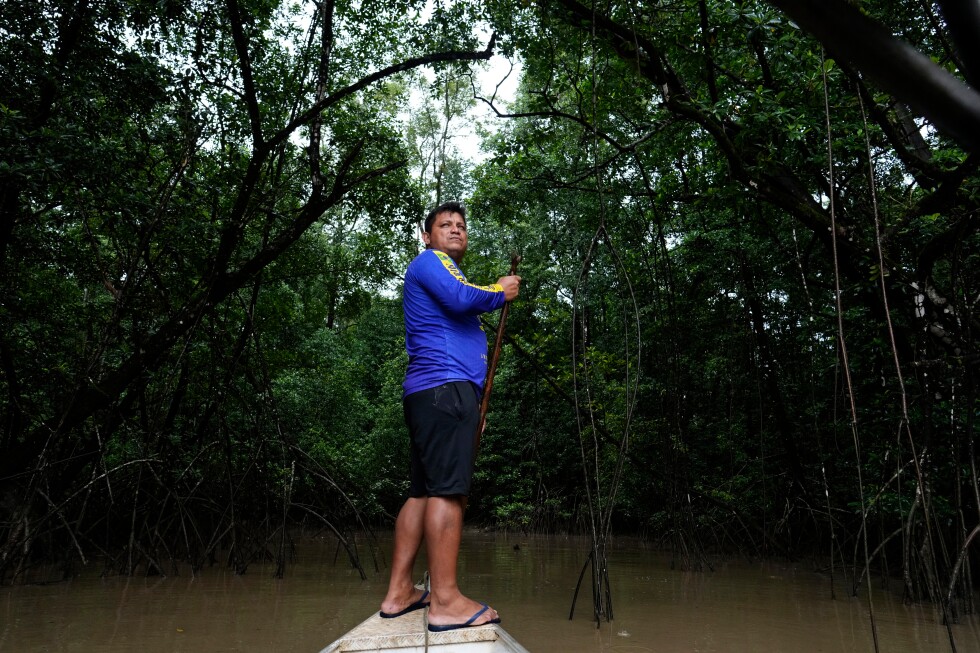
Today, the city’s mood is a tangled mix of fevered hope and simmering anxiety. At the river border with French Guiana, small port boats display green-and-yellow stickers emblazoned with a slogan pushed by local politicians: “Oil yes! Development yes!” But just a 20-minute boat ride away, members of the Indigenous Galibi Kali’na community, whose ancestral territory spans this stretch of the Amazon coast, say they have already paid a price for the promise of oil.
Renata Lod, a representative of Oiapoque’s Indigenous council, says Petrobras sold a fairy tale of overnight transformation to local leaders: “Petrobras arrived with strong political backing, promising progress as if we would go to sleep one way and wake up like Dubai.” The reality, she says, is “completely disorganized population growth, invasions of Indigenous lands.” Lod notes that both Indigenous and non-Indigenous residents already face overcrowded public schools, and the city’s only hospital is already operating over full capacity. Most alarming is the risk of an offshore oil spill: the region’s coastal Indigenous territories are made up of fragile flooded wetlands, where oil contamination is nearly impossible to fully clean up. “Most Indigenous lands are flooded wetlands. How do you clean a wetland? Once oil enters the rivers, there is no way to remove it,” Lod said. An oil spill could quickly spread pollutants across the region’s coasts and rivers, destroying fishing grounds and mangrove ecosystems that the community depends on for survival.
Petrobras has defended its operations, saying it conducted detailed spill risk modeling to secure its environmental license, and has deployed monitoring devices to track ocean currents since drilling began. Still, the company already faced a penalty for a safety incident: in January 2024, a leak of drilling fluid forced a temporary halt to operations, leading federal environmental regulator IBAMA to fine Petrobras roughly $470,500.
For Araújo, the city councilman, local residents already see Petrobras as a silver bullet for Oiapoque’s generations of poverty. “But even a remedy has side effects,” he noted. “And we’re already experiencing the side effects before seeing any of the benefits.”
Environmental and Indigenous organizations have already filed lawsuits against the federal government and Petrobras to halt exploration, arguing that the licensing process failed to require proper consultation with traditional communities, underestimated spill risks, and ignored the full long-term climate impact of extracting new fossil fuel reserves. Federal prosecutors have also asked IBAMA to annul or suspend the environmental license, saying Petrobras’ environmental impact studies are incomplete and the company has hidden the full scope of potential harm. No ruling has been issued on the challenges yet, leaving Oiapoque’s future hanging in the balance.