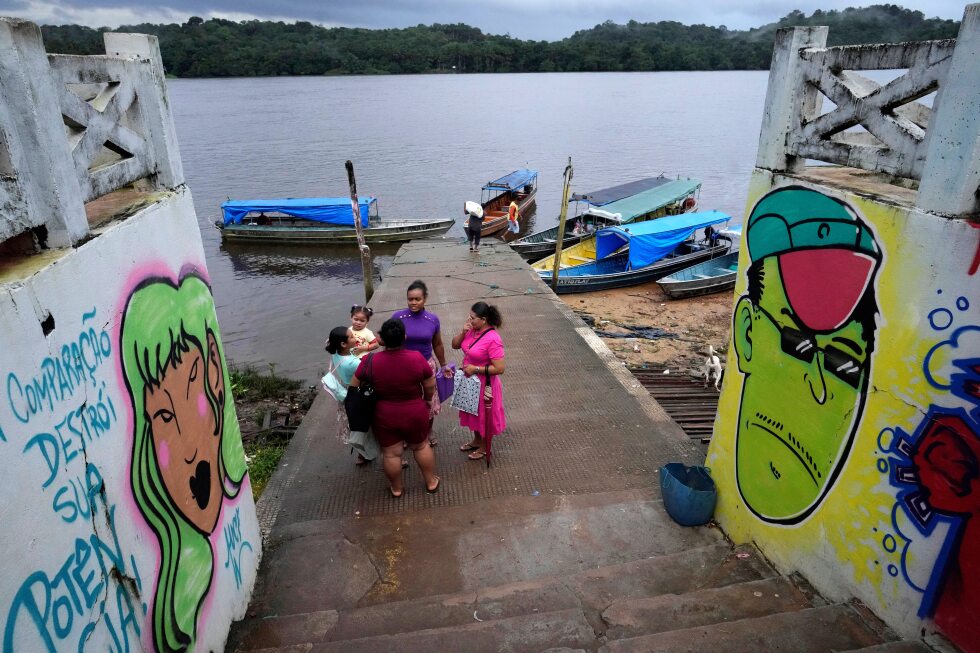
Tucked away in the far northern reaches of Brazil’s Amapá state, the small, remote border city of Oiapoque is already grappling with the uneven, disruptive early impacts of a projected oil-fueled economic boom, months after state-owned energy giant Petrobras launched exploratory offshore drilling along the Amazon rainforest coast. What was once a quiet community reliant on fishing, informal gold mining and cross-border trade with neighboring French Guiana has been upended by an unprecedented influx of thousands of job-seeking migrants, who have cleared large swathes of intact forest to build makeshift informal settlements while waiting for the employment opportunities they expect to emerge once full-scale oil production begins.
Local officials confirm that the rapid, unplanned population expansion has already overwhelmed the city’s limited, underfunded public infrastructure. Oiapoque city councilor Tiago Vieira Araújo reports that seven entirely new residential neighborhoods have sprung up across the city in just 12 months, with several carved out of pristine rainforest that stood undisturbed barely a year ago. Local residents have raised widespread complaints about overcrowded public schools, and the city’s only public hospital is currently operating at 100% capacity, unable to accommodate the sudden jump in population.
For Indigenous communities that have long called the region home, the drilling project and its aftermath have brought outright displacement and broken promises. Renata Lod, a representative of Oiapoque’s Indigenous council, harshly criticized Petrobras’ arrival in the region, noting that the company entered with robust political backing and marketed the project as a transformational development effort that would turn the remote city into a prosperous, Gulf-like economic hub overnight. “They promised we would go to sleep a small fishing town and wake up like Dubai,” she said. Instead, the region has faced chaotic unregulated growth and the illegal invasion of protected Indigenous territorial lands.
Still, for thousands of economic migrants, the prospect of stable, high-wage work in the new oil sector has outweighed concerns about environmental risk and uncertainty. Reginaldo Nunes Fonseca, one such migrant, relocated to Oiapoque from Brazil’s northeastern state of Maranhão just weeks after seeing a televised report that Petrobras had secured its exploration license. “I’m going there,” he recalled thinking, drawn by the promise of opportunity that has eluded many working-class people across Brazil’s poorer interior regions.
Beyond the immediate strain on urban services, the drilling project has sparked widespread alarm over potential long-term environmental harm to one of the world’s most biodiverse ecosystems. Environmental advocacy groups warn that even a small offshore oil spill would cause irreversible damage to the region’s sensitive coastal wetlands and critical commercial fisheries, which support the livelihoods of thousands of local families. Indigenous leaders add that the project’s expansion threatens the survival of their traditional way of life and the intact forest lands that their communities have stewarded for centuries.
Brazilian federal prosecutors have already filed a formal request asking the country’s national environmental regulator to annul or suspend Petrobras’ exploration license, arguing that the company’s environmental impact assessments are incomplete and that it has hidden the full scope of potential harm the project could cause. As of early 2026, no court or regulatory ruling has been issued on the request.
Petrobras has pushed back against these criticisms, stating that it completed comprehensive oil spill modeling as part of its license application and has deployed a network of floating monitoring devices to track ocean currents in the drilling area since operations launched in October 2025. Even so, the company was fined 2.5 million reais (equivalent to roughly $470,500) by IBAMA, Brazil’s federal environmental enforcement agency, after a drilling fluid leak in January 2026 that forced a temporary halt to operations.
The situation unfolding in Oiapoque lays bare a central contradiction at the heart of Brazil’s current climate and energy policy under President Luiz Inácio Lula da Silva. Just last year, Brazil hosted the 30th UN Climate Change Conference (COP30) in Belém, where Lula and his negotiating team championed a global agreement to phase out fossil fuels, the leading driver of human-caused global climate change. Brazil has also joined dozens of other nations in committing to sharp cuts in greenhouse gas emissions over the coming decades.
Yet for many developing countries including Brazil, the tension between climate action and economic development remains unresolved. Many local residents in Oiapoque and across the Amazon region hold out hope that new oil revenues will lift local living standards and lift the region out of persistent poverty. The expansion of oil drilling into the Amazon basin, even in this offshore project, also raises significant questions about whether Lula will fulfill his high-profile campaign pledge to protect the Amazon rainforest from destructive extractive development, a key promise that helped power his return to the presidency in 2022.