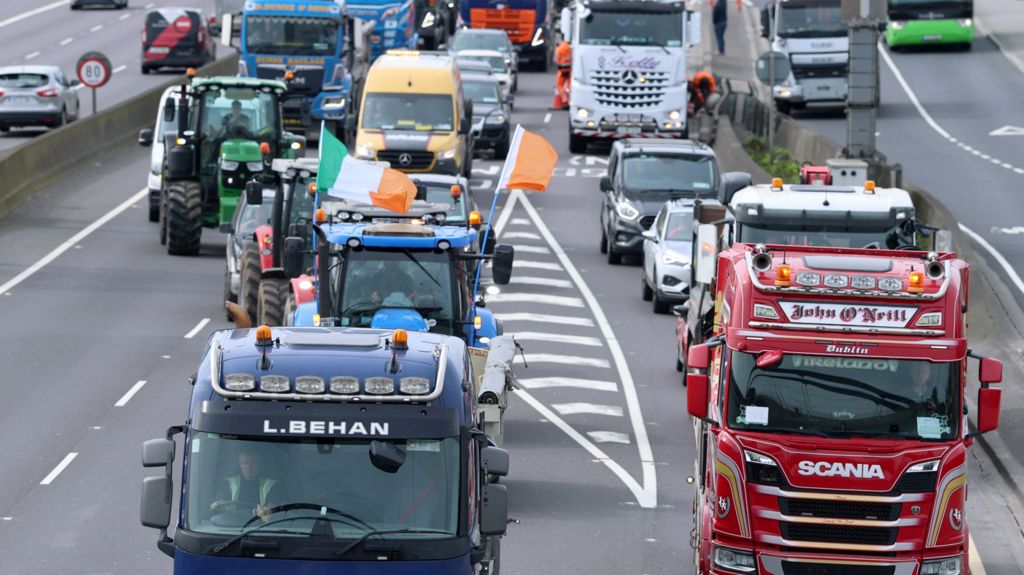
For the second straight day, widespread fuel price protests driven by skyrocketing energy costs linked to Middle East conflict have thrown travel and transportation across the Republic of Ireland into chaos. The slow-moving vehicle convoys, which launched early Tuesday morning, have spread beyond Dublin’s core urban area to major arterial routes leading into the capital and key transport corridors near other large population centers across the country.
Organized in response to dramatic fuel price surges triggered by the ongoing conflict between the US, Israel and Iran, the demonstrations have brought some of Dublin’s busiest central locations to a complete standstill. Ireland’s national police force, Gardaí, confirmed that both O’Connell Street and O’Connell Bridge — two critical thoroughfares in the heart of the capital — are completely blocked by protest activity. The disruption has extended to major intercity routes across multiple counties, with slowdowns and blockages reported on the N21 from Adare to Limerick city, Limerick’s Ballysimon Road, the Macroom bypass in County Cork (in both directions), Galway Docks in Galway city, the northbound M8 between junctions 6 and 9 in County Tipperary, and the M8 at Junction 18 in Glanmire, County Cork.
The root cause of the price spike traces back to escalating tensions in the Middle East, which have disrupted global energy markets. The closure of the Strait of Hormuz, a critical chokepoint that carries roughly 20% of the world’s total oil trade, has cut off global supplies of the crude oil used to produce both petrol and diesel, sending costs soaring across Ireland. Current average prices now sit at approximately €2.14 (£1.86) per litre for diesel and €1.91 (£1.66) per litre for petrol, with some regional locations recording even higher rates.
The travel disruption has hit cross-border services particularly hard, with public transport operator Translink confirming ongoing delays and service alterations for its cross-border routes. Until further notice, all of Translink’s X1, X2, X3 and X4 services will terminate at Dublin Airport rather than completing their full routes into the city center. Dublin Airport has also issued an advisory for all passengers departing or arriving at the facility, urging people to add significant extra travel time to their itineraries to account for unexpected delays along access routes.
In response to the growing crisis, Irish Tánaiste (Deputy Prime Minister) Simon Harris has scheduled a dedicated emergency meeting focused on energy issues to take place later on Wednesday, as government officials work to address public anger over rising costs and resolve the transport disruption across the country.