Tensions that had gripped the globe for days over an imminent US-Iran military conflict defused at the 11th hour on Tuesday, when President Donald Trump announced a bilateral two-week ceasefire, struck just moments before a self-imposed deadline that carried warnings of catastrophic destruction for Iran.
The breakthrough agreement, mediated by Pakistani Prime Minister Shehbaz Sharif and Pakistan’s Chief of Army Staff Field Marshal Asim Munir, was shared publicly by Trump on his social media platform Truth Social. In his post, Trump confirmed he would suspend planned bombing and military strikes against Iran for 14 days, contingent on Iran’s commitment to fully, immediately, and safely reopen the Strait of Hormuz, the world’s most critical oil chokepoint at the center of the latest standoff.
According to Reuters, Iranian officials submitted a 10-point negotiating proposal to Washington, which Trump described as a “workable basis” for finalizing a broader formal agreement. Trump added that nearly all longstanding points of dispute between the two nations had already been preliminarily agreed upon, and the two-week window will allow teams to hammer out remaining details to lock in a permanent deal. Israel has also signed off on the ceasefire arrangement.
Iran’s state television framed the agreement as a diplomatic victory for the country, while the Supreme National Security Council of Iran confirmed in an official statement that top-level leadership had approved holding direct negotiations with US negotiators in Islamabad across the 14-day truce. Talks are scheduled to kick off this Friday.
Global energy markets reacted immediately to the de-escalation: West Texas Intermediate crude futures for May plummeted nearly 19 percent, falling below $92 a barrel as fears of supply disruptions from conflict in the Persian Gulf evaporated.
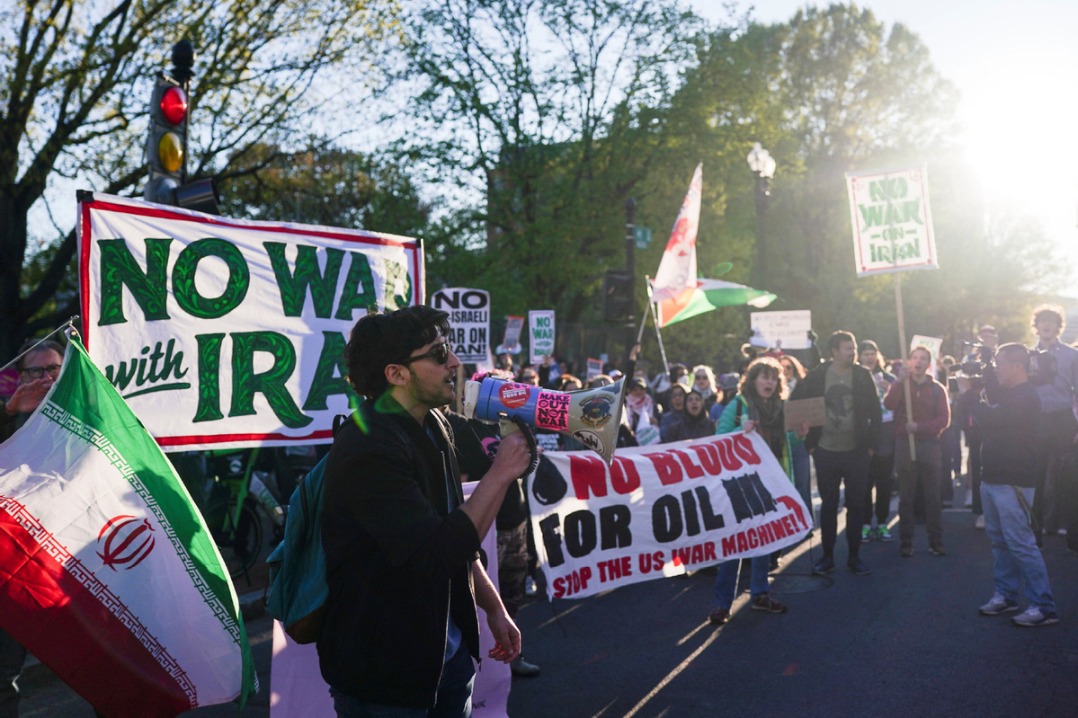
Hours before the ceasefire announcement, the United States had been swept by widespread anxiety, triggered by days of increasingly aggressive rhetoric from Trump that left the public and global leaders deeply alarmed. On Monday, Trump issued an ultimatum threatening to obliterate Iran’s entire civilian infrastructure – including every bridge and power plant – if Tehran failed to meet his demands by the Tuesday deadline. On Tuesday morning, he doubled down on the threat, warning that “a whole civilization will die tonight” if Iran did not comply.
That incendiary language drew fierce backlash from across the political spectrum, the public, and international institutions. Many American civilians voiced profound distress over the president’s approach. Adam Turner, a 54-year-old New York resident, told China Daily that Trump’s harsh rhetoric over Iran, paired with his confrontational style on other issues, had left him severely stressed. “It’s not speech that I would accept from any horrible person on the street. It is without respect, without intelligence, without dignity,” Turner said. “It makes me sad because I don’t think the Iranian people deserve it. He got rid of [former President Barack] Obama’s Iran deal. We had a deal in place that was effective.”
Lewis Fox, a 66-year-old Manhattan resident, echoed that criticism, calling for a return to diplomatic diplomacy rather than coercion. “He has converted the United States into being the bully of the world versus the savior of the world. And therefore, he definitely shouldn’t be talking like that,” Fox said.
Criticism even extended to Trump’s own political circle. Marjorie Taylor Greene, a Republican Representative and once a staunch Trump ally, publicly condemned the threat on X, writing: “Not a single bomb had dropped on America. We cannot kill an entire civilization. This is evil and madness.”
Democratic House Minority Leader Hakeem Jeffries of New York called on congressional Republicans to intervene to prevent full-scale conflict. “Congress must immediately end this reckless war of choice in Iran before Donald Trump plunges us into World War III,” Jeffries wrote on X. “It’s time for every single Republican to put patriotic duty over party and stop the madness. Enough.”
International bodies also raised sharp objections ahead of the ceasefire. A spokesperson for UN Secretary-General António Guterres said the UN chief was “deeply troubled” by statements that threatened to hold civilian populations responsible for political outcomes. UN High Commissioner for Human Rights Volker Türk warned Tuesday that the Trump administration’s threats could constitute severe violations of international law, ahead of the last-minute truce that pulled the region back from the brink of large-scale war.