Five weeks into the joint U.S.-Israeli military campaign against Iran, U.S. President Donald Trump has issued one of his most unambiguous ultimatums to date: new, devastating strikes on Iranian infrastructure will kick off at 8 p.m. Washington time Wednesday (00:00 GMT Wednesday), with every bridge and power plant across the country set to be “decimated” within four hours. “Very little is off-limits,” the president told reporters Monday.
To avert the planned assault, Trump demanded Tehran reach a new agreement that meets his terms, with unimpeded oil transit through the Strait of Hormuz framed as a non-negotiable core component of any deal. As the clock winds down to the deadline, however, there has been no public sign Iran is prepared to accept Washington’s demands. Iranian officials have already rejected a proposed temporary ceasefire and put forward their own set of demands, which a senior anonymous U.S. official characterized as “maximalist.”
The standoff has left Trump in a politically precarious position. With no deal on the table, the president faces the choice of extending his deadline for the fourth time in three weeks, or following through on the highly public, sharply worded threats he has laid out. Backing down from such explicit warnings, delivered with harsh language and dire predictions, could erode his credibility as the months-long conflict drags on. Critics and even some diplomatic observers warn that the repeated use of ultimatums without follow-through could lead both Iran and the broader international community to conclude that the United States, despite its demonstrated military prowess, is not negotiating from a position of unchallenged strength. That prowess was on full display just this weekend, when U.S. special operations forces carried out a complex deep-penetration mission inside Iran to rescue two downed U.S. airmen, an operation that showcased American tactical skill and coordination.
Trump has repeatedly insisted that Iran is already militarily defeated. “We won,” he declared during Monday’s White House press briefing. “The only thing they have is the psychology of: ‘Oh, we’re going to drop a couple of mines in the water.’” But that ability to disrupt global energy supplies by deterring commercial oil tankers from transiting the Strait of Hormuz via drones, missiles and naval mines may be a far more potent Iranian leverage than the Trump administration has publicly acknowledged. The president himself acknowledged this reality Monday, admitting: “We can bomb the hell out of them. We can knock them for a loop. But to close the Strait, all you need is one terrorist.”
During the briefing, Trump highlighted a string of past U.S. military wins he said showcased American precision and power: last year’s “Midnight Hammer” bombing raid on Iranian nuclear sites, the capture of Venezuelan President Nicolás Maduro in January, and this weekend’s successful hostage rescue. The president and his national security team celebrated the rescue mission, which involved coordination across hundreds of aircraft, deployment of elite special operations personnel, and the use of advanced tactical misdirection and cutting-edge technology. But as Defense Secretary Pete Hegseth acknowledged, the mission was ultimately carried out to avoid a “potential tragedy” for the downed airmen. Even with the successful outcome, the high-risk operation underscored the persistent danger U.S. personnel continue to face inside Iranian territory, reinforcing growing recognition within the administration that U.S. military power has clear limits in the region.
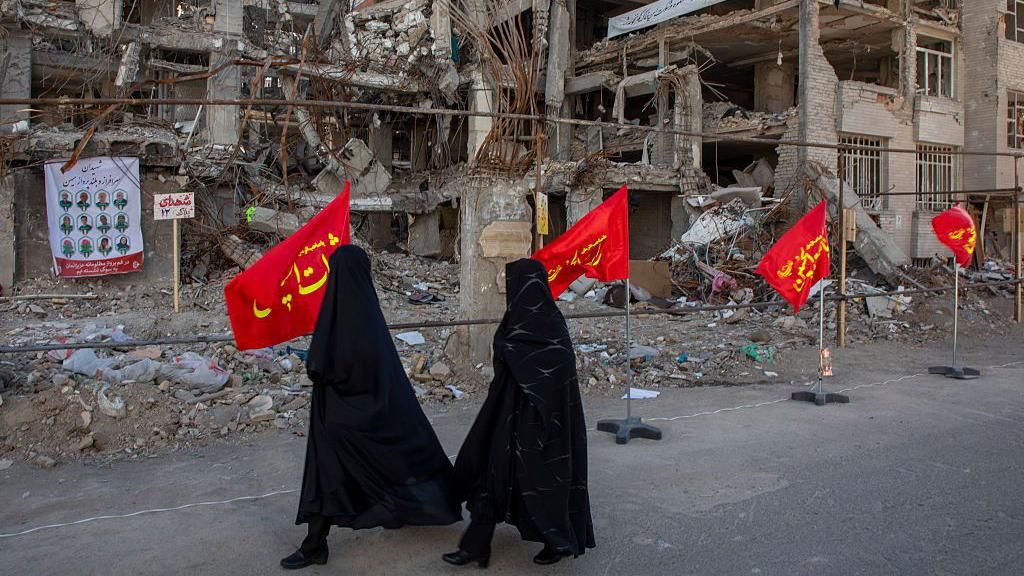
Following through on threats to decimate Iranian infrastructure is an outcome Trump says he wants to avoid. He acknowledged that any infrastructure destroyed in new strikes would eventually need to be rebuilt, and suggested the U.S. could ultimately be on the hook for part of that reconstruction. “Do I want to destroy their infrastructure? No,” he said. Currently, he estimates, it would take Iran 20 years to rebuild the country if the U.S. withdrew its forces today; a full follow-through on his bombing threats would push that timeline to a full century, he said. That figure falls short of his earlier, incendiary promise to reduce Iran to the “stone age,” but the projected humanitarian damage—compounded by the widespread regional fallout Tehran has promised from its retaliatory strikes—would still be catastrophic.
Even amid the high stakes, Trump says he remains hopeful that a last-minute diplomatic breakthrough is possible. He claimed Monday that “We have an active, willing participant on the other side. They would like to be able to make a deal. I can’t say any more than that.” The president’s deliberate lack of detail has drawn notice, even as he insists his administration has planned for every possible outcome. “Every single thing has been thought out by all of us,” he said, declining to share further details of his plan.
The opacity could signal that behind-the-scenes negotiations are further along than the public narrative has suggested. But it could also be a combination of tactical bluffing and optimistic wishful thinking, as the deadline for action draws near. “They have till tomorrow,” Trump said. “We’ll see what happens. I believe they’re negotiating in good faith. I guess we’ll find out.”