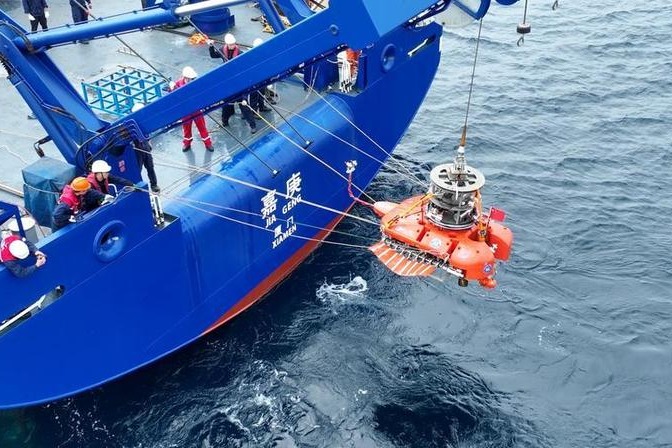
Off the rugged coast of Zhuhai, Guangdong, choppy grey-green South China Sea waters have become an unexpected testing ground for a technological revolution that could reshape China’s rapidly growing marine aquaculture industry. In late March, 16 teams of engineers and researchers gathered here for the final round of the first-ever Guangdong-Hong Kong-Macao Greater Bay Area Marine Underwater Robot Application Challenge – a competition unlike any before, held not in controlled laboratory tanks or calm shallow coastal bays, but in a fully operational working marine ranch.
This shift from controlled testing environments to unforgiving open-sea conditions is no trivial change. Organizers designed the competition to directly tackle the most persistent operational challenges that have long held back marine ranching operators, turning industry pain points into a catalyst for building more cost-effective, reliable, commercially viable robotic solutions that can power a smarter, more resilient ocean economy.
Over two days of competition, participating teams put their custom-built machines through real-world tasks that mirror the daily work of marine ranch crews: recovering misplaced submerged mooring anchors, harvesting shellfish from the seabed, and removing accumulated biofouling from aquaculture netting. Unpredictable offshore currents, choppy swells, and high water turbidity – conditions that often disrupt sensitive underwater electronics – put every robot’s capabilities to a rigorous, unforgiving test.
Judges emphasized that the open-sea setting pushes developers to prioritize practical, industry-ready performance over flashy lab prototypes. Teams are forced to optimize their designs for three critical industry requirements: cost-effectiveness, long-term reliability, and user-friendliness for on-site ranch workers, clearing key barriers to rapid commercial rollout.
The need for these solutions is far from hypothetical. In 2025, Typhoon Ragasa devastated local marine ranch operations, leaving Yuehe Fisheries, a major local producer, with more than 700 lost iron anchors scattered across the seabed. Hiring human divers to recover the anchors is prohibitively expensive, leaving most of the valuable equipment unrecovered to date.
“That’s nearly 1 million yuan (around $145,000) in direct losses,” explained Lin Jincheng, general manager of Yuehe Fisheries. Lin noted that multiple competing teams already demonstrated the exact capabilities the industry desperately needs: strong autonomous operation and reliable anti-interference performance in messy, real-sea conditions.
For winning competitors like Shenzhen Hanhai Huafan Cleaning Robotics, a specialized underwater cleaning robot developer based in nearby Shenzhen, the event has made the massive market opportunity for practical underwater robotics crystal clear.
Cai Qianxia, the company’s marketing manager, explained that its proprietary cleaning robots can operate around the clock, delivering efficiency more than 10 times higher than traditional manual cleaning methods. “Before, if you wanted to clean even a small sailboat hull, you either had to hire expensive divers or wait weeks for a dry dock slot,” Cai said. “That takes your vessel out of service, costs you money, and there are countless other limitations that robots eliminate.”
In the competition’s inspection and monitoring category, a team from Westlake University took home first prize by integrating underwater embodied AI with large language models and advanced multimodal perception technology. Team member Wang Zhangyuan noted that the competition broke down the long-standing barrier between lab research and industrial demand, bringing algorithms out of controlled lab environments and into the real-world scenarios where they are needed most.
The Zhuhai challenge was intentionally built from the ground up to respond directly to unmet industry needs. Before the competition opened, organizers published a 150-million-yuan “opportunity list” of real operational requirements from marine ranch operators, covering everything from aquaculture net inspection to lost debris retrieval and ecological monitoring. That request for solutions has already translated to more than 100 million yuan in potential orders from 17 marine ranch developers across Guangdong province. Four of the competition’s top award-winning teams have already signed preliminary agreements to establish local operations in Zhuhai’s Xiangzhou District.
This event fits into a much broader national push to develop China’s blue economy and deep-sea technology sector. China’s domestic underwater robotics market surpassed 10 billion yuan in 2024, and industry forecasts project it will grow to 40 billion yuan by 2027. For the first time, the Chinese government identified “deep-sea technology” as a strategic emerging industry in its 2025 Government Work Report, unlocking new investment and policy support for the sector.
Zhuhai, a coastal city with 9,348 square kilometers of maritime territory under its jurisdiction, has emerged as a leading hub for this development. By the end of 2025, the city had built 10 large truss-type marine ranch platforms and 452 gravity net cages, and is home to 40 oceanographic innovation platforms and 140 high-tech marine enterprises.
A senior official from the Zhuhai Municipal Marine Development Bureau explained that the competition will accelerate the translation of underwater robotic research into real-world commercial applications, while strengthening connections across the entire “industry-academia-research-application-finance” innovation chain. The end goal is to upgrade China’s marine ranching sector and cement Zhuhai’s position as a leading regional marine economy hub.