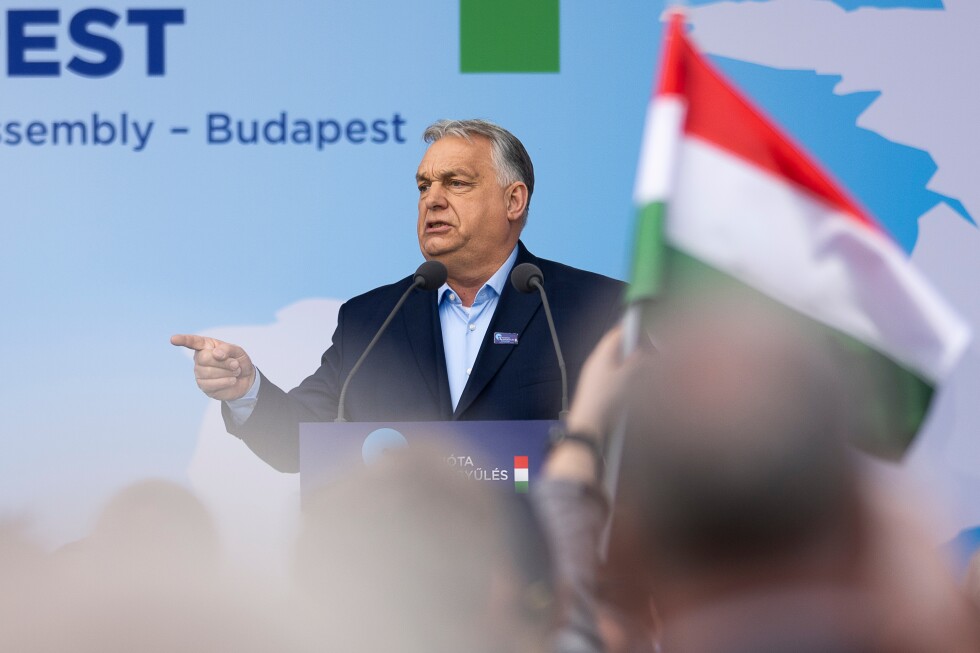
As Hungarians prepare to head to the polls for national elections on April 12, the outcome carries far-reaching consequences that extend well beyond Budapest’s borders, with much of the European Union holding its breath for a shift away from the nationalist agenda of long-serving Prime Minister Viktor Orbán. Widely framed as a test of the bloc’s institutional resilience, the vote comes as Orbán — the EU’s longest-tenured national leader — has consistently trailed his challenger Péter Magyar in pre-election opinion polling, ending what has been a 16-year unbroken grip on power that has repeatedly strained the EU’s post-WWII governance framework.
Magyar, Orbán’s main opposition candidate, has already told the Associated Press that a victory for his campaign would immediately prioritize repairing the fractured relationship between Hungary and the 27-nation bloc, a stark departure from the current administration’s approach that has gridlocked EU decision-making for years.
The bloc currently faces a cascade of unprecedented threats: the growing momentum of right-wing populism across member states, ongoing conflicts in Ukraine and the Middle East, covert Russian sabotage operations, expanding Chinese economic influence, and a shifting U.S. administration that has upended decades of established transatlantic cooperation. Against this volatile backdrop, Orbán’s repeated use of national veto power has emerged as one of the most significant barriers to collective EU action.
Political analysts and lawmakers argue that Orbán has leveraged his veto authority and deep institutional knowledge of the EU’s funding distribution system to entrench his domestic power, extract major concessions from the bloc, and wield outsize influence disproportionate to Hungary’s size. “He entered a club, read the rules, figured out how he can rig the rules, and then started to be a free rider and blackmail all of the other club members,” explained Dániel Hegedűs, deputy director of the Berlin-based Institute for European Politics. “The question is, how long will the club members tolerate it?”
The current tension between Budapest and Brussels was not inevitable. When Hungary joined the EU in 2004 as part of the bloc’s largest single expansion in history, alongside nine other post-Cold War Central and Eastern European nations, widespread optimism surrounded its integration into the European project. “It didn’t start that way,” noted Jim Townsend, a fellow at the Center for a New American Security.
But following a series of economic crises, Orbán rose to power by promising broad-based prosperity for all Hungarians, while building strategic alliances with conservative political forces across the bloc. Gábor Scheiring, a former Hungarian lawmaker now teaching at Georgetown University in Qatar, explained that for years Orbán maintained a contradictory position: he regularly vilified EU leadership in Brussels, often drawing unflattering comparisons to the former Soviet Union, while simultaneously collecting billions in EU development funding and resisting widespread international pressure to reverse democratic backsliding within Hungary’s borders.
From 2014 to 2022, “Hungary was one of the biggest beneficiaries of EU funds,” Scheiring said. “Orbán could navigate the EU system really well: get all the money and get away with his political shenanigans.”
By 2022, growing frustration over Orbán’s failure to uphold EU standards of judicial independence, press freedom, and anti-corruption safeguards prompted Brussels to freeze nearly €10 billion in allocated funding to Budapest. The rift deepened dramatically after Russia’s full-scale invasion of Ukraine in 2022: Orbán, who has long maintained close personal ties to Russian President Vladimir Putin, has repeatedly used his veto to block EU-wide efforts to provide military and financial support to Kyiv and impose harsh economic sanctions on Moscow.
The most high-profile standoff came in early 2024, when Orbán backed out of a December 2023 agreement to approve a €90 billion ($104 billion) support package for Ukraine, prompting a rare public rebuke from European Council President Antonio Costa, who told reporters: “Nobody can blackmail the European Union institutions.”
Beyond the immediate standoff over Ukraine, Orbán’s persistent use of the veto has laid bare a fundamental structural flaw in the EU’s governing framework: the requirement of unanimous member state approval for all major policy decisions. Critics note that this rule has already blocked stronger collective action on other critical global issues, including the ongoing conflict in Gaza.
German MEP Daniel Freund pointed to an internal European Parliament analysis showing that Orbán has issued more vetoes than any other national leader in the EU’s history. “It’s staggering. No one else even comes close,” Freund said. “This is the biggest design flaw in the EU that he has exposed.”
The crisis sparked by Orbán’s governance has reignited calls for sweeping reform of the EU’s foundational treaties to build greater protections against authoritarian member states, regardless of whether Orbán wins or loses the April election. Multiple reform pathways have been proposed, but each carries significant limitations.
The most widely discussed change would reduce the number of policy areas that require unanimous voting, allowing major measures to pass with a qualified majority of the 27 member states representing at least two-thirds of the bloc’s total population. Other proposals include tougher targeted sanctions from the European Commission against member states that violate core EU rules, and even invoking Article 7 of the Treaty on European Union — a rarely used legal mechanism that would revoke Hungary’s voting rights within bloc institutions. Invoking Article 7 requires unanimous approval from all other EU leaders, however, and Slovak Prime Minister Robert Fico has already publicly stated he would veto such a move.
Brussels also holds an existing bargaining chip in the form of €16 billion ($18.4 billion) in allocated defense capability funding, part of a bloc-wide program to boost national defense infrastructure. Every other member state that has submitted a funding request has received approval, but Hungary’s bid remains stalled in Brussels. If Orbán secures a new term, Hegedűs argues that the EU could use this funding to extract concessions, such as lifting his veto on the Ukrainian support package. But he also warns that the strategy carries risks: “What will the EU offer in two to three or four months when the next strategic decision will come and Orbán will block again?” Hegedűs asked.
Beyond institutional reform, Orbán’s confrontational approach has prompted a full re-evaluation of the EU’s processes for accepting new member states and monitoring compliance from existing members. Ongoing accession negotiations with Moldova, Montenegro, and Ukraine are already being reshaped by the bloc’s turbulent experience with Hungary.
In February, European Enlargement Commissioner Marta Kos noted that the 2004-2007 expansion that brought Hungary and 11 other nations into the bloc “led to a new era of stability for our continent and an impressive level of economic convergence.” But without naming Hungary specifically, she acknowledged that the experience has revealed critical gaps in oversight. “A lesson learned from 2004 is that we need to have safeguards that ensure new members stick to the rules,” Kos said. “If countries go backwards on our fundamentals, such as democracy and rule of law, the safeguards must bite. No Trojan horses.”
Hungary’s Orbán has long annoyed the European Union. Now some hope he faces defeat