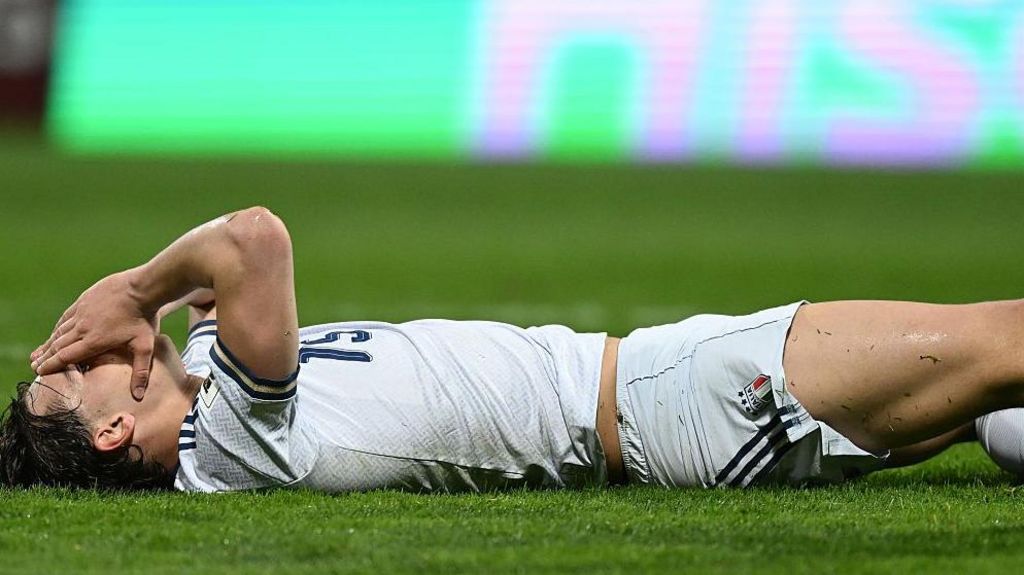
On a crisp spring morning in central Rome, 65-year-old Tommaso Silvestri leaned against a brick wall beside a neighborhood newsstand, his eyes drifting across bold, gloomy front pages dominated by headlines labeling Italy’s latest international football exit an “apocalypse,” “scandal,” and “disaster.”
“We’ve made a real mess of it,” Silvestri told reporters, shaking his head in quiet disappointment. “We had players who couldn’t even find the target. The golden days of Italian football are well and truly gone.”
The heartbreak unfolded Tuesday night in Zenica, where four-time World Cup champions Italy fell to a devastating 4-1 penalty shootout defeat against Bosnia and Herzegovina, sealing the nation’s third consecutive elimination from World Cup qualification. The match turned against the Azzurri before halftime, when defender Alessandro Bastoni was sent off with a red card, reducing Italy to 10 men for the rest of regulation. A late equalizer from Moise Kean briefly sent Italian fans into a frenzy of hope, forcing the contest to penalties — only for Pio Esposito to miss the team’s opening spot kick, setting the stage for elimination.
Italy’s run of international disappointment stretches back nearly two decades, dating to the team’s iconic 2006 World Cup title. Outside of a shock, beloved European Championship victory over England at Wembley in 2021, the Azzurri have consistently underperformed in major global tournaments, leaving long-time fans disheartened.
“We are what our results say we are,” Silvestri said. “When you shoot and can’t even hit the goal, you’re not going to go far. When it comes to taking the game home, Italy just doesn’t get there anymore.”
The defeat sparked immediate, fierce reaction across Italian political and civic circles. Senate president Ignazio La Russa, a senior leader of Prime Minister Giorgia Meloni’s far-right Brothers of Italy party, lamented the outcome in a public post on X.
“Everything has a limit,” La Russa wrote. “We’re not going to the World Cup. We supported them, we hoped, we even railed against a couple of questionable refereeing decisions… but deep down we feared it. In fact, we knew it.”
Prominent anti-mafia author Roberto Saviano, best known for *Gomorrah*, went further, pointing to deep-rooted systemic failures across every layer of Italian football, from top-level club governance to grassroots youth development.
“Clubs are corrupt and at the mercy of criminal organisations. True laundering vaults,” Saviano wrote in an Instagram post. “No investment in young players, no care for second-generation talent. It’s easier to buy foreign players than to develop new athletes.”
Across Rome, a city steeped in decades of Azzurri triumph, long-time supporters expressed deep anger and disillusionment. Seventy-one-year-old Giovanni Colli, sipping espresso at a sidewalk café near the Pantheon, told reporters he felt “betrayed” by the result.
“Not going to the World Cup three times in a row, how on earth did it happen?” Colli said. “What a huge disappointment. Everyone should resign. Give the young players a chance.”
The grief of the moment was captured by Azzurri head coach Rino Gattuso, a 2006 World Cup-winning midfielder who only took the national team job last June. A teary-eyed Gattuso struggled to hold back his emotions as he addressed reporters after the match, before retreating to the dressing room.
“We don’t deserve this, it’s not fair. I’m sorry I couldn’t make it happen,” Gattuso said, his voice breaking. Despite the crushing defeat, he added that he remained proud of his team’s effort: “I’m proud of my boys and what they gave on the pitch.”
Gattuso acknowledged the team’s missed opportunities, a recurring theme of the night. “When you have chances and don’t take them, football punishes you,” he said. “This hurts. We gave everything we could. It’s a real shock.”
Elisabetta Esposito, a veteran sport journalist with leading Italian outlet *La Gazzetta dello Sport*, told the BBC that the defeat exposes a broader, long-running crisis in Italian football that will not be fixed with quick fixes. Esposito noted that loyalty to top domestic clubs increasingly overshadows national team pride, a shift that has eroded public support for the Azzurri.
“The risk is that this third consecutive failure to qualify will deepen young people’s disengagement from the Azzurri,” Esposito said. “The disappointment is profound, but the country is not only disappointed but almost disillusioned. It’s as if a new generation no longer knows what it means to cheer for their country.”
From a technical perspective, Esposito added, every part of the game broke down for Italy. The team lacked consistent chemistry built through long-term work together, and rushed, short-sighted decisions focused on immediate wins will not fix the underlying issues. “Rebuilding will require a long-term strategy,” she emphasized.
Even casual observers across Italy acknowledged the weight of the moment. Walking her dog through a busy central Rome street, 56-year-old Teresa expressed surprise when told of the result, echoing the national sense of gloom. “Oh, we are not going to the World Cup? I don’t know much about football, but that’s a bit of disaster, isn’t it?”