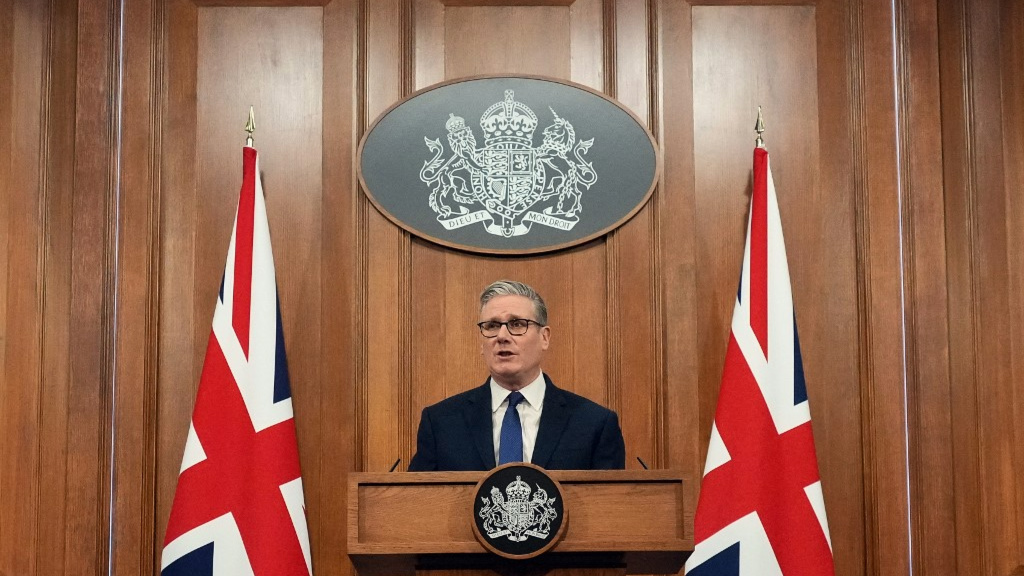
As the conflict between the US-led coalition and Iran enters another week, British Prime Minister Keir Starmer has delivered a televised address to the nation seeking to ease widespread public anxiety over the UK’s potential entanglement in the war. Standing behind a Downing Street podium on Wednesday morning, flanked by two Union Jacks and clad in a somber blue tie, the prime minister appeared visibly fatigued and grave as he addressed the unfolding crisis in the Gulf region.
Starmer’s speech shifted between moments of calm reassurance, expressions of sympathy for those affected by escalating tensions, and weighty, often abstract warnings about the historic stakes of the current conflict. Opening with a message of resolve, he told the British public: “No matter how fierce this storm, we are well placed to weather it.”
The core policy announcement of the address was the formation of a 35-nation unified coalition dedicated to protecting maritime security in the Gulf waters. Starmer confirmed that UK Foreign Secretary will host the first in-person gathering of coalition members later this week, with the explicit goal of securing unimpeded, safe access to the Strait of Hormuz — the strategically critical chokepoint currently held under de facto Iranian control. Acknowledging the challenge ahead, Starmer admitted: “This will not be easy.”
Throughout the 20-minute address, the prime minister repeatedly pushed back against growing public fears that the UK would be pulled into active combat. “People worry that the UK will be dragged into this,” he said. “We won’t. This is not our war. We will not be drawn into the conflict.”
The address comes amid significant pressure on Starmer from former US President Donald Trump, who has spent weeks publicly mocking and criticizing the British leader for his initial hesitation to back the US-Israeli operation against Iran. Wednesday’s speech was widely seen as an attempt to balance defiance against US pressure with reassurance for a war-weary British public.
But Starmer’s insistence on UK neutrality has left many Britons confused, given the critical role British territory plays in US military operations against Iran. RAF Fairford, a Royal Air Force base located in southwest England’s Gloucestershire, has become a key launching pad for US strikes targeting Iranian military infrastructure. As of the start of this week, 23 long-range US bombers are stationed at the base, which the US has been permitted to use for strikes against Iranian missile sites and offensive operations intended to open the Strait of Hormuz, a deployment that entered its second week this week.
Just hours before Starmer’s address, Iran’s ambassador to the UK, Seyed Ali Mousavi, told Times Radio that Tehran was actively considering retaliatory strikes against British bases hosting US forces. A week and a half earlier, Iranian Foreign Minister Seyyed Abbas Araghchi had already warned the UK’s foreign secretary that allowing the US to use British soil for military action amounted to “participation in aggression.” Speaking Wednesday, Mousavi called the UK’s position “very unfortunate.”
Beyond the question of military involvement, Starmer sought to manage public expectations around the economic fallout of the crisis, pushing back against optimistic claims from Donald Trump that the war is nearly over. Trump, who on Tuesday publicly told the UK to “go get your own oil” and insisted the US would not assist European allies in re-opening the Strait of Hormuz, has framed the conflict as nearing a successful conclusion. Starmer pushed back against that optimism, telling the public: “I don’t think it can necessarily be assumed that a de-escalation of the conflict at the same time brings a reopening of the Strait of Hormuz.”
On the topic of domestic energy costs, which have been rocked by Gulf conflict volatility, Starmer confirmed that existing government support measures remain in place: a four-month cap on household energy bills and a freeze on fuel duty lasting until September. He claimed the government was “ahead of the game” in responding to price swings, and deflected repeated questions from reporters about whether he would follow Australian Prime Minister Anthony Albanese’s lead, who earlier the same day urged his citizens to reduce fuel consumption by switching to public transport where possible. “I’m sick and tired of your energy bills fluctuating up and down,” Starmer said. “We’re taking back control of our energy security by investing in clean British energy.”
The prime minister also used the crisis to announce a vague long-term strategy, promising that the UK would not return to “business as usual” after the conflict ends. “This time will be different,” he pledged, revealing that the government has drafted a “long term plan to emerge from this war a stronger and more secure nation” — though he offered no specific details on what the plan entails. “How we emerge from this crisis will define us for a generation,” he said. For Starmer, the immediate political priority remains upcoming local elections scheduled for May, as the prime minister balances national crisis management with domestic political pressures.