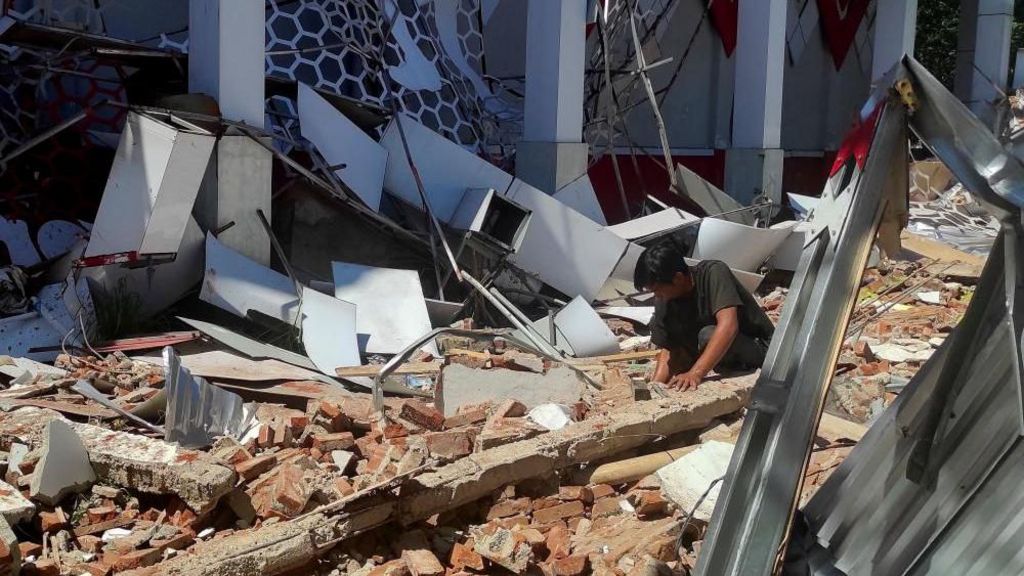
In the early hours of Thursday local time, a powerful 7.4-magnitude earthquake jolted the Molucca Sea off Indonesia’s Ternate Island, leaving one person dead and triggering panic across coastal communities in the country’s eastern region.
The United States Geological Survey recorded the tremor striking at 6:48 a.m. local time (22:48 GMT Wednesday) at a depth of 35 kilometers, with its epicenter located roughly halfway between the Sulawesi city of Manado and the North Maluku volcanic island of Ternate. Within an hour of the initial shock, Indonesia’s national geological agency confirmed structural damage to buildings and reported multiple injuries, though full casualty and damage assessments were still ongoing in the hours after the event. At least two aftershocks measuring 5.5 and 5.2 magnitude followed the main quake, with local authorities warning residents to prepare for additional aftershocks in the coming hours and days.
One confirmed fatality has been recorded: a 70-year-old woman in North Sulawesi who was crushed by falling building debris, according to Indonesia’s state-run national news agency Antara. A second person suffered a broken leg after jumping from a multi-story building to escape the shaking.
The powerful tremor immediately sparked a regional tsunami warning, with the Hawaii-based Pacific Tsunami Warning Center initially noting that low-lying waves less than 0.3 meters high could reach coastlines stretching from Guam and Japan to Malaysia, the Philippines, Papua New Guinea and Taiwan. The alert was fully lifted just two hours later after no abnormal tsunami activity was detected across the region.
For residents across eastern Indonesia, who live in one of the world’s most seismically active zones and experience frequent small tremors, the strength of Thursday’s quake stood out as unprecedented in recent memory. Multiple residents told international reporters it was the most powerful seismic event they had experienced in at least six years.
Isvara Safitri, a journalist based in central Manado, described the scene to BBC Indonesian: “It was really strong… My head even felt dizzy. Even the roads outside the house were shaking.” In Bitung, a coastal city on Sulawesi’s northeastern shore, Yayuk Oktiani was shopping at a local market when the tremors began. “Everything started shaking. Several stores experienced power outages, and as the tremors got stronger, everyone fled,” she recalled. Oktiani immediately rushed to her child’s school, located just steps from the ocean, where chaos had already broken out. “Teachers immediately told parents to bring their children home, even though they had only just arrived,” she said.
On Ternate Island, resident Budi Nurgianto told Agence France-Presse that the walls of his home vibrated for more than a minute, forcing him to rush outside into widespread panic. “There were many people outside… I even saw some people leaving their house without having finished their shower,” he said. At Manado’s Siloam Hospital, 69-year-old patient Admini described the frantic evacuation process. “We were sitting there drinking tea… Initially we didn’t realise it was an earthquake. And then we heard a child scream, ‘Come down, hurry up,’” he recalled. Medical staff quickly moved patients out of the hospital building, setting up makeshift treatment zones in open outdoor areas and inside parked vehicles. “Everyone was huddled together outside. Some were in wheelchairs, others were helping each other,” Admini said.
Footage captured by search and rescue teams operating in Manado shows first responders and local residents navigating the rubble of a damaged local sports complex, where large pieces of furniture were thrown across the ground and steel support structures were bent out of shape by the force of the quake. Search and recovery operations are ongoing, with teams working to clear damaged structures and account for any residents who may still be missing.
The Indonesian archipelago sits along the Pacific Ring of Fire, a zone of intense tectonic activity that sees frequent volcanic eruptions and large earthquakes, making seismic risk preparedness a persistent priority for national authorities.