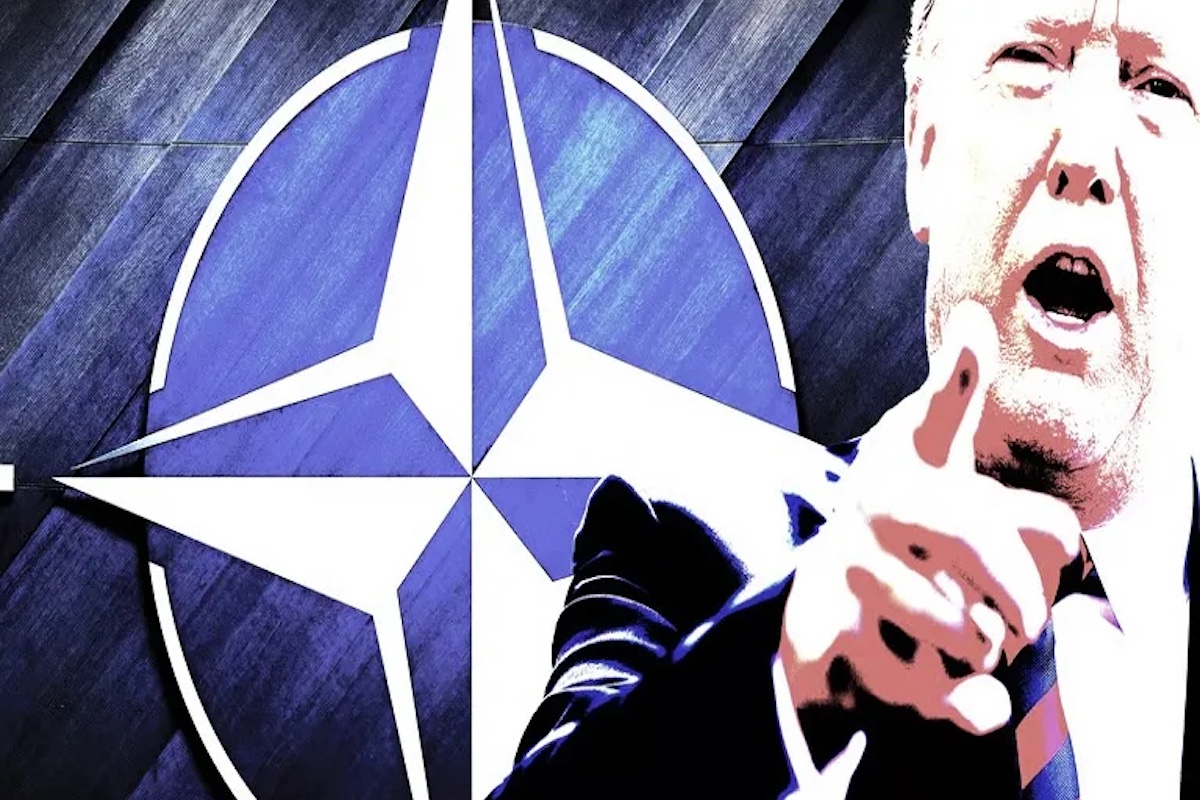
A growing transatlantic crisis has erupted over the US-led war on Iran, with major European allies rejecting Washington’s demands to join the conflict and pushing forward independent diplomatic efforts to resolve the closure of the critical Strait of Hormuz. The rift has escalated to the highest levels, with US President Donald Trump openly lambasting European allies for their refusal to back the conflict, threatening to withdraw the United States from the 75-year-old NATO alliance, while the United Kingdom has moved forward with a landmark diplomatic summit excluding the US to de-escalate the crisis.
On Wednesday, UK Prime Minister Keir Starmer announced that London would host talks bringing together 35 nations to pursue a diplomatic solution to reopen the Strait of Hormuz, the strategic chokepoint through which roughly one-quarter of the world’s global oil supplies transit. The initiative builds on earlier joint efforts by the UK and France to secure unimpeded safe passage for commercial shipping in the waterway, which has been closed amid the ongoing conflict. Starmer emphasized that the gathered nations will collaborate to evaluate every viable diplomatic and political pathway to restore freedom of navigation, secure the release of trapped vessels and seafarers, and restart the flow of critical global commodities through the strait.
Iran’s Islamic Revolutionary Guards Corps pushed back on the same day, reaffirming that the strait will remain closed to what it describes as the “enemies of this nation,” and asserting full, unchallenged control over the waterway. This statement contradicts repeated claims from Trump that a negotiated end to the war is imminent.
Trump’s aggressive rhetoric toward Europe began a day earlier, when he launched a blistering tirade against European leaders who have refused to join the US-Israeli war on Iran. He called European leaders “cowards,” told them to “go get your own oil,” and warned that the US would no longer come to their defense, stating “you will have to start learning how to fight for yourselves, because the US won’t be there to help you anymore, just like you weren’t there for us.”
These remarks came amid confirmed reports that multiple major European nations have restricted access for US military aircraft involved in the Iran campaign to their airspace and military bases. On Monday, Spanish Prime Minister Pedro Sánchez’s socialist government, which has publicly condemned the war as illegal, formally closed Spanish airspace to all US aircraft participating in operations against Iran. Italy has also followed suit, labeling the conflict illegal and denying US warplanes permission to refuel and stage from the key Sigonella air base in Sicily. France, meanwhile, issued a formal denial of Trump’s claims that it had blocked US military overflights of its territory.
In a revealing development, The Telegraph reported Wednesday that Trump is actively considering a full US withdrawal from the North Atlantic Treaty Organization, describing the alliance as nothing more than a “paper tiger” in comments to the British outlet. Secretary of State Marco Rubio amplified this position in an interview with Fox News host Sean Hannity Tuesday evening, arguing that the alliance must be fundamentally reevaluated. “If now we have reached a point where the NATO alliance means that we can’t use those bases, that in fact we can no longer use those bases to defend America’s interests, then NATO is a one-way street,” Rubio added.
Founded in 1949 to counter Soviet influence in Europe, NATO faces an unprecedented existential crisis from Trump’s threats. Any US withdrawal would require congressional approval, a high bar after lawmakers passed 2023 legislation explicitly requiring congressional consent for any US exit from the alliance, a measure directly drafted in response to Trump’s earlier threats to leave the pact.
Starmer, responding to Trump’s comments on NATO, reaffirmed the UK’s unwavering commitment to the alliance during a Wednesday press conference. “NATO is the single most effective military alliance the world has ever seen,” the Labour leader said. “It has kept us safe for many decades.”
“Whatever the pressure on me and others, whatever the noise, I’m going to act in the British national interest,” Starmer continued. “And that’s why I have been absolutely clear that this is not our war, and we’re not going to get dragged into it. But I’m equally clear that when it comes to defense and security, and our economic future, we have to have closer ties with Europe.”
Critics have pushed back on Starmer’s claim that the UK is not a participant in the conflict, pointing out that his government continues to allow US forces to use British military bases to launch strikes against Iran. UK Green Party leader Zack Polanski has called on Starmer to demonstrate genuine leadership by ending all British involvement in the war and canceling King Charles III’s upcoming state visit to the United States.
This is not the first time NATO has faced deep internal rifts over US military action. In 1986, France, Italy and Spain denied US overflight access for Ronald Reagan’s bombing of Libya, and a far deeper split opened in 2003 over George W. Bush’s illegal regime-change war in Iraq, which split European allies between participating and opposing nations. Anti-war critics have long argued that NATO has been obsolete since the end of the Cold War 35 years ago, and that its expansion eastward helped provoke Russia’s full-scale invasion of Ukraine, while supporters maintain the alliance has been the foundation of post-WWII European peace and prosperity.
Starmer’s call for closer alignment with Europe comes a decade after the UK’s 2016 Brexit referendum, amid growing public regret over the decision to leave the European Union. A September 2025 poll by Best for Britain found more than 60% of respondents now view Brexit as a mistake, with only 11% calling the departure a success.
The escalating tensions come as conflicting claims emerged this week over a potential ceasefire. Trump posted on his Truth Social platform Wednesday claiming Iran “has just asked the United States of America for a CEASEFIRE!” — a claim immediately denied by official Iranian media. Trump doubled down on his hardline position, echoing Defense Secretary Pete Hegseth’s mantra that the US is “negotiating with bombs,” stating: “We will consider [a ceasefire] when Hormuz Strait is open, free, and clear. Until then, we are blasting Iran into oblivion or, as they say, back to the Stone Ages!!!”
The human cost of the 33-day US-Israeli bombing campaign has been steep. Iranian officials confirm nearly 2,000 Iranians have been killed. A coalition of international human rights groups reported Friday that nearly 1,500 of those killed were civilians, including 217 children. A large share of these civilian deaths came from a late February US cruise missile strike on a girls’ school in Minab that killed approximately 175 people.