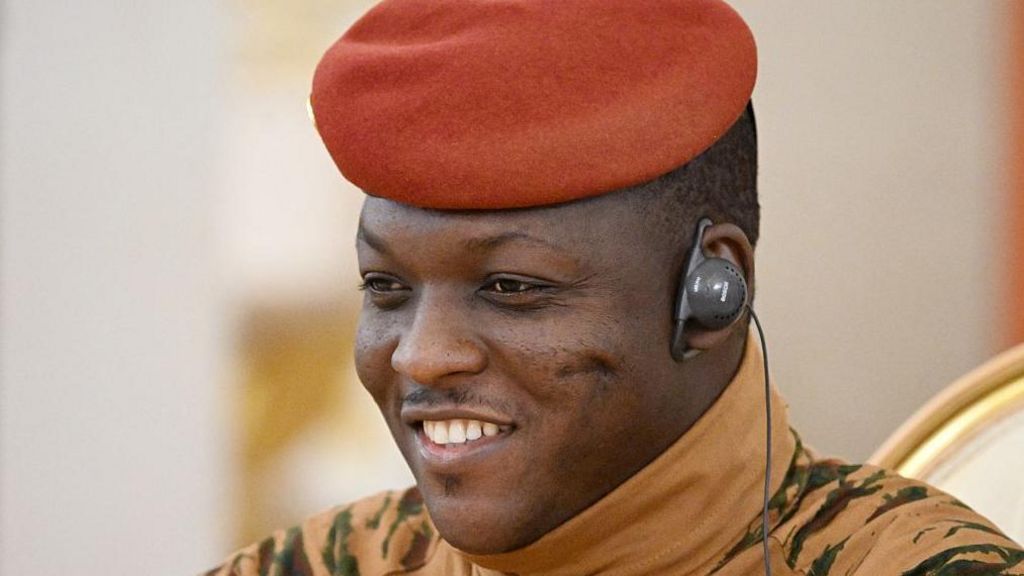
Three years after Ibrahim Traoré seized power in a military coup in Burkina Faso, a damning new investigation from Human Rights Watch (HRW) has uncovered staggering civilian casualties, including allegations of systematic war crimes and crimes against humanity perpetrated by both state forces and armed jihadist groups. Between January 2023 and August 2025 alone, the rights organization documented 57 separate violent incidents that left 1,837 civilians dead, among them dozens of children. More than two-thirds of these deaths — 1,255 in total — are attributed to the Burkinabé military and its allied civilian militias, while the remaining killings are linked to Islamist insurgent groups active in the region.
The report’s most significant legal finding holds that Traoré and six senior military commanders may bear command responsibility for these grave human rights abuses, and recommends that all seven be formally investigated for their alleged roles. Five top jihadist leaders are also named as potentially culpable for violence against civilian populations. The BBC reached out to Burkinabé junta officials for comment on the new findings; authorities have repeatedly rejected past accusations of indiscriminate civilian killings by their forces.
When Traoré’s junta seized power in September 2022, ousting the interim military leader Paul-Henri Sandaogo Damiba who had taken power just nine months prior, its core stated justification was a promise to more effectively defeat a decade-long Islamist insurgency linked to al-Qaeda that has seized control of large swathes of Burkina Faso’s territory and destabilized neighboring countries. But the HRW report, which draws on rigorous open-source intelligence analysis — including verified photos, video footage, satellite imagery, and firsthand interviews with hundreds of witnesses and survivors — paints a far grimmer picture: that all parties to the conflict have systematically violated international humanitarian law.
“All sides are responsible for the war crimes of willful killing, attacks on civilians and civilian objects, pillage and looting, and forced displacement,” the report concludes. It specifically accuses the Traoré-led junta of committing “horrific abuses,” failing to hold any perpetrators accountable for civilian deaths, and actively blocking independent reporting to conceal the scale of suffering among trapped populations. Philippe Bolopion, HRW’s executive director, emphasized the gap between the scope of the crisis and global indifference: “The scale of atrocities taking place in Burkina Faso is mind-boggling, as is the lack of global attention to this crisis.”
One of the deadliest single incidents documented by the investigation dates to December 2023, when military forces and allied militias allegedly killed more than 400 civilians in the northern border town of Djibo. A 35-year-old survivor who spoke to researchers described losing her two daughters immediately in the attack, while she and her nine-month-old infant suffered bullet wounds. She recounted a militia fighter telling his comrades, “Make sure no-one is breathing before heading out.” Many survivors described the mass killings as “butchery,” and researchers confirmed that nearly all who lost family or escaped violence carry permanent, severe psychological trauma from their experiences.
The militias that work alongside the Burkinabé military, known as the Volunteers for the Defence of the Fatherland (VDP), are civilian recruits the junta enlisted to bolster counter-insurgency operations. The report also documents allegations that the junta has forced political critics to join the VDP as a form of punishment. Traoré has publicly defended this forced conscription policy, arguing that “individual freedoms [are] not superior to national freedom” and that “a nation is not built on indiscipline and disorder.”
Since the military government took power, counter-insurgency operations have increasingly targeted civilian communities in response to attacks by JNIM, al-Qaeda’s regional affiliate and the largest active jihadist group in the country. For ordinary Burkinabé, this has created an untenable catch-22: civilians told HRW they feel “caught between a rock and a hard place,” threatened with execution by JNIM for suspected collaboration with the state, and targeted by government forces for alleged ties to insurgents. For its part, JNIM has carried out widespread campaigns of violence and intimidation to control local communities, deliberately targeting civilians who refuse to submit to the group’s authority. In one high-profile 2024 attack, JNIM fighters shot dead at least 133 people and injured more than 200 in less than two hours, according to the report.
In line with its findings, HRW is calling on the International Criminal Court (ICC) to open an immediate preliminary investigation into all alleged crimes committed by all parties to the conflict since September 2022. The organization is also urging international partners and donor countries to impose targeted sanctions on senior Burkinabé officials and suspend all military cooperation with the Traoré government.
Despite his authoritarian rule and the allegations of mass atrocities, 38-year-old Traoré has built a large popular following across the African continent, buoyed by his vocal pan-Africanist politics and sharp criticism of Western neocolonial influence. Like neighboring Mali and Niger, both of which are also controlled by military juntas, Burkina Faso has cut most security cooperation with Western nations — particularly former colonial power France — since Traoré took power, and has turned to Russia for military support. Even with this new partnership, the ongoing insurgency and civilian death toll have continued to rise with no sign of abating.