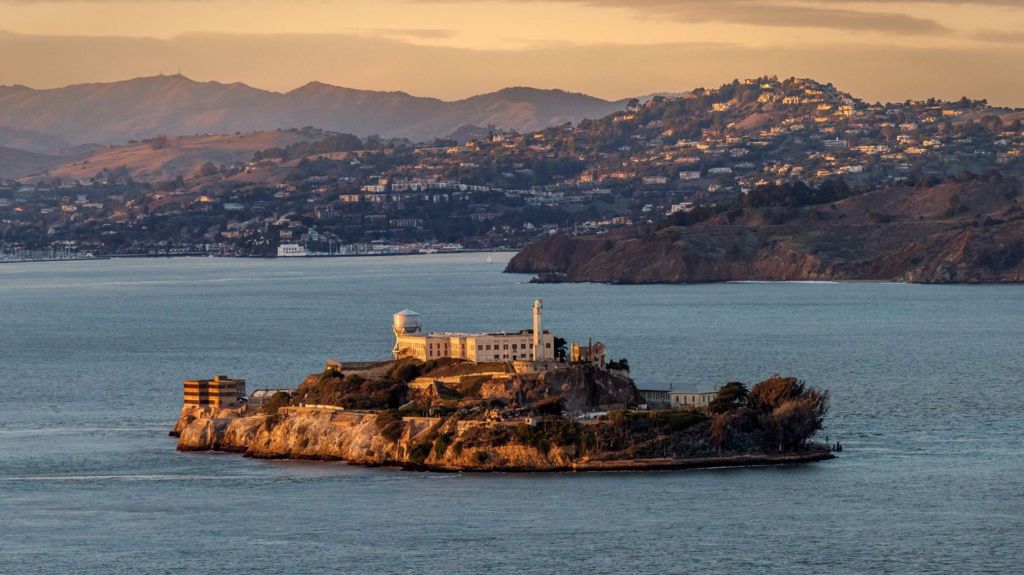
A controversial new provision in the Trump administration’s 2027 fiscal budget request has sparked fierce political debate across California, as the White House seeks $152 million to restart operations at one of America’s most infamous correctional facilities: Alcatraz Island.
Perched just off the coast of San Francisco, within view of the iconic Golden Gate Bridge, Alcatraz—widely nicknamed “The Rock”—has held a unique place in American popular culture for decades. First built as a coastal naval defense fort in the 1800s, the site was converted first into a military prison, then into a maximum-security federal prison in the 1930s under the U.S. Department of Justice. For nearly 30 years, it held some of the nation’s most notorious criminals, including gang kingpin Al Capone, organized crime leader Mickey Cohen, and Prohibition-era outlaw George “Machine Gun” Kelly. The site’s remote location and brutal conditions made it nearly impossible to escape, cementing its reputation as the most feared prison in the country.
Alcatraz’s operational costs far outpaced those of other federal facilities, however. By 1963, the Bureau of Prisons confirmed running the island prison cost three times more than any comparable mainland facility, in large part due to the lack of natural infrastructure: the island has no native running water or permanent sewage system, meaning all supplies and waste must be shipped in and out by boat. It was permanently decommissioned as a prison that year, and turned over to the National Park Service to operate as part of the Golden Gate National Recreation Area. Today, it is one of San Francisco’s most popular tourist landmarks, drawing millions of visitors each year and generating roughly $60 million in annual tourism revenue for the region. It has also been featured in dozens of major Hollywood films, including *Escape from Alcatraz* starring Clint Eastwood and *The Rock* starring Sean Connery and Nicolas Cage.
The Trump administration’s proposal would reverse that decades-long status. The $152 million request would cover the first year of construction costs to “rebuild Alcatraz as a state-of-the-art secure prison facility,” and is part of a broader $1.7 billion investment package for the Bureau of Prisons. President Trump first announced the plan on his social media platform Truth Social last year, stating he was directing the Bureau of Prisons, Department of Justice, FBI, and Department of Homeland Security to collaborate on a “substantially enlarged and rebuilt ALCATRAZ” that would “house America’s most ruthless and violent offenders.”
The proposal has faced immediate, fierce pushback from Democratic politicians in California, who have raised a host of practical, financial, and cultural objections to the plan. House Democratic leader and longtime California representative Nancy Pelosi called the proposal “absurd on its face and should be rejected outright.” In a statement, Pelosi argued that “rebuilding Alcatraz into a modern prison is a stupid notion that would be nothing more than a waste of taxpayer dollars and an insult to the intelligence of the American people.” Pelosi and other local politicians also warned that converting the island back into an active prison would permanently eliminate one of the Bay Area’s most iconic tourist landmarks, cutting off millions in annual economic revenue.
Beyond the loss of tourism, critics point to long-standing structural challenges that led to Alcatraz’s original closure 62 years ago, which remain unresolved. The island still lacks any natural source of running water or a permanent, modern sewage system, requiring all infrastructure for the facility to be built from scratch at massive extra cost. Unlike the 1960s, modern environmental regulations would also add billions in unaccounted-for costs to the project, critics say, making the final price tag far higher than the Trump administration’s initial estimate. Even if construction is completed, ongoing operational costs will still dwarf those of any mainland federal prison, as all food, fuel, staff, and supplies must be ferried to the island daily.
Before the plan can move forward, it must first receive full approval from the U.S. Congress, where Democratic leaders have already signaled they intend to block the provision. While the proposal is popular with some conservative voters who frame Alcatraz as a symbol of harsh justice for violent crime, it remains deeply unpopular with California voters, local leaders, and the tourism industry that relies on the landmark for thousands of local jobs.