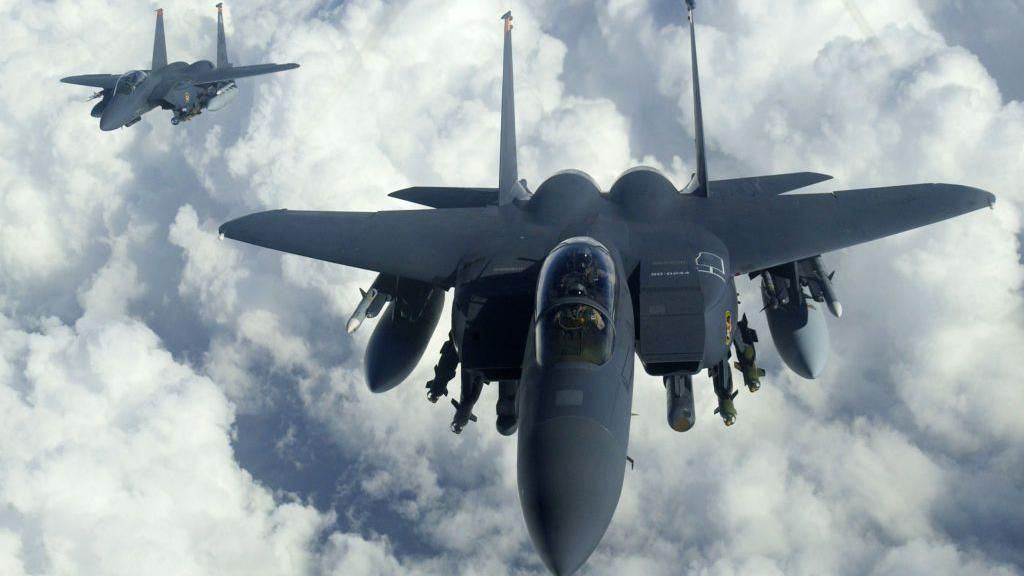
In a high-stakes operation that U.S. officials are calling one of the most audacious combat search and rescue missions in modern American military history, U.S. forces have successfully recovered the second missing crew member from a U.S. F-15E Strike Eagle shot down by Iranian air defenses over southern Iran late last week.
Former President Donald Trump confirmed the successful extraction in a series of social media posts Sunday morning, announcing the downed air officer was “now SAFE and SOUND!” before later clarifying the service member had sustained serious injuries during the incident. The two-person F-15 crew both ejected after the jet was downed, and the first crew member was recovered by U.S. forces in an earlier, separate extraction attempt.
Details of the cross-border operation remain tightly held, but emerging accounts from U.S. officials and major media partners paint a picture of a frantic race against time between U.S. and Iranian forces to locate the missing airman after the crash. A source familiar with the mission described it as a massive, high-risk combat search and rescue (CSAR) operation launched deep into Iranian sovereign territory.
According to CBS News, the U.S. media partner of the BBC, Trump halted multiple pre-planned U.S. operations across Iran to reallocate resources to the rescue, deploying dozens of elite special operations personnel to execute the mission. The president emphasized the extraordinary danger of the operation in his social media remarks, noting that such high-risk raids inside enemy territory are almost never attempted, calling the successful outcome a remarkable achievement.
CSAR missions for downed aircrew are among the most complex and time-sensitive operations special operations forces prepare for, typically requiring low-flying helicopters to penetrate hostile airspace, supported by strike aircraft and combat patrols to secure the extraction zone. In this case, the downed airman, a colonel, evaded Iranian capture for more than 24 hours while hiding in rugged, treacherous southern Iranian mountain terrain. He survived alone with only a handgun, taking shelter in a rocky mountain crevice after hiking 7,000 feet up a remote ridge to avoid detection. U.S. intelligence and military teams maintained 24-hour surveillance of the colonel’s position throughout the evasion period to plan the optimal extraction window. Following the successful recovery, he was airlifted to a U.S. medical facility in Kuwait to receive treatment for his injuries.
U.S. media reports highlight the Central Intelligence Agency playing a critical role in the mission: agency assets tracked the colonel’s exact position in the mountain crevice and relayed the coordinates directly to Pentagon planners. The CIA also ran an elaborate deception campaign inside Iran during the operation, spreading false information that the airman had already been captured and extracted to divert Iranian search teams away from the actual extraction zone. Trump confirmed that dozens of U.S. aircraft were deployed to support the mission, and emphasized that no U.S. personnel were killed or wounded during the operation itself.
Iranian state media has pushed back on the U.S. account, claiming that Islamic Revolutionary Guard Corps (IRGC) air defense units shot down a U.S. drone that was participating in the search for the downed airman. Prior to the successful U.S. extraction, Iranian officials had announced they were searching for the missing American with the goal of taking him alive, and even offered a public reward to Iranian citizens for any information that would lead to his capture.
Jennifer Kavanagh, director of military analysis at the Washington-based think tank Defense Priorities, explained that downed U.S. aircrew undergo rigorous training for exactly these types of survival scenarios. “Their number-one priority is to stay alive and to avoid capture,” Kavanagh told the BBC. “They’re trained to move away from the ejection site as quickly as possible, conceal their position, and rely on specialized survival training to forage for resources and go extended periods without food or water if needed.”
Iranian state media first broke news of the downing on Friday, confirming that IRGC air defenses had shot down the U.S. jet over southern Iran. While the exact crash site has not been officially confirmed, Iranian state media has named two possible provinces: Kohgiluyeh and Boyer-Ahmad, and Khuzestan.
Beyond the recovery of the second F-15 crew member, details have also emerged about the earlier extraction of the jet’s pilot. That operation included support from an A-10 Warthog strike aircraft, which was itself hit over the Persian Gulf, forcing its pilot to eject before he was also successfully rescued. One extraction helicopter carrying the recovered F-15E pilot sustained damage from small arms fire, leaving several crew members wounded, but the aircraft was able to land safely with no fatalities. Iran’s top joint military command has claimed that new domestically produced Iranian air defense systems were responsible for downing both U.S. aircraft, according to the country’s state-run IRNA news agency.
The F-15E Strike Eagle is a dual-role combat aircraft designed for both air-to-air combat and deep air-to-ground strike missions. U.S. military analysts note that in the context of recent tensions with Iran, F-15s operating in the region are most commonly used for defensive counter-air missions, intercepting Iranian drones and cruise missiles targeted at U.S. regional assets. When configured for strike operations, the jet can deploy a full range of precision-guided munitions, including laser and GPS-guided bombs. The jet’s standard two-person crew consists of a front-seat pilot and a back-seat weapons systems officer, nicknamed a “Wizzo,” who is responsible for target selection and weapons programming. While no official confirmation has been released on what weapon systems downed the F-15, military analysts note that if the jet was indeed shot down by Iranian forces, a surface-to-air missile (SAM) is the most likely cause.