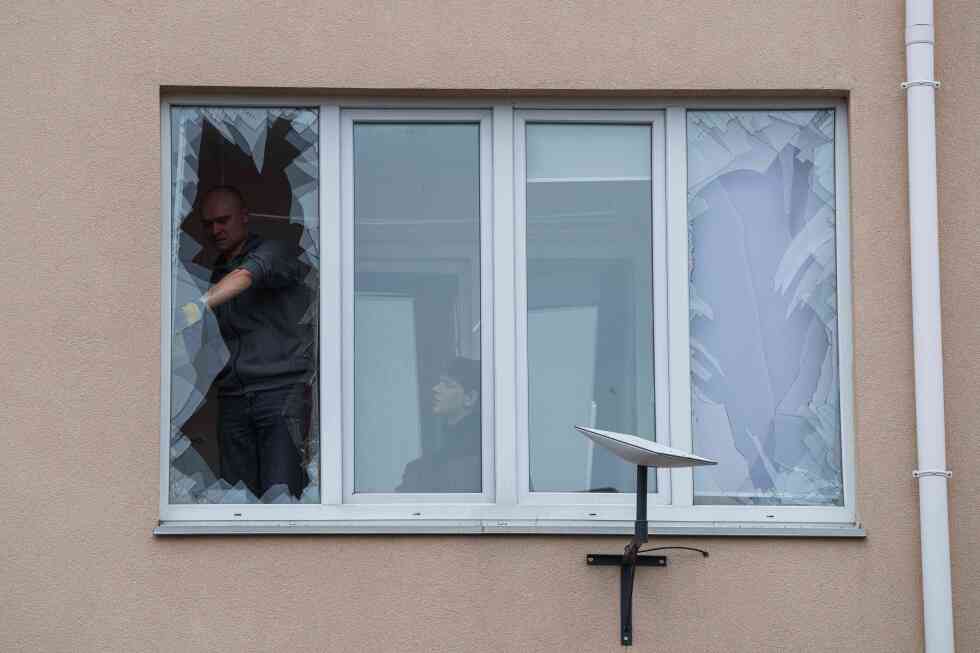
Fresh deadly Russian strikes across multiple regions of Ukraine have left at least eight civilians dead and dozens wounded, marking a violent escalation just days before the Orthodox Easter holiday, as Kyiv officially confirms it remains open to a temporary holiday truce and warns of a dramatic shift in Moscow’s aerial attack tactics.
Local Ukrainian military officials first reported the wave of attacks early Friday, highlighting what they described as a massive combined assault of missiles and drones targeting communities near the Ukrainian capital Kyiv. Mykola Kalashnyk, head of Kyiv’s regional military administration, announced via Telegram that one civilian was killed and eight more injured in strikes on three satellite towns surrounding the capital: Bucha, Fastiv and Obukhiv. The attack came as Bucha residents just marked the somber fourth anniversary of widespread atrocities committed by Russian invading forces during their early advance on the capital in 2022.
Lesia Podoriako, a 37-year-old Obukhiv resident who was at work with her child when the strike hit her residential building, told the Associated Press she only learned of the damage through social media alerts. “I have no words,” she said, adding that the greatest relief was that all her family members emerged unharmed.
Deadly strikes were reported far beyond the Kyiv region. In northern Ukraine’s Sumy region, one civilian died after a Russian guided aerial bomb hit a local apartment block, according to regional governor Oleh Hryhorov. In eastern Ukraine’s Donetsk region, a midday Russian bombing of Kramatorsk killed two more people and left three injured, regional military head Vadym Filashkin confirmed. Ukraine’s second-largest city Kharkiv, which has faced near-constant bombardment for months, saw two additional fatalities from sustained drone and missile strikes that stretched from Thursday into Friday, with at least five more civilians wounded. In the southern Kherson region, a Russian drone strike hit a public bus, leaving the driver critically injured and eight passengers hurt. Casualties were also reported in the Zhytomyr region, bringing the total nationwide death toll to at least eight.
Ukrainian officials have drawn sharp attention to what they call a deliberate change in Russian attack strategy. For months, Moscow relied heavily on large-scale nighttime barrages of missiles and drones, but in recent weeks, strikes have increasingly been carried out during daytime working hours. Andrii Kovalenko, head of the Center for Countering Disinformation under Ukraine’s defense ministry, said the tactical shift is an intentional choice to raise civilian harm. “The daytime strikes aim to increase civilian casualties,” Kovalenko wrote in a Telegram post Friday. “That is why the combined attack is carried out on a working day, using a large number of drones and missiles.”
Ukrainian Foreign Minister Andrii Sybiha criticized Moscow’s timing, noting that the large-scale assault came directly in response to Kyiv’s Easter truce proposal. “This is how Moscow responds to Ukraine’s Easter ceasefire proposals — with brutal attacks,” Sybiha wrote on social platform X, adding that nearly 500 drones and cruise missiles have been launched against Ukraine in the past 24 hours.
President Volodymyr Zelenskyy confirmed Thursday that Kyiv remains willing to implement a temporary truce during Orthodox Easter, which falls on April 12 for both Ukrainian and Russian Orthodox churches following the Julian calendar. The proposal has been relayed to the Kremlin through U.S. diplomatic channels, Zelenskyy said, though Moscow has yet to deliver a formal response.
The Kremlin has already signaled skepticism of a temporary truce. Kremlin spokesperson Dmitry Peskov said earlier this week that Moscow is seeking a long-term peace settlement rather than a short holiday pause. Last year, Russian President Vladimir Putin unilaterally declared a 30-hour Easter truce, but both sides quickly accused one another of violating the ceasefire.
Beyond the shift to daytime strikes, Zelenskyy warned that Russian attacks are also expected to expand beyond the energy infrastructure that has been the primary target of Moscow’s winter aerial campaign. Ukrainian intelligence indicates future strikes will target water supply networks, transportation and logistics hubs including key railway routes, and other critical civilian infrastructure that has so far been spared intense bombardment. “We are already making all necessary preparations to repel these potential attacks,” Zelenskyy added.
On a more positive note for Kyiv, Zelenskyy reported that the overall frontline situation has stabilized in recent weeks, with intelligence assessments from both Ukrainian and British MI6 services describing the current conditions as the most favorable for Ukraine in 10 months. While intense fighting continues across eastern front sectors, Ukrainian forces have successfully disrupted multiple recent Russian offensives and reclaimed small amounts of territory, he said.
As diplomatic efforts continue, Zelenskyy confirmed that Ukraine has invited senior U.S. negotiators to visit Kyiv for further talks on long-term security guarantees and a broader framework to end the full-scale invasion. Recent discussions have also included NATO Secretary General Mark Rutte, with Ukraine pushing for clearer, more binding commitments on long-term defense support and collective responses to any future Russian aggression.
In tit-for-tat strikes across the border, Ukraine launched a wave of drone attacks on Russian territory Friday, hitting targets hundreds of kilometers from the shared border. In Russia’s Leningrad region, more than 1,100 kilometers from the Ukrainian border, a drone strike injured two people and set fire to an unoccupied building at the Morozov industrial zone, regional governor Alexander Drozdenko reported. The zone is home to a state-owned explosives and ammunition plant that produces solid fuel for Russia’s Topol-M intercontinental ballistic missile systems, and has been under Western sanctions since the 2022 full-scale invasion. In border region Belgorod, 12 people including three Russian soldiers were injured in a late Thursday Ukrainian drone strike, regional governor Vyacheslav Gladkov said. Four additional drones were shot down outside Moscow early Friday, with no casualties or damage reported, according to Moscow mayor Sergei Sobyanin. Russia’s Defense Ministry added that a total of 192 Ukrainian drones were intercepted and shot down overnight across Russian territory and occupied Crimea.